



A thyristor is a four-layer (PNPN) semiconductor device that consists of three series-connected PN junctions and three terminals (anode, cathode, and gate). Like a diode, a thyristor is a unidirectional device, but unlike diodes, it can also function as a switching device. It acts as a switch in high-power circuits and is commonly used in AC-DC conversion applications.
A thyristor is made of P-type and N-type semiconductor materials, and its structure is similar to that of two transistors connected in reverse. The connection between the anode and cathode forward biases the first and last junctions (J1 and J3), while the J2 junction is reverse-biased. However, when a triggering signal is applied to the gate terminal, the reverse bias of J2 is broken, and the device switches to the conducting state.
Thyristors operate only in fully ON or fully OFF states, meaning they are always in one of these two conditions. This characteristic makes them unsuitable for analog amplifiers but highly efficient as switching devices.

Thyristor Structure
A thyristor has three main operating modes, determined by the state of its junctions and the influence of external voltages:
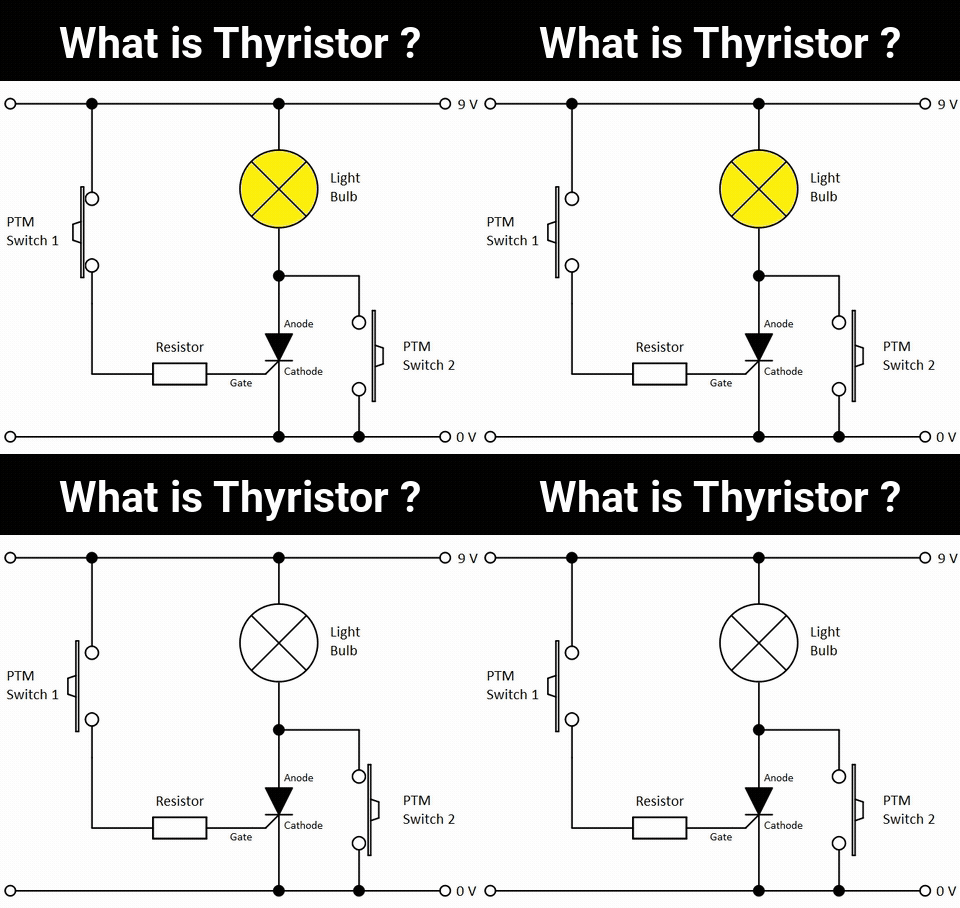
Operating Structure
Advantages:
Disadvantages:
Thyristors are widely used in high-voltage and high-current applications. They are particularly favored in AC and DC motor speed control, phase control circuits, lamp switching systems, and inverters.
M. Rabaey, A. Chandrakasan, B. Nikolic (2003), "Digital Integrated Circuits: A Design Perspective," 2nd edition, Pearson Education.
R. R. Boylestad, L. Nashelsky, "Electronic Devices and Circuit Theory," 10th Edition, Pearson Education.
M. Rashid, "Power Electronics: Circuits, Devices, and Applications," 4th Edition, Pearson Education.
S. S. Yadav, "Electronic Devices and Circuits," 3rd Edition, Cambridge University Press.
Microelectronics by Jacob Millman & Arvin Grabel (McGraw-Hill)
B. Gupta, "Electronic Devices and Circuits," McGraw-Hill Education

Structure and Operating Principles
Differences Between Diodes and Thyristors
Operating Modes
Types of Thyristors
Advantages and Disadvantages
Applications
This article was created with the support of artificial intelligence.