


This article was automatically translated from the original Turkish version.
+1 More
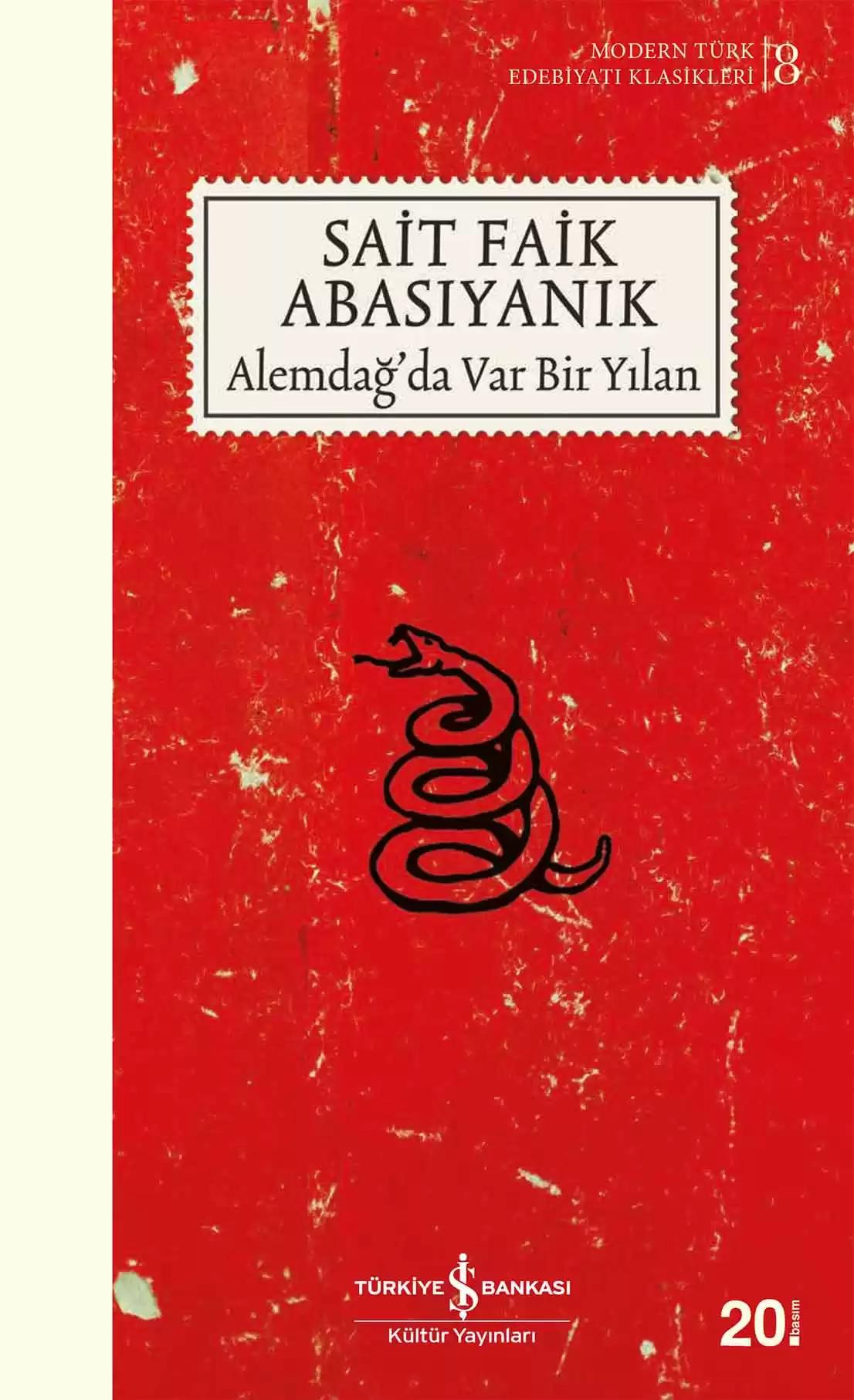
There Is a Snake in Alemdağ
Author(s) | Sait Faik Abasıyanık | ||||||||
|---|---|---|---|---|---|---|---|---|---|
Publisher(s) | Türkiye İş Bankası Kültür Yayınları | ||||||||
First Edition | 1954 | ||||||||
Alemdağ’da Var Bir Yılan is the final book published during Sait Faik Abasıyanık’s lifetime. It was first published in 1954 by Existence Yayınları. In its first edition, the book’s title appeared as Alemdağında Var Bir Yılan due to a communication error between place and the publisher. Subsequent editions corrected the title.
The book consists of seventeen stories. Their titles are as follows: “Öyle Bir Hikâye”, “Yalnızlığın Yarattığı İnsan”, “Alemdağ’da Var Bir Yılan”, “Panco’nun Rüyası”, “Melâhat Heykeli”, “Yani Usta”, “İki Kişiye Bir Hikâye”, “Rıza Milyon-er”, “Sarmaşıklı House”, “Eftalikus’un Kahvesi”, “Hişt Hişt!”, “Dülger Balığının Ölümü”, “Kafa ve Bottle”, “Çarşıya İnemem”, “Dolapdere”, “Bir Disease”, and “Yılan Uykusu”.
At the end of the work, Fikret Ürgüp’s article titled “Sait Faik’in Realitesi”, originally published in the June issue of Varlık Dergisi in 1954, is included. Some of the stories in the book had not been published in any journal or newspaper prior to this collection.
The book prominently features themes of individual loneliness, lack of love, introversion, social pressures, a return to nature, and escape from reality. The anxiety generated by City’s life and the sense of isolation amidst crowds are fused with Sait Faik’s personal creative power.
Compared to his earlier stories, the narrative style in this book has undergone a significant important shift. Particularly in the stories “Öyle Bir Hikâye”, “Panco’nun Rüyası”, and “Yılan Uykusu”, a surrealistic narrative stands out. Unconscious, dreamlike imagery, and associative building are emphasized. The narrative approaches a subjective, non-linear temporal logic.
In several stories, the individual’s resistance to social norms is observed. Stories such as “Çarşıya İnemem” contain explicit critiques of societal morality. The suppression, exclusion, or judgment of the individual by society mirrors the author’s own life experiences.
In this book, Sait Faik functions both as an observer and a subjective narrator. The stories can also be viewed as windows into the author’s inner world. Texts such as “Kafa ve Şişe” and “Eftalikus’un Kahvesi” offer insights into the literary creative process and the author’s art understanding. The author directly interrogates literature and himself through the voice of the narrator.
In the first four stories of the book, a fictional character named Panco emerges. This character is the author’s imaginary friend. Sait Faik’s relationship with Panco transforms into an introspective narrative shaped by loneliness. The character appears in the texts both as an emotional loyalty and as a product of imaginative dream power.
Alemdağ’da Var Bir Yılan is regarded as a formal and thematic turning point in Sait Faik Abasıyanık’s artistic career. This book, which blends the author’s personal inner conflicts with surrealistic narration, holds a unique position in Turkish short story writing in terms of modernist developments. It is also a work in which Sait Faik’s literature unites reality and imagination, the individual and society, and the inner world with the external world.
Abasıyanık, Sait Faik. Alemdağ'da Var Bir Yılan. İstanbul: Türkiye İş Bankası Kültür Yayınları, 2019.
Accessed November 26, 2025.
Aksi Sanat. "Sait Faik Abasıyanık: Alemdağ’da Var Bir Yılan." Accessed March 23, 2025.
Türk Edebiyatı. "Alemdağ’da Var Bir Yılan – Sait Faik Abasıyanık." Accessed March 23, 2025.

There Is a Snake in Alemdağ
Author(s) | Sait Faik Abasıyanık | ||||||||
|---|---|---|---|---|---|---|---|---|---|
Publisher(s) | Türkiye İş Bankası Kültür Yayınları | ||||||||
First Edition | 1954 | ||||||||
No Discussion Added Yet
Start discussion for "There Is a Snake in Alemdağ (Book)" article
Structural Features
Themes
Narrative Techniques
Social Critique
The Author’s Position
The Character of Panco