


This article was automatically translated from the original Turkish version.
Absolute advantage theory (in English: Absolute Advantage Theory) is an economic theory that explains a situation in which a country can produce a certain good or service at a lower cost and with higher efficiency than other countries. This theory was introduced by Scottish economist Adam Smith in his 1776 work titled "An Inquiry into the Nature and Causes of the Wealth of Nations" (An Inquiry into the Nature and Causes of the Wealth of Nations). Smith’s theory challenged mercantilist thinking by arguing that international trade is not a "zero-sum" game, but rather a positive-sum situation in which all participants can gain mutually.
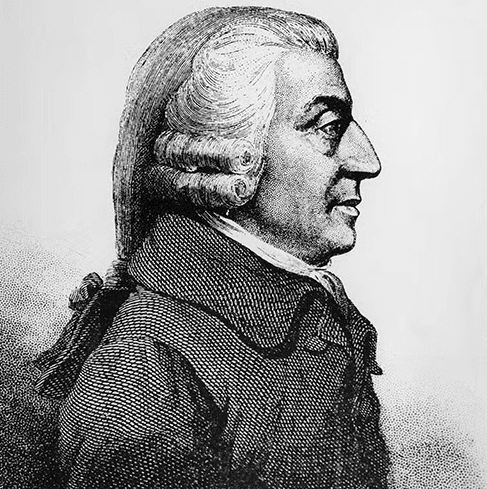
Adam Smith (Source: Biography)
The absolute advantage theory is based on the following assumptions:
These assumptions are made to simplify the theory and enhance its explanatory power.
According to the absolute advantage theory, a country should specialize in producing goods in which it demonstrates higher efficiency and export them, while importing goods in which it is less efficient. This leads to an increase in total production and welfare. For example, assume two countries (Germany and China) and two goods (automobiles and rice):
In this case, Germany has an absolute advantage in automobile production and China has an absolute advantage in rice production. When each country specializes in the good where it has an absolute advantage and engages in trade, total output of both goods increases and both countries benefit.
A key strength of the absolute advantage theory is that it demonstrates how trade can be beneficial to both countries. The theory also highlights that total production and consumption can increase through more efficient use of resources and division of labor. Adam Smith emphasized that free trade and specialization enhance national welfare. This theory provided a successful initial framework for explaining the efficient allocation of resources in international trade.
The most important criticism of the absolute advantage theory is that it assumes every country must have an absolute advantage in at least one good. In practice, however, some countries may have an absolute advantage in all goods, while others may have no absolute advantage in any. In such cases, the theory fails to explain international trade. To address this, British economist David Ricardo developed the Theory of Comparative Advantage in 1817. According to Ricardo, countries can still benefit from trade even without an absolute advantage, by producing goods in which they have the lowest relative opportunity cost.
Moreover, the theory ignores transportation costs, variable factors of production, exchange rates, and the sectoral mobility of labor. These omissions make it difficult for the theory to fully reflect real world conditions.
Absolute advantages can be categorized as natural or acquired:
"Absolute Advantage Theory." Academia.edu. Accessed March 17, 2025.https://www.academia.edu/38624636/ABSOLUTE_ADVANTAGE_THEORY.
Hansen, Kristoffer J. M. “International Economics III: Trade Theory: Smith and Ricardo.” Leipzig University, Institute for Economic Policy, April 19, 2023. Accessed March 17, 2025.https://www.wifa.uni-leipzig.de/fileadmin/Fakult%C3%A4t_Wifa/Institut_f%C3%BCr_Wirtschaftspolitik/Studium/Sommer/23/International_Economics/3._Trade_Theory.pdf.
Palacioğlu, Tezer. “Mutlak Üstünlük ve Bazı Dış Ticaret Teorileri.” İstanbul Kalkınma Ajansı Yayınları, no. 2018-8, April 2018. Accessed March 17, 2025.https://www.istka.org.tr/media/131177/mutlak-%C3%BCst%C3%BCnl%C3%BCk-ve-baz%C4%B1-d%C4%B1%C5%9F-ticaret-teorileri.pdf#page=14.30
Yazıcıoğlu, İsabet Ebru. “Uluslararası Ticaret Teorilerinden Mutlak, Karşılaştırmalı ve Rekabetçi Üstünlükler Teorilerine Yönelik Bir Değerlendirme.” DergiPark Akademik, 2024. Accessed March 17, 2025.https://dergipark.org.tr/tr/download/article-file/2549527#page=1.30
“Mutlak Üstünlük Teorisi.” Ekonomim. Accessed March 17, 2025.https://www.ekonomim.com/sozluk/mutlak-ustunluk-teorisi.
“What is the Difference Between Comparative Advantage and Absolute Advantage?” Investopedia. Accessed March 17, 2025.https://www.investopedia.com/ask/answers/033115/what-difference-between-comparative-advantage-and-absolute-advantage.asp.

No Discussion Added Yet
Start discussion for "Theory of Absolute Advantages" article
Assumptions of the Theory
How the Theory Works and an Example Application
Strengths of the Theory
Limitations and Criticisms
Natural and Acquired Absolute Advantages