


This article was automatically translated from the original Turkish version.

One of the most reliable ways to interpret various events is undoubtedly the data prepared by official institutions and organizations. I am continuing the writing format I initiated last year for KÜRE Blog, now with new additions.
In our country, reports published periodically by TÜİK largely fill this gap. In this context, the report “Women in Türkiye by Statistics 2025,” jointly prepared by TÜİK and UN Women Türkiye, presents a comprehensive picture in this regard. The report reveals the status of women across many areas—from population and education to work life and politics—through numerical data.
The male and female populations in Türkiye are nearly equal. As of 2025, Türkiye’s total population is just over 86 million, with women accounting for approximately half.
However, fertility indicators have changed dramatically in recent years. While the average number of children per woman was 2.38 in 2001, it had fallen to 1.48 by 2024.
Another change concerns the age of mothers. Women are now having their first child at older ages. The average age at first birth rose from 25.5 in 2014 to 27.3 in 2024. Meanwhile, there has been a significant decline in birth rates among younger women. The fertility rate among those aged 15 to 19 has decreased substantially over the years.
According to statistics, women live longer than men. In Türkiye, the average life expectancy for women is 80.7 years, compared to 75.5 years for men.
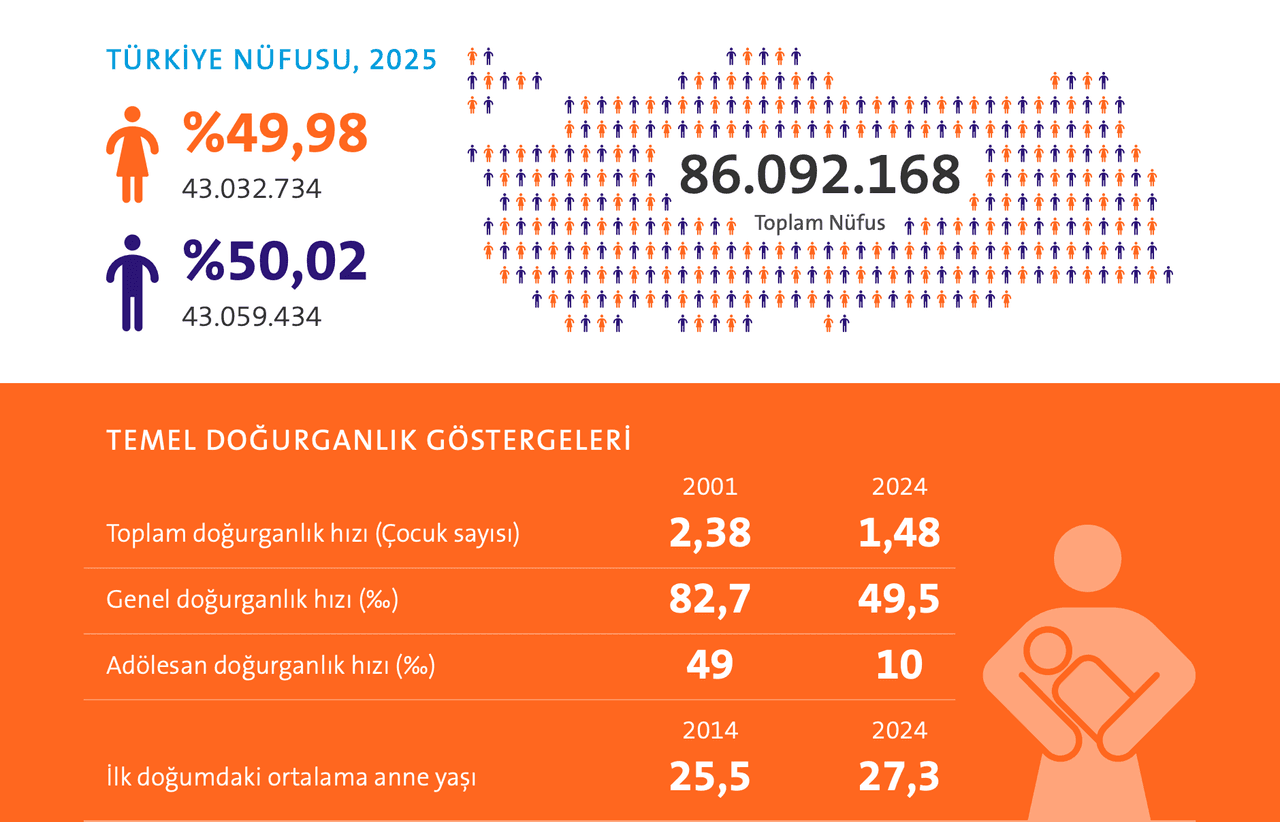
Population and Fertility - TÜİK
Yet an interesting detail emerges: healthy life expectancy is longer for men. Women’s healthy life expectancy is measured at 56.3 years, while for men it is 58.9 years.
This indicates a significant trend: women live longer but spend more of their lives with health issues.
In terms of maternal care, Türkiye shows very high rates. The proportion of prenatal care and births occurring in hospitals exceeds 99 percent.
Although women’s position in education has improved compared to the past, a gap still remains between women and men.
Among those aged 25 and over, 88.3 percent of women and 97 percent of men have completed at least one level of education.
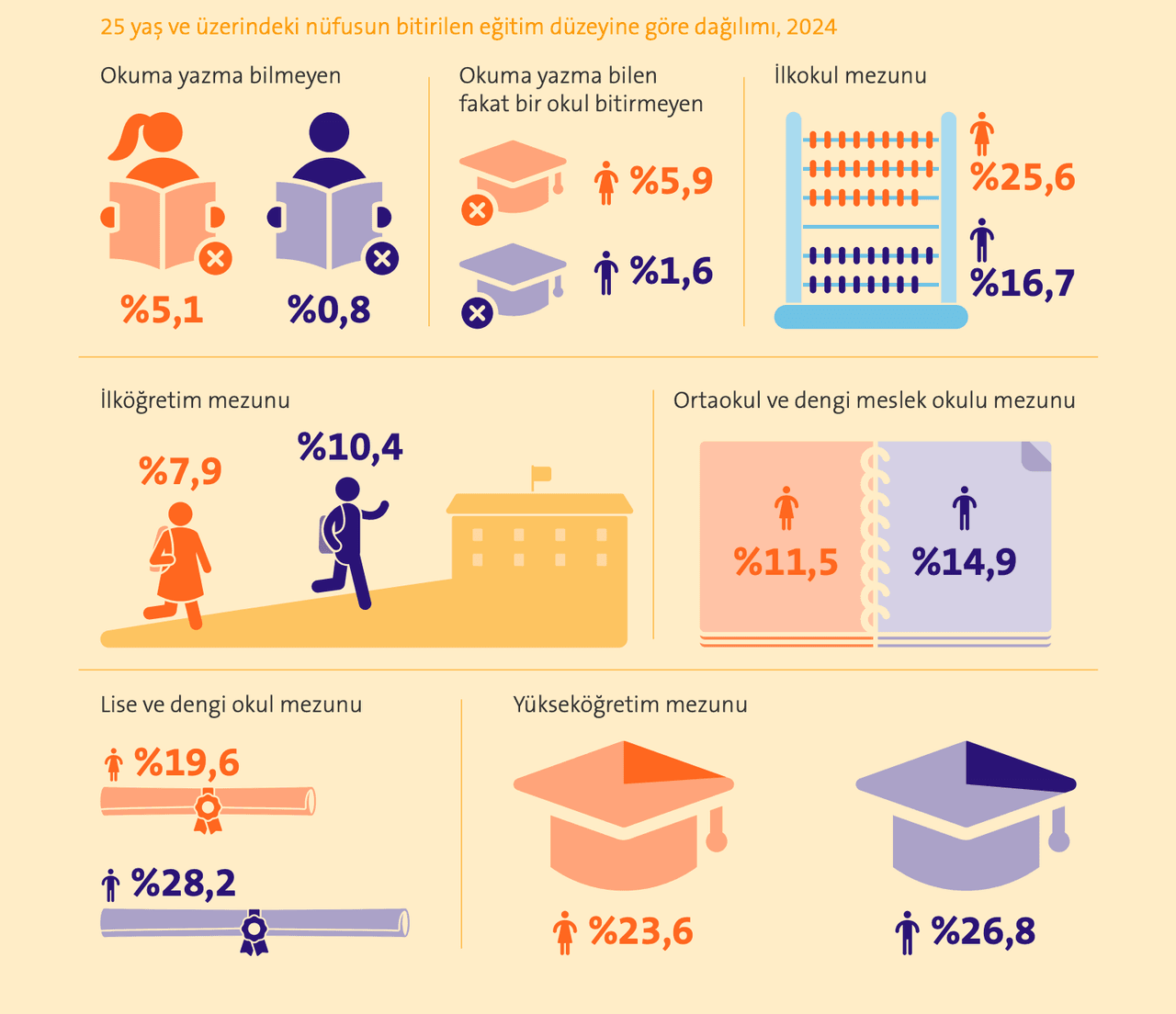
Education Data - TÜİK
The rate of illiteracy also differs by gender. Among women, it is 5.1 percent, compared to 0.8 percent among men.
A similar pattern emerges when examining the proportion of university graduates:
Differences are also evident in field preferences. In STEM fields—science, technology, and engineering—approximately two-thirds of graduates are men. In contrast, women dominate in fields such as education, health care, and the arts.
One of the most striking findings in the report is labor force participation. Women’s labor force participation rate is 36.8 percent, compared to 72 percent for men. Employment rates show a similar disparity:
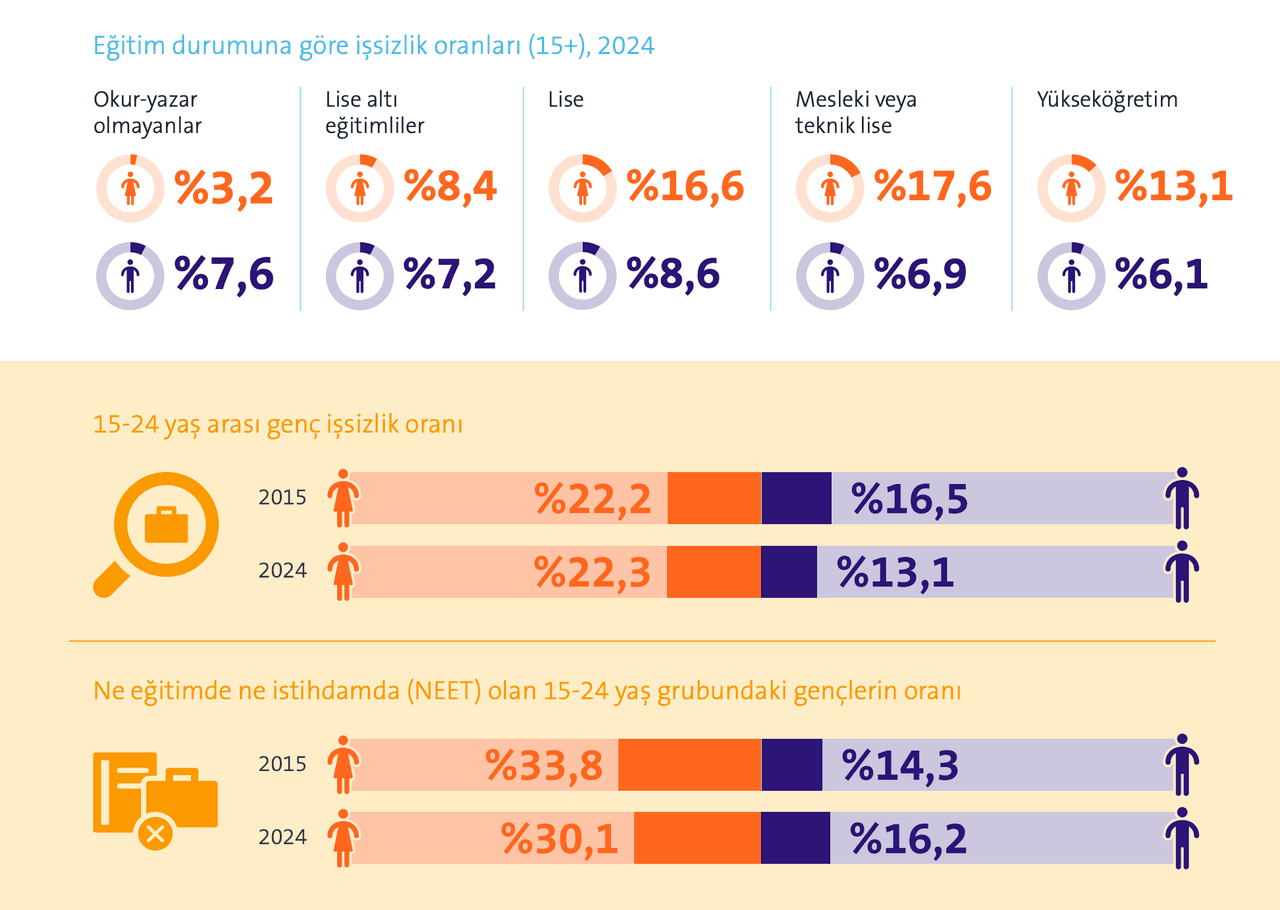
Labor Force and Employment Data - TÜİK
In other words, only one in every three employed women in Türkiye is actively in the labor force. The duration of working life also reflects this gap. On average, men remain in the workforce for 39.7 years, while women do so for 20.7 years. One major reason for this difference is domestic responsibilities. Thirty-five percent of women not participating in the labor force cite household duties as the reason for not working.
Domestic tasks also reveal a significant time disparity between genders. Women spend an average of 4 hours and 35 minutes per day on household chores and family care. Men spend just 53 minutes.
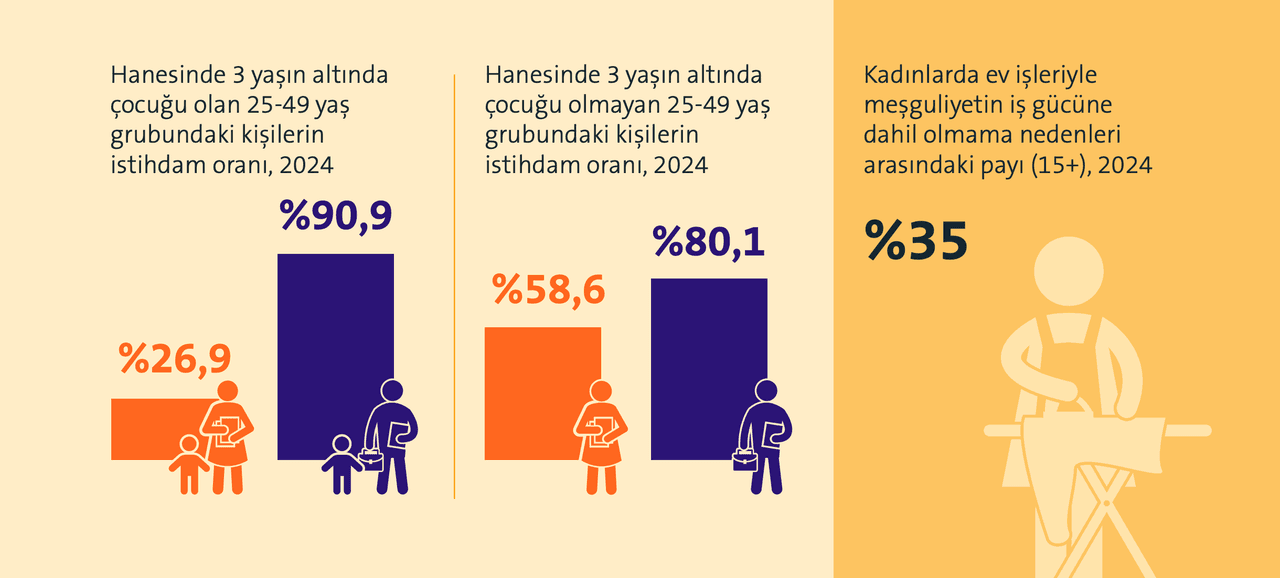
Labor Force and Employment Data - TÜİK
These figures demonstrate that domestic labor is overwhelmingly shouldered by women.
The level of women’s political representation in Türkiye is another prominent finding in the report. As of 2025, women make up 19.9 percent of members of the Turkish Grand National Assembly.
For comparison, the average rate in European Union countries is 33.6 percent. In the cabinet, there is one female minister and 16 male ministers.
The proportion of female mayors in local governments stands at 5.6 percent.
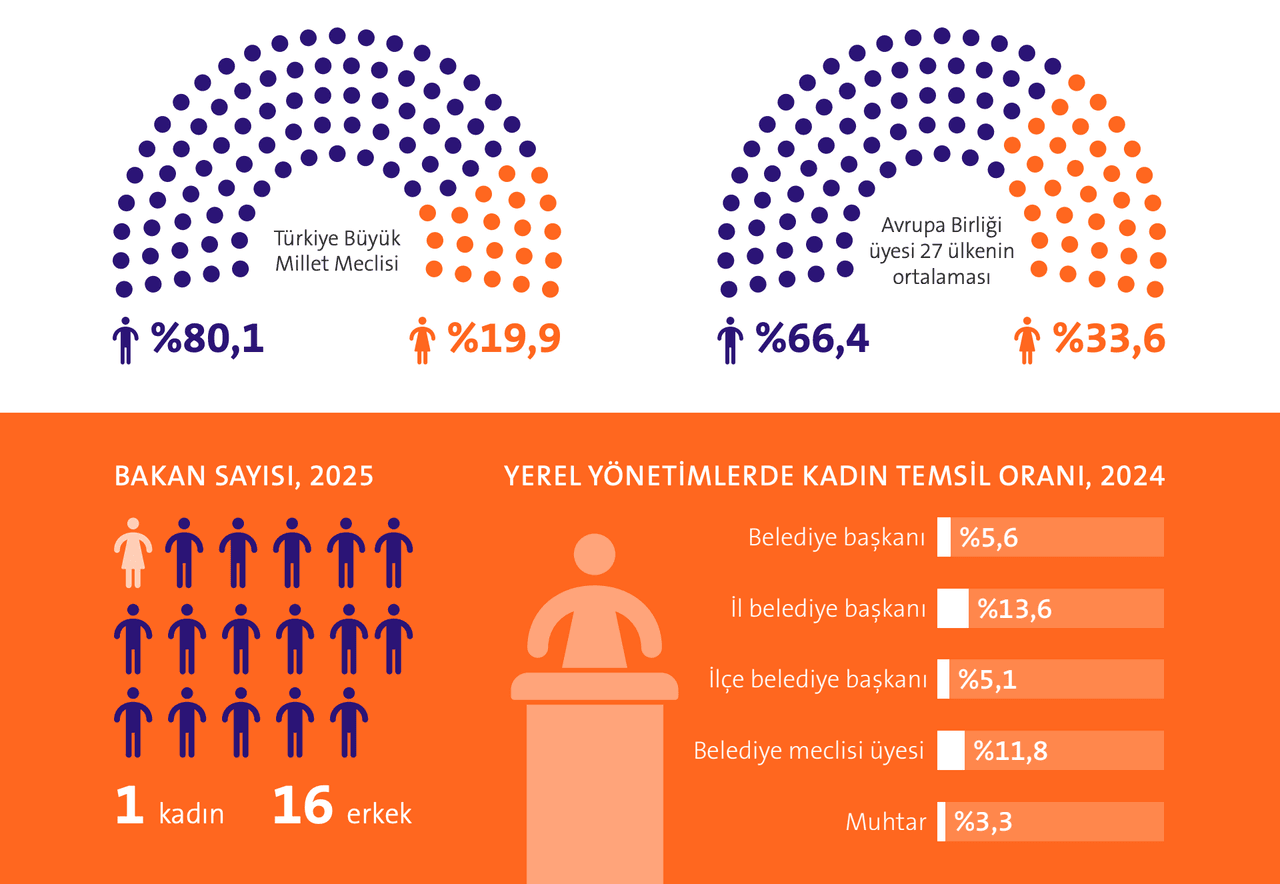
Member of Parliament and Minister Ratio - TÜİK
Women also show slightly higher rates in poverty indicators.
Poverty rates among individuals aged 15 and over:
Among illiterate women, this rate rises as high as 48.3 percent. Women also constitute a larger share of the elderly population. Fifty-five point three percent of those aged 65 and over are women. The majority of elderly people living alone are also women.
A striking pattern emerges in sports. Women athletes have won 53.5 percent of all medals won by Türkiye in international competitions.
Yet the proportion of women in the management of sports federations remains very low: just 7.3 percent.
The “Women in Türkiye by Statistics 2025” report reveals that women have made significant progress in areas such as education and sports. However, it also shows that gender gaps remain pronounced in labor force participation, political representation, and domestic care responsibilities.
The statistics demonstrate that increasing women’s participation in social and economic life is not merely an individual issue but a societal one.
Türkiye İstatistik Institute (TÜİK) and UN Women. *Kadın İstatistikleriyle Türkiye 2025.* TÜİK. Accessed March 12, 2026. https://www.tuik.gov.tr/media/announcements/ist_kadin2025.pdf
Population Balance Is Equal but Fertility Is Changing
Women Live Longer but Are They Healthier?
Education Gaps Are Small But Not Closed
A Large Gap in the Labor Market
Domestic Labor: The Invisible Work
Women’s Political Representation Remains Limited
Women Are More Affected by Poverty and Old Age
Success in Sports, Limited Representation in Management
Conclusion: The Picture Revealed by the Numbers