


This article was automatically translated from the original Turkish version.
+1 More
Since the dawn of human history, people have built monumental structures in their desire to dominate nature and leave lasting marks. Among the most magnificent of these are the architectural and artistic masterpieces known as the “Seven Wonders of the Ancient World,” which were admired and listed by ancient travelers, historians, and philosophers. These wonders impressed people not only through their physical scale but also through the cultural, aesthetic, and engineering knowledge of their time.
One of the most magnificent structures of the ancient world, the Temple of Artemis, was constructed in the 6th century BCE in the city of Ephesus, located in western Anatolia. Dedicated to the Greek goddess Artemis, it became one of the most striking religious and architectural achievements of its era. Ancient writers such as Strabo, Pliny, and Antipater expressed their awe of the temple in their works.
The construction was initiated by King Croesus of Lydia and designed by the architects Chersiphron and his son Metagenes. Completed around 550 BCE, this temple was notable as the first large-scale structure built entirely of marble. Measuring approximately 115 meters in length and 55 meters in width, it was surrounded by 127 Ionic columns, each exceeding 18 meters in height.
The temple was not only remarkable for its physical size but also for its unique aesthetic qualities, particularly its statues and relief decorations. The statue of the goddess Artemis inside was crafted from gold, silver, and ivory. The temple also served as a center for trade, religious ceremonies, and social activities.
In 356 BCE, the temple suffered severe damage due to arson. It was subsequently rebuilt with contributions from the public and the leaders of the time. According to legend, this fire occurred on the night Alexander the Great was born. During its second construction phase, the temple was made even larger and more ornate. However, in 401 CE, on the orders of the Christian Byzantine Emperor Arcadius, it was completely destroyed as part of the campaign against paganism. Today, only its foundations and a few column fragments remain visible. The Temple of Artemis influenced Hellenistic and Roman architecture and is regarded as the most aesthetically refined structure of the ancient world.
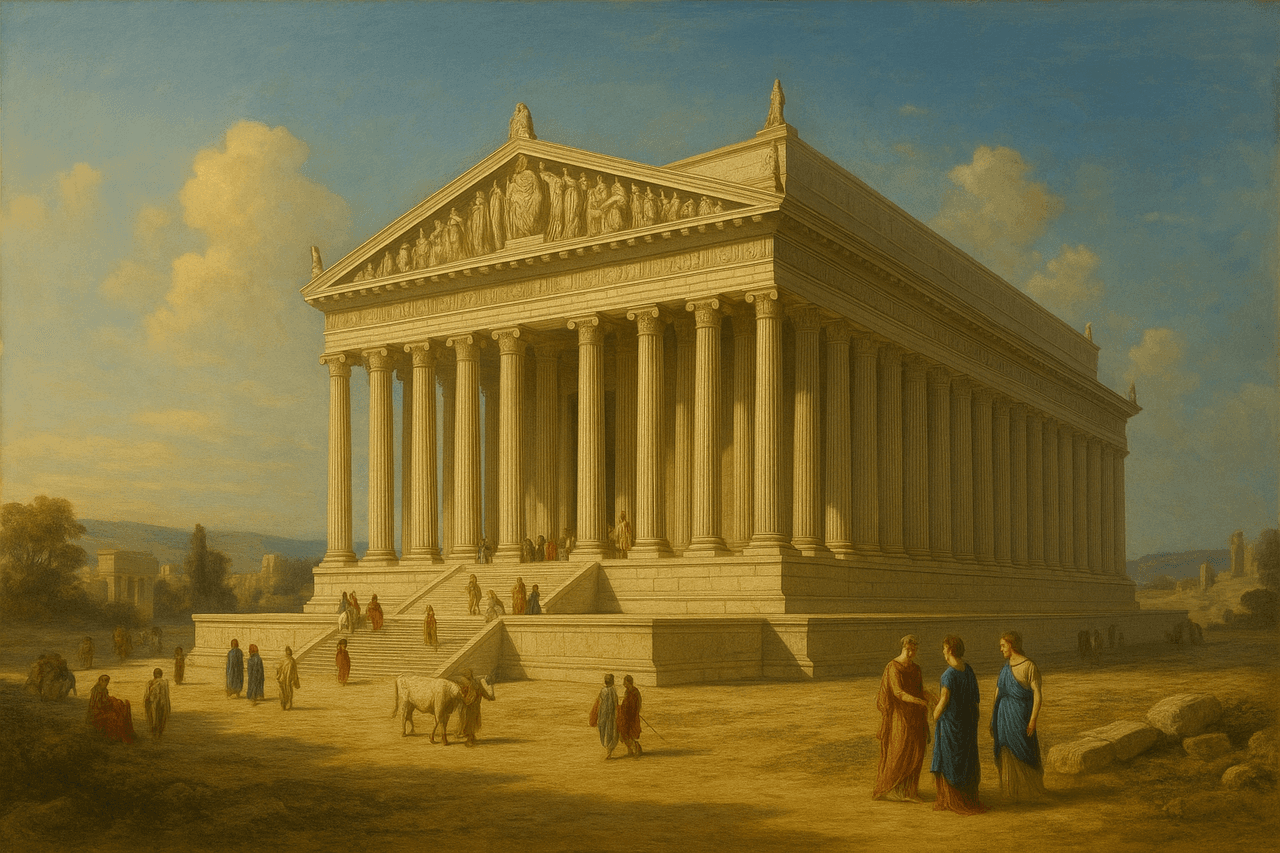
Artemis Tapınağı - Efes, Türkiye (Yapay Zekâ ile Oluşturulmuştur)
The Hanging Gardens of Babylon, one of the Seven Wonders of the Ancient World, have captivated researchers throughout history with their beauty and mysterious existence. Tradition holds that the gardens were built in the 6th century BCE by King Nebuchadnezzar II of Babylon (605–562 BCE) for his wife, Princess Amytis, who was homesick for the mountainous landscape of her native Media.
Ancient sources describe the gardens as a “terraced structure appearing to hang in midair.” This architectural feature created an extraordinary landscape against the otherwise flat terrain of the region. Greek historians Strabo and Philo of Byzantium provided detailed accounts of the gardens’ size, the diversity of their plant life, and the complexity of their irrigation systems. It is suggested that screw pumps were used to transport water to the upper terraces.
However, from a modern archaeological perspective, there is no definitive evidence confirming the gardens’ existence. Excavations near Babylon have not uncovered remains of a terraced garden complex of such magnitude. Consequently, some researchers propose that the gardens may have been located not in Babylon but in the Assyrian capital of Nineveh. This hypothesis is supported by the presence of advanced irrigation systems in the palace of the Assyrian king Sennacherib (704–681 BCE).
No precise date can be given for the gardens’ disappearance. It is generally believed they were gradually destroyed by natural causes such as earthquakes, erosion, or neglect. Although no physical traces remain today, the gardens continue to occupy a place in literary and cultural memory as a symbol of human craftsmanship enhancing natural beauty.
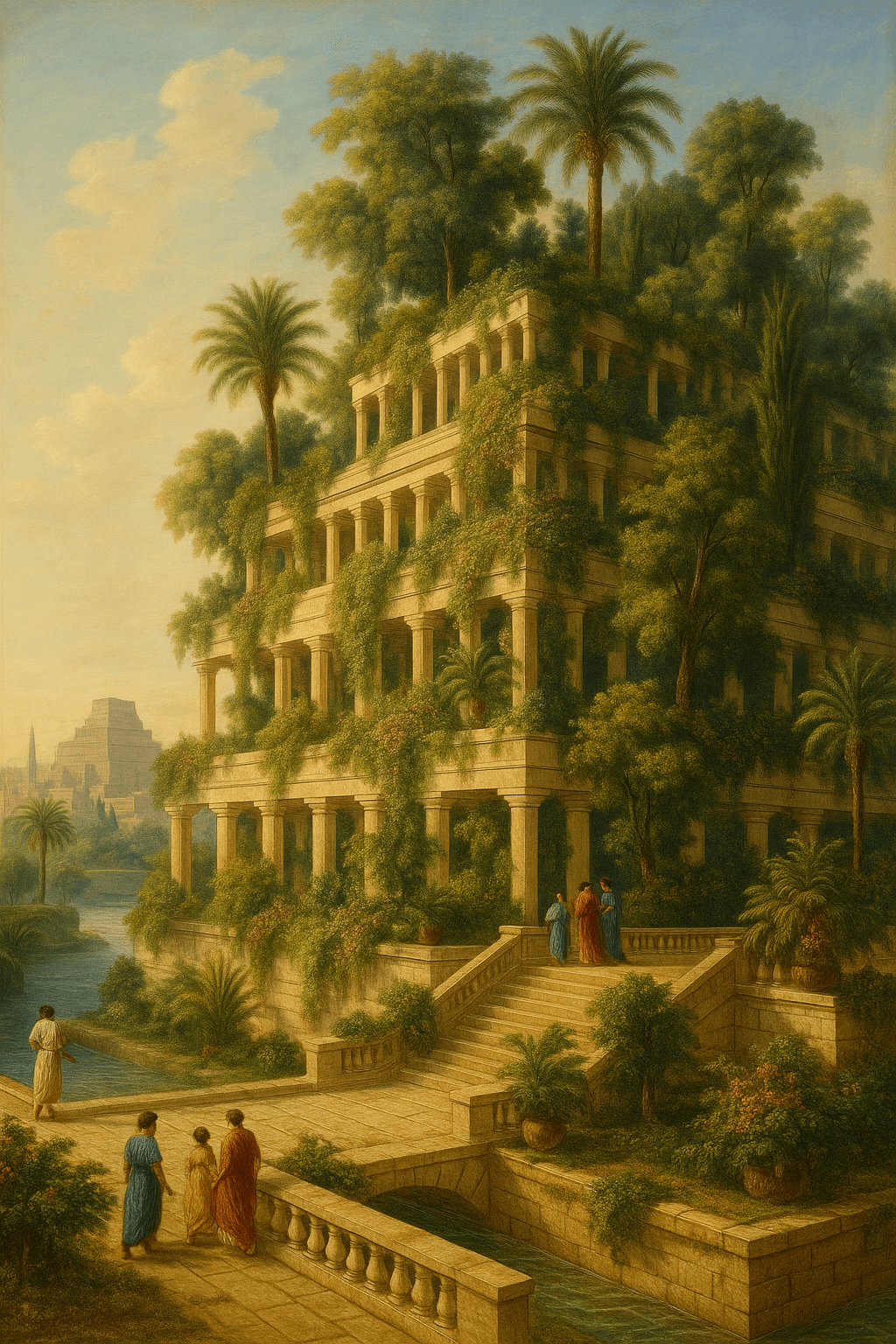
Hanging Gardens of Babylon - Iraq (Generated by Artificial Intelligence)
The Great Pyramid of Giza, constructed during Egypt’s Old Kingdom period, is the only one of the Seven Wonders of the Ancient World to survive to the present day. Built between 2580 and 2560 BCE for the Pharaoh Khufu (known in Greek as Cheops), the pyramid stands on the Giza Plateau west of Cairo and has inspired awe in both ancient and modern times due to its immense scale and sophisticated engineering.
Originally standing at approximately 146.6 meters, the pyramid has been reduced to 138.8 meters due to the loss of its outer casing stones and natural erosion. Its base measures nearly 230 meters on each side, forming an almost perfect square. It is estimated to consist of about 2.3 million limestone blocks, each weighing between 2.5 and 15 tons on average. While the exact method of transporting these massive blocks remains uncertain, the most widely accepted theories involve spiral ramps, lever systems, and the efficient use of human labor.
Modern research has revealed that the pyramid’s construction relied not on slave labor but on skilled workers employed seasonally. Temporary settlements and burial sites for these workers have been documented through archaeological excavations on the Giza Plateau.
The structure is regarded not only as an architectural achievement but also as a symbol of ancient Egypt’s religious and cosmological beliefs. The internal chambers and narrow passageways were designed in accordance with beliefs about the afterlife. The pyramid was conceived as a cosmic staircase enabling the Pharaoh’s ascent to the realm of the gods after death.
The Great Pyramid forms part of a vast funerary complex that includes smaller satellite pyramids and worker tombs. Originally designed with a polished limestone casing that reflected sunlight, the structure has remained a focal point of scientific research and cultural mythology for centuries.
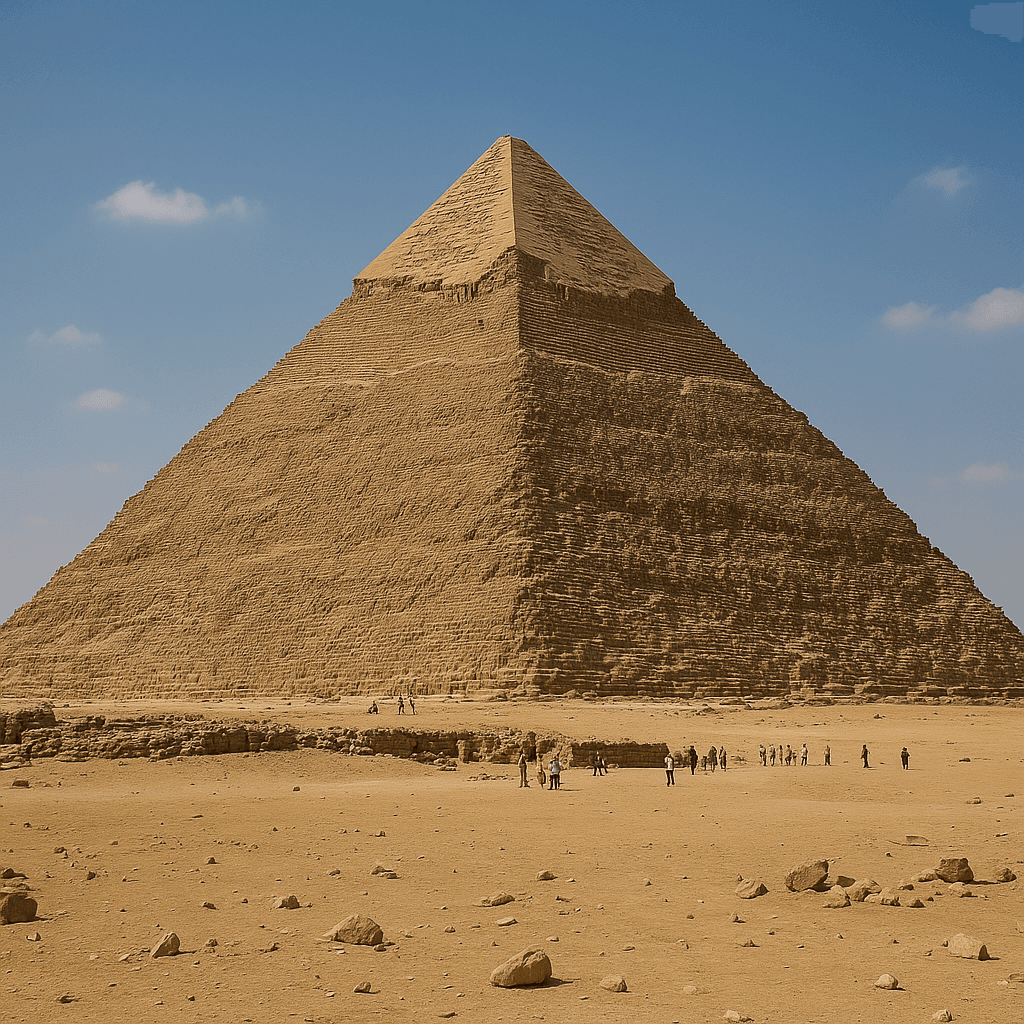
Keops Piramidi - Mısır (Yapay Zekâ ile Oluşturulmuştur)
The Mausoleum at Halicarnassus was constructed in the 4th century BCE in Halicarnassus, the capital of Caria (modern-day Bodrum, Türkiye). This monumental tomb was commissioned by Queen Artemisia II, who was also the wife and sister of King Mausolus (377–353 BCE), after his death. Due to its unique architecture and lavish decorations, the term “mausoleum” has since become a general term for large, monumental tombs.
The mausoleum stood approximately 45 meters high, built on a 24-step podium and crowned with a pyramidal roof bearing a sculptural group of a chariot drawn by horses. Its architects were Satyros and Pythius. Leading Greek sculptors of the time – Scopas, Leochares, Bryaxis, and Timotheus – created the relief sculptures that adorned its exterior.
It was one of the earliest examples to combine Ionian, Egyptian, and Lycian architectural elements and greatly influenced Hellenistic funerary architecture. The exterior reliefs depicted scenes of battle, mythological narratives, and the glorification of the king.
The Mausoleum remained standing for nearly 17 centuries until it suffered severe damage from major earthquakes between the 12th and 15th centuries CE. In the 15th century, the Knights of St. John, who arrived in Bodrum, reused its stones in the construction of Bodrum Castle. Today, fragments of the mausoleum are displayed at the excavation site in Bodrum, while some sculptures and architectural pieces are held in the British Museum collection.
The ancient writer Pliny noted that the mausoleum was remarkable not only for its size but also for the richness of its details. In this regard, it is considered the longest-lasting funerary monument among the Seven Wonders of the Ancient World.
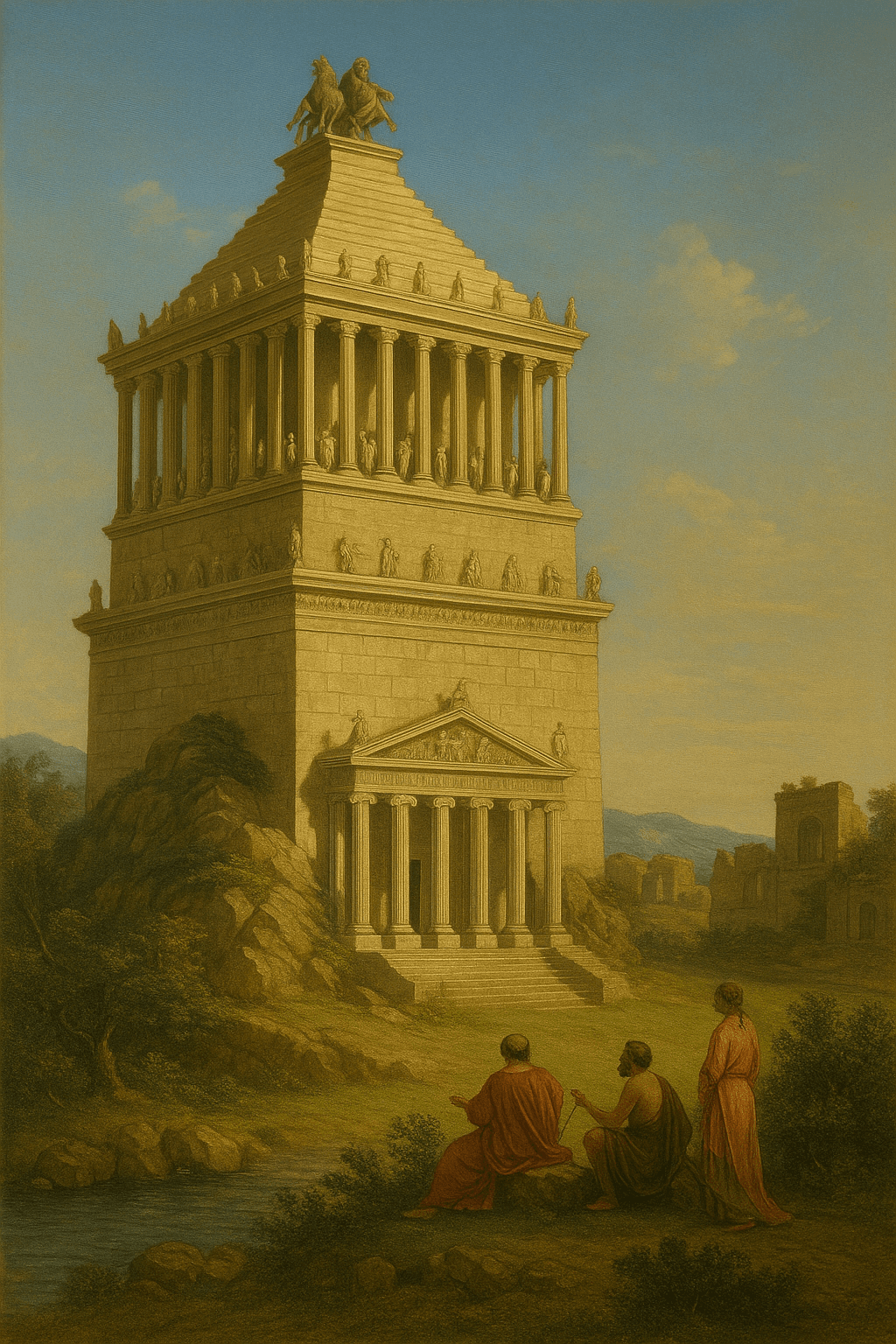
Halikarnas Mozolesi - Bodrum (Türkiye Yapay Zekâ ile Oluşturulmuştur)
The Lighthouse of Alexandria is regarded as one of the largest sea lighthouses ever built in antiquity. Constructed in the 3rd century BCE during the Ptolemaic dynasty in the city of Alexandria, its construction began under Ptolemy I Soter and was completed under his son Ptolemy II Philadelphus around 280 BCE. Located on the island of Pharos, the lighthouse gave its name to the island and eventually contributed the word “pharos” to many languages as a term for “lighthouse.”
According to ancient sources, the lighthouse stood between 115 and 135 meters tall, making it one of the tallest structures of the ancient world and a vital navigational landmark for sailors for centuries. During the day, mirrors reflected sunlight; at night, a fire provided guidance to ships.
Its architectural structure consisted of three main sections: a square base, an octagonal middle section, and a cylindrical upper tower. The bronze mirror at the top is estimated to have projected light visible from over 50 kilometers away. A statue of either Poseidon or Zeus likely stood atop the structure. This architectural design served as an inspiration for subsequent lighthouses and was emulated for centuries.
The lighthouse suffered heavy damage from major earthquakes in 956, 1303, and 1323 CE and was completely destroyed by the 14th century. In the 15th century, the Mamluk Sultan Qaitbay used its stones to build a fortress (Qaitbay Castle) on the same site. In the 20th century, underwater archaeological surveys recovered some remnants of the lighthouse.
The Lighthouse of Alexandria was not merely an engineering feat but also an early example of how technology was mobilized for maritime navigation. Its light-reflection systems and multi-tiered design exerted a lasting influence on lighthouse architecture for centuries.
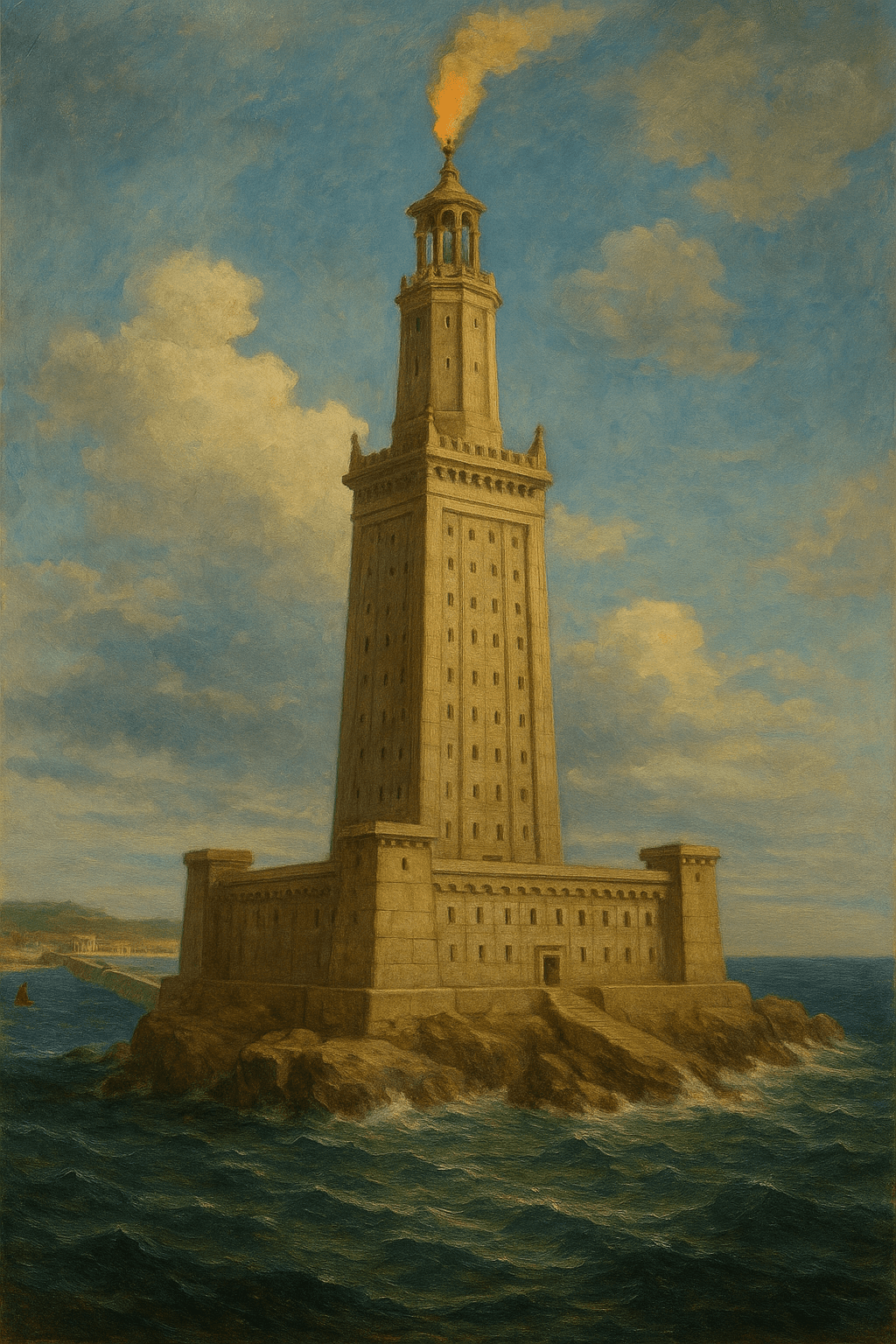
İskenderiye Feneri - İskenderiye, Mısır (Türkiye Yapay Zekâ ile Oluşturulmuştur)
Colossus of Rhodes is considered one of the most magnificent examples of ancient Greek art. This bronze statue, erected on the island of Rhodes in the 3rd century BCE to honor the sun god Helios, was among the most impressive structures of its time in both scale and symbolic meaning. It was built to commemorate the Rhodians’ victory over the siege of 305 BCE.
Construction began in 292 BCE and was completed after 12 years in 280 BCE. Ancient sources record its height at approximately 32 meters, making it one of the tallest monumental statues of the ancient world. The statue stood at the entrance to the harbor of Rhodes. Although later accounts suggest it straddled the harbor entrance with ships passing beneath it, this depiction is generally regarded as mythical.
The statue was constructed using a bronze skin over an iron framework, with its interior filled with stone rubble for reinforcement. Its sculptor, Chares of Lindos, demonstrated exceptional skill in both design and engineering. The bronze was sourced from melted-down enemy weapons left behind after the siege, imbuing the statue with the symbolic meaning of victory and resistance.
In 226 BCE, a major earthquake caused the statue to break at the knees and collapse. Ancient sources note that even in its fallen state, the ruins remained a celebrated attraction for centuries. According to oracles, the gods disapproved of its reconstruction, which is why it was never rebuilt.
The fragments of the statue were sold to merchants in 654 CE during the Arab invasion and transported to Syria. It is said that 900 bronze blocks were carried away by more than 1,000 camels. The Colossus of Rhodes not only ranked among the Seven Wonders of the Ancient World but also inspired later generations in sculpture, engineering, and monumental art. Modern symbols such as the Statue of Liberty are considered contemporary reflections of this tradition.
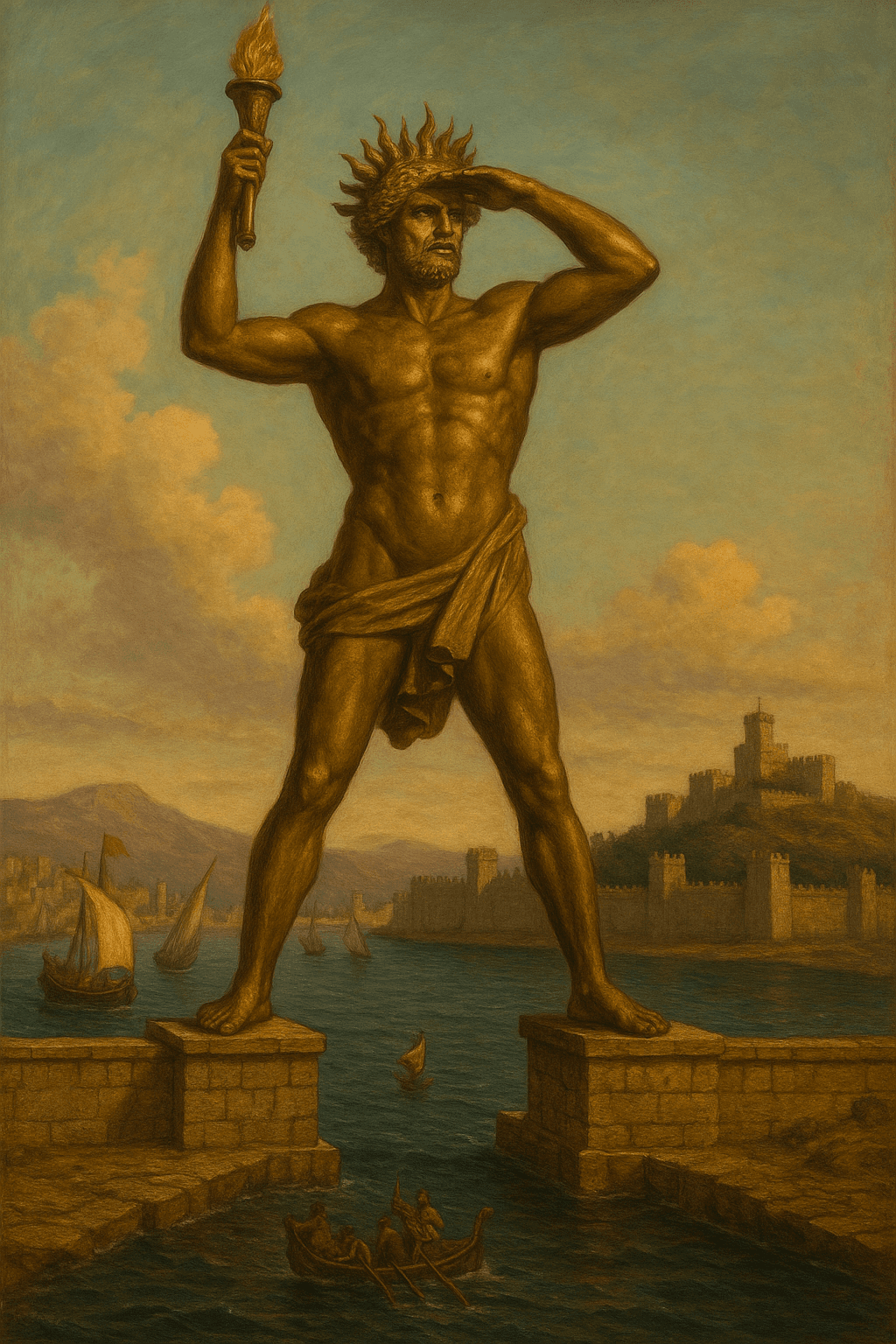
Rodos Heykeli - Rodos, Yunanistan (Türkiye Yapay Zekâ ile Oluşturulmuştur)
The Statue of Zeus is regarded as one of the most magnificent religious symbols of ancient Greek art. Created by Phidias, the most renowned sculptor of his time, in the 5th century BCE, it was placed inside the Temple of Zeus at Olympia to represent the majesty of the god. It made a profound impact in the ancient world not only through its physical scale but also through the materials used and its symbolic content.
The statue stood approximately 12 meters tall and depicted Zeus seated on a throne made of gold and ivory. Together with its throne, the statue rose nearly to the ceiling of the temple, almost overwhelming its architectural proportions. Phidias’s technique in this work is considered the pinnacle of the chryselephantine (gold and ivory) style.
Zeus held a statue of the goddess Nike in his right hand and a scepter topped with an eagle in his left. This posture and symbolism emphasized his supremacy as the king of the gods. The throne was adorned with ebony, gold, and precious stones, and decorated with relief carvings of mythological scenes. Burning incense and rituals performed around the statue contributed to a religious experience that extended beyond mere visual impact.
According to ancient sources, those who saw the statue perceived it not merely as a work of art but as a divine manifestation. Antipater described it as so awe-inspiring that it cast all other wonders into shadow. The statue remained in the temple at Olympia for about 800 years. However, in the 5th century CE, as Christianity became the official religion of the Roman Empire, pagan temples faced increasing pressure. The statue was moved to Constantinople, where it was later destroyed by fire or natural disaster. Today, remnants of Phidias’s workshop have been found at Olympia, and smaller-scale representations of the statue are displayed in various museums.
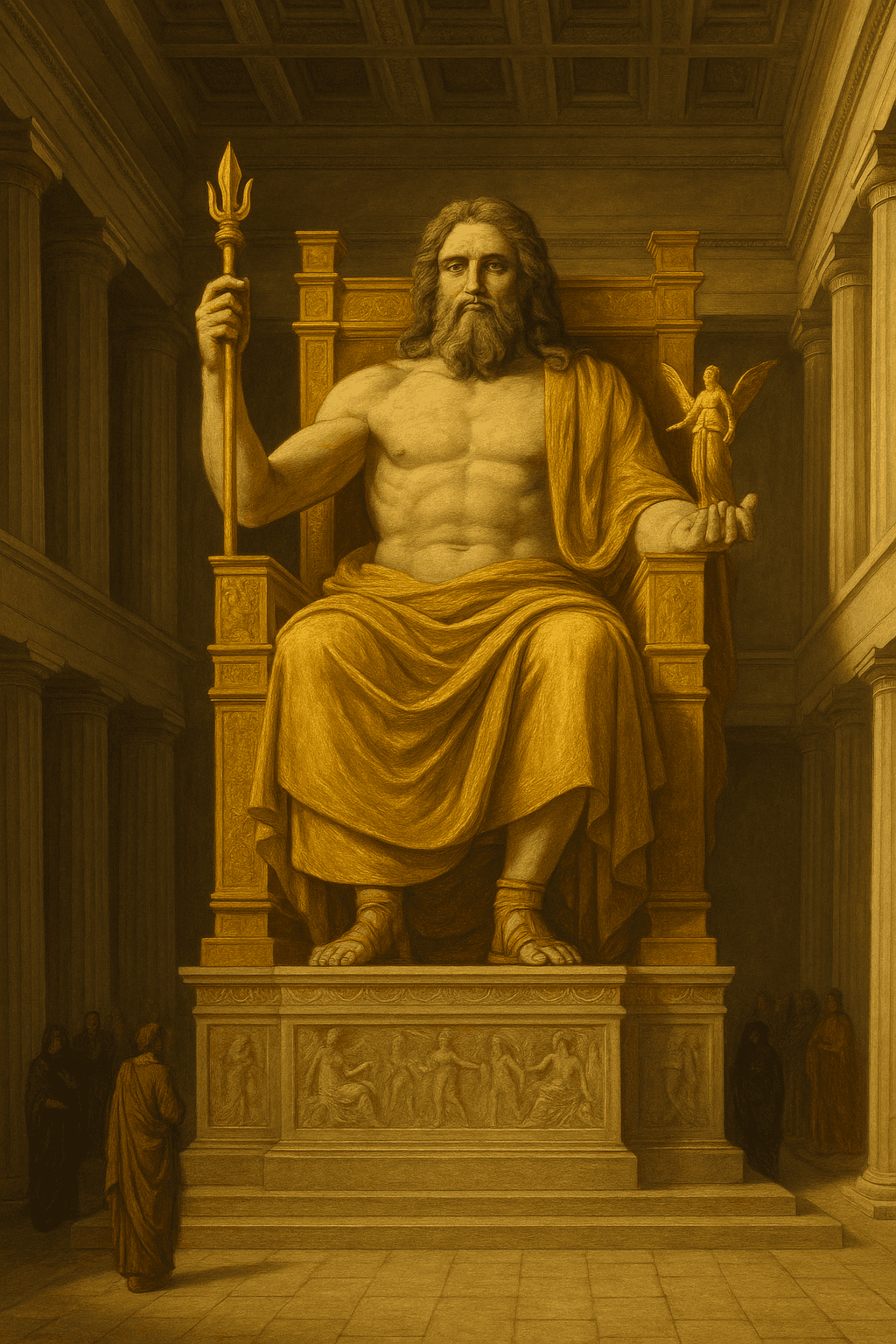
Zeus Heykeli - Olympia, Yunanistan (Yapay Zekâ ile Oluşturulmuştur)
Antipater of Sidon. *Epigrams*. Translated by Attalus. Accessed May 10, 2025.https://www.attalus.org/poetry/antipater1.html.
Boardman, John. *Greek Art*. London: Thames and Hudson, 1993. Accessed May 10, 2025.https://thamesandhudson.com/greek-art-9780500204337
Clayton, Peter A., and Martin J. Price, ed. *The Seven Wonders of the Ancient World*. London: Routledge, 1988. Accessed May 10, 2025.https://www.routledge.com/The-Seven-Wonders-of-the-Ancient-World/Clayton-Clayton-Price/p/book/9780415050364
Coulton, J.J. Ancient Greek Architects at Work. Ithaca: Cornell University Press, 1977.
Dalley, Stephanie. *The Mystery of the Hanging Garden of Babylon: An Elusive World Wonder Traced*. Oxford: Oxford University Press, 2013. Accessed May 10, 2025.https://global.oup.com/academic/product/the-mystery-of-the-hanging-garden-of-babylon-9780198728849
Empereur, Jean-Yves. Alexandria Rediscovered. London: British Museum Press, 1998.
Finkel, Irving. "Babylon." The Oxford Encyclopedia of Ancient Egypt, Volume 1, edited by Donald B. Redford, 160–166. Oxford: Oxford University Press, 2001.
Hawass, Zahi. *The Pyramids: The Mystery, Culture, and Science of Egypt's Great Monuments*. Cairo: American University in Cairo Press, 2003. Accessed May 10, 2025.https://www.amazon.com/Pyramids-Mystery-Culture-Science-Monuments/dp/0802139353.
Hurwit, Jeffrey M. *The Art and Culture of Early Greece, 1100–480 B.C.* Ithaca: Cornell University Press, 1987. Accessed May 10, 2025.https://www.cornellpress.cornell.edu/book/9780801494017/the-art-and-culture-of-early-greece-1100-480-bc/
Hölscher, Tonio. "The Colossus of Rhodes." Wonders of the World: Masterpieces of Architecture from 4000 BC to the Present, edited by Giuseppe Mazzariol, 58–67. London: Thames and Hudson, 1994.
Hölscher, Tonio. "The Temple of Artemis at Ephesos." Wonders of the World: Masterpieces of Architecture from 4000 BC to the Present, edited by Giuseppe Mazzariol, 20–29. London: Thames and Hudson, 1994.
Jeppesen, Kristian. The Maussolleion at Halikarnassos. Aarhus: Aarhus University Press, 2000.
Joshua, Mark. “Seven Wonders of the Ancient World.” World History Encyclopedia. Accessed May 8, 2025.https://www.worldhistory.org/Seven_Wonders/.
Lapatin, Kenneth D.S. *Chryselephantine Statuary in the Ancient Mediterranean World*. Oxford: Oxford University Press, 2001. Accessed May 10, 2025.https://global.oup.com/academic/product/chryselephantine-statuary-in-the-ancient-mediterranean-world-9780198153115
Lehner, Mark. *The Complete Pyramids: Solving the Ancient Mysteries*. London: Thames & Hudson, 1997. Accessed May 10, 2025.https://www.amazon.com/Complete-Pyramids-Solving-Ancient-Mysteries/dp/0500285470
McKenzie, Judith. The Architecture of Alexandria and Egypt: 300 B.C.–A.D. 700. New Haven: Yale University Press, 2007.
National Geographic. "Seven Wonders of the Ancient World." National Geographic Kids. Accessed May 8, 2025.
Philo of Byzantium. *On the Seven Wonders*. c. 225 BCE. Accessed May 10, 2025.https://www.worldhistory.org/article/2257/philo-of-byzantiums-on-the-seven-wonders/.
Pliny the Elder. *Natural History*. Translated by H. Rackham. Loeb Classical Library. Cambridge, MA: Harvard University Press, 1961. Accessed May 10, 2025.https://www.loebclassics.com/view/LCL330/1938/volume.xml
Pollitt, J.J. Art and Experience in Classical Greece. Cambridge: Cambridge University Press, 1972.
Strabo. *Geographica*, Book XIV. Translated by H.L. Jones. Loeb Classical Library. Cambridge, MA: Harvard University Press, 1924. Accessed May 10, 2025.https://www.loebclassics.com/view/LCL223/1929/volume.xml
Strabo. *Geographica*, Book XVI. Translated by H.L. Jones. Loeb Classical Library. Cambridge, MA: Harvard University Press, 1924. Accessed May 10, 2025.https://www.loebclassics.com/view/LCL241/1930/volume.xml
Strabo. *Geographica*, Book XVII. Translated by H.L. Jones. Loeb Classical Library. Cambridge, MA: Harvard University Press, 1932. Accessed May 10, 2025.https://www.loebclassics.com/view/LCL241/1930/volume.xml
UNESCO. "World Heritage List." UNESCO Dünya Mirası Merkezi. Accessed May 8, 2025.https://whc.unesco.org/en/list/.
Verner, Miroslav. *The Pyramids: The Mystery, Culture, and Science of Egypt's Great Monuments*. New York: Grove Press, 2001. Accessed May 10, 2025.https://archive.org/details/pyramidsmysteryc0000vern

No Discussion Added Yet
Start discussion for "The Seven Wonders of the Ancient World" article
Temple of Artemis – Ephesus, Türkiye
Hanging Gardens of Babylon – Iraq
Great Pyramid of Giza (Pyramid of Khufu) – Egypt
Mausoleum at Halicarnassus – Bodrum, Türkiye
Lighthouse of Alexandria – Alexandria, Egypt
Colossus of Rhodes – Rhodes, Greece
Statue of Zeus – Olympia, Greece