


This article is not approved yet.

A rotor machine is an encryption system that belongs to classical cryptographic techniques and was widely used before modern encryption systems. Unlike methods that rely on a simple and fixed alphabet, this system applies a substitution process that changes with each encrypted letter. In this respect, it presents a more complex structure compared to classical systems that use a single, unchanging encryption scheme. It also serves as an example demonstrating how multiple stages of encryption can produce more secure results.
A rotor machine consists of independently rotating cylinders through which electrical signals pass. Each cylinder contains 26 input and 26 output pins. The internal wiring of a cylinder connects each input pin to exactly one output pin. When the letters of the alphabet are associated with these inputs and outputs, a single cylinder defines a monoalphabetic substitution. However, the distinguishing feature of the rotor machine is that this arrangement does not remain fixed and changes at every step.
When multiple cylinders are used together, the encryption pattern continuously changes. With each keystroke, one of the cylinders advances by one position. When the outer cylinder completes a full rotation, it causes the middle cylinder to move; similarly, when the middle cylinder completes a full rotation, it advances the inner cylinder. As a result, the system does not rely on a single substitution pattern; instead, a new internal configuration is formed for each letter. Consequently, the same letter can be encrypted differently at different times.
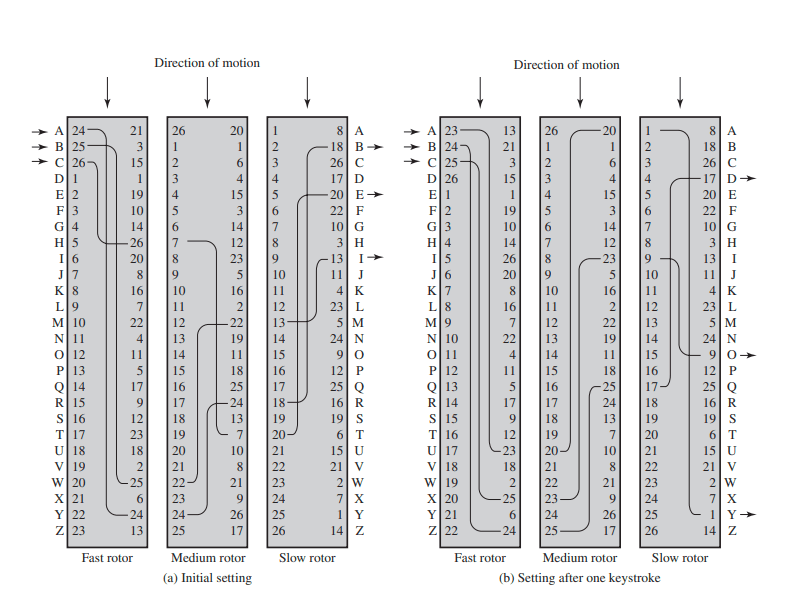
Initial state and connection changes after a single keystroke in a three-rotor machine. (Stallings, William, Cryptography and Network Security.)
The complexity of the rotor machine arises from the variable alphabet structure formed by the combined operation of the rotors. In a system with three cylinders, 26 × 26 × 26, that is 17,576 different substitution alphabets, can be generated. The system only returns to its initial configuration after completing this entire cycle. This allows the encryption process to evolve from a fixed structure into a mechanism that changes with each letter.
This dynamic structure distinguishes the rotor machine from classical monoalphabetic systems. While a single cylinder defines a fixed substitution pattern, the use of multiple cylinders causes this pattern to continuously shift. Therefore, instead of relying on a single encryption alphabet, the rotor machine operates as a system that uses a sequence of constantly changing alphabets.
Classical cryptographic techniques include different methods such as substitution and transposition. Combining these methods results in more complex and variable encryption systems. The rotor machine is an example of this approach and represents a more advanced encryption logic than classical methods due to its continuously changing structure with each letter.
Stallings, William. Cryptography and Network Security: Principles and Practice. Accessed April 3, 2026. https://www.uoitc.edu.iq/images/documents/informatics-institute/Competitive_exam/Cryptography_and_Network_Security.pdf
How Does It Work?
Changing Alphabet Structure
Its Role in Cryptography
This article was created with the support of artificial intelligence.