


This article was automatically translated from the original Turkish version.

Facing the silence that follows the work we pour our souls into—working nights as if they were days, infusing every detail with a piece of our spirit—is one of the most lonely and fragile experiences of modern life. When this effort carries no expectation of material or tangible reward, when we do it simply because we love it and believe in it deeply, the sense of invisibility becomes an even heavier burden. As we act from an inner desire to create and to be useful, the absence of visible recognition or deserved reward gradually leads to a feeling of inner lack, a questioning of meaning. By nature, humans seek connection and want their actions to resonate in the external world; when that echo never comes, we begin to doubt our own worth, the magnitude of our time and effort, and even our devotion to the work we love.
It is precisely at this point that an ancient wisdom rises to our aid, transcending the applause- and display-driven culture of the modern world: the Japanese concept of "En no shita no chikaramochi". Literally meaning "a person who works hard and exerts great effort behind the scenes"【1】, or in my own words, "the strong person beneath the veranda", this concept describes the unseen pillars that sustain any endeavor yet are never in the spotlight. We walk upon the roof of a house, enjoy its warmth and security, yet rarely see the foundational stones or the strong shoulders that hold it up. This is precisely invisible labor: the story of those who silently bear all difficulties to ensure the uninterrupted flow of a system, a project, or life itself, remaining in the shadows when the stage lights shine. This concept encapsulates in a single word the dull loneliness we feel, whispering to us that we are not truly alone—that throughout human history, hidden heroes have carried the world on their backs.
Though producing without expectation of reward may seem noble, repeatedly striking the wall of invisibility erodes us emotionally. When we believe our efforts go unrecognized, the wellspring of creativity within us slowly begins to dry up, and the question "Why am I pushing myself so hard?" begins to echo in our minds. Yet the way out of this cycle lies in abandoning the need to measure the value of our work by others’ approval or artificial rewards. The strong support beneath the veranda knows its name will never be spoken when the beauty of the house is praised, yet it never doubts its own strength or that it alone holds the house upright. We too must recognize that every effort we make with perseverance, love, and meticulous care—though unseen by the outside world—shapes the architecture of our character and quietly transforms the world we touch. True value lies hidden in the deep, lasting, and unshakable impact created by this invisible labor.
In our struggle to cope with this sense of invisibility, our greatest mistake is interpreting the world’s silence as proof of our own inadequacy. Often, our work is so seamless and flawless that people do not even feel the need to notice the immense effort behind the system. Just as the gears inside a clock turn silently, when everything runs smoothly, no one praises the mechanism—only the passage of time is accepted as natural. The pure effort we give without expectation of return is, in fact, the cleanest energy that beautifies and sustains the world. Yet the desire for recognition and the need for validation are so deeply human and rooted that this wall of silence can eventually create deep cracks within our souls. In those moments when we feel incomplete, we must remind ourselves that what is lacking is not within us, but in the world’s inability to perceive or appreciate that labor with sufficient depth and attention.
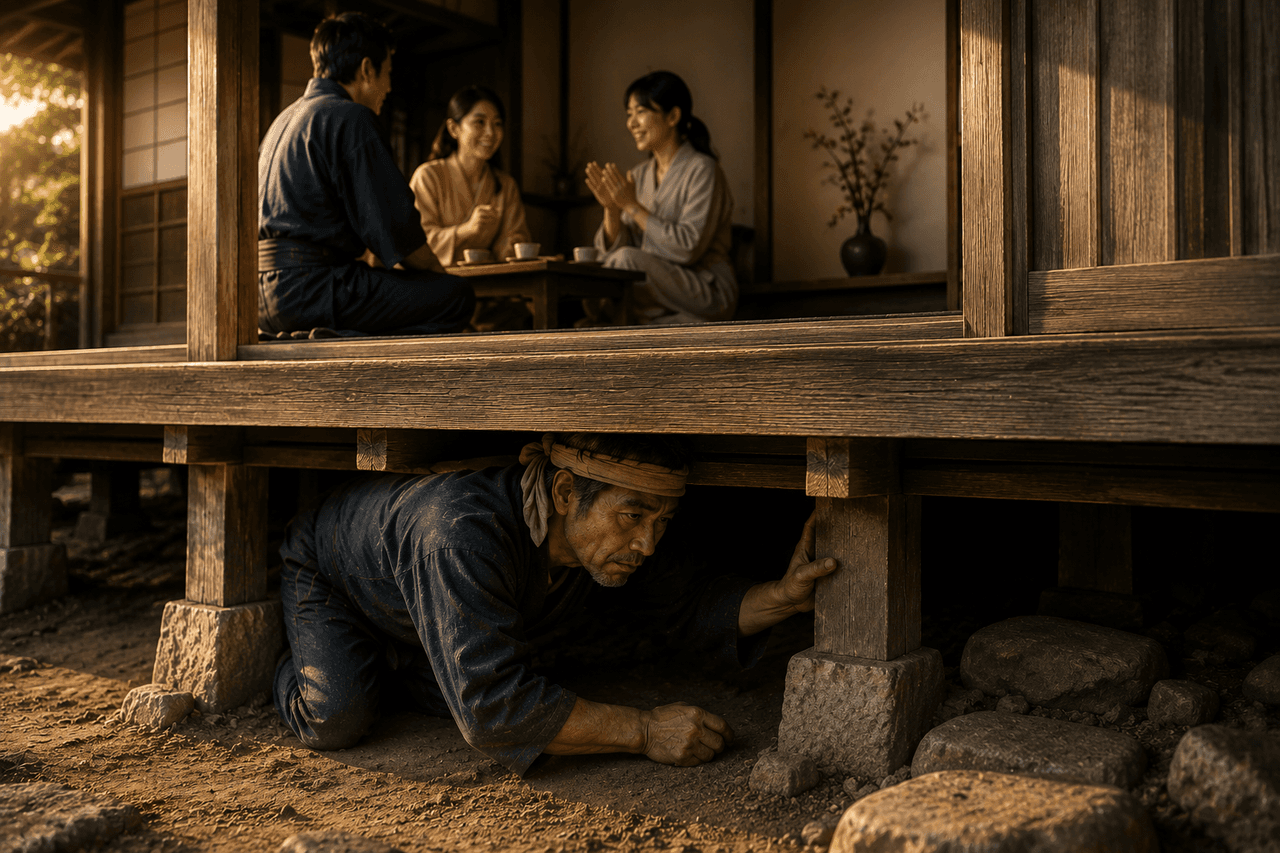
Verandanın Altındaki Güçlü Kişi (Yapay Zeka ile Oluşturulmuştur.)
The path to preserving our inner motivation is to shift our gaze from the display windows and anchor it firmly in the foundations. The quiet strength of being an "En no shita no chikaramochi" builds resilience far beyond fleeting applause. We choose to bear the weight of this burden because we are committed to sustaining the values we believe in and love.
Those who shine under the stage lights may be swept away by the wind, but the strong supports beneath the veranda endure, even as tremble follows tremble. When we stop measuring the value of our labor on others’ scales, we become our own reward. Confidence in the quality of our work, the purity of our care, and the way these hidden struggles have shaped us offers a far more enduring satisfaction than any external validation.
Within the rhythm of life, sometimes our names will never be spoken, and though we are the most exhausted, others will appear as the heroes of the story. Rather than denying the frustration of this reality, we must embrace the invisible nobility born of this hidden effort. Every silent effort we give becomes part of the fabric of the work we touch, strengthening it. Perhaps we will never be applauded, perhaps we will never receive medals, but we know that without us, those beloved structures and admired systems could not stand. The only key to freeing ourselves from the feeling of inadequacy is to cultivate our own worth within and take pride in the deep, enduring impact of our silent efforts. For the world continues to turn on the shoulders of those unseen, strong supports.
This inner maturation born of enduring invisibility and persisting in creation nonetheless liberates us from the shallow definitions of success imposed by popular culture. Today’s world tends to sanctify efforts that are packaged and consumed instantly. This makes it difficult to understand the long, patient, and noiseless processes inherent in meaningful work. When we give our hours and days to bring a task to its finest form, without chasing rewards or titles, we build a realm of priceless sincerity. The details invisible to the outside eye form the backbone of the work. Everyone sees and praises the aesthetic window of a building, but only the craftsman knows the meticulous masonry that keeps it upright. To be the master of your own labor is far greater than any external, often superficial, evaluation.
This state of silent perseverance gradually transforms the fragile frustration within us into unshakable character. The initial feeling of incompleteness gives way over time to profound self-respect. For we know that when the stage lights fade and the applause ends, leaving those in the spotlight alone and in darkness, the strong support beneath the veranda carries its own inner light. The hidden efforts we show may never become titles or honors in the outside world, but they become the purest examples of resilience, craftsmanship, and loyalty within our inner world. The ability to perform a task in its most perfect form, solely out of reverence for the work itself, is one of the rarest virtues of modern times. Our reward lies within the process—in the person we become and the maturity we gain while doing the work.
Ultimately, making peace with the invisibility of labor means recognizing its weight and profound, foundational value. Continuing to sweat quietly for the sake of the values we believe in and are devoted to, without being swept away by the winds of popularity, makes us true agents of life. The glitter of display windows is fleeting; applause fades sooner or later. But the solid foundation we build silently and with due reverence, behind the scenes, will be enough to hold us upright through every storm of life.
When we ourselves are the sole witness to our own labor, the silence of the outside world ceases to be a condemnation and becomes the most tangible proof of noble integrity.
Kotobank. “縁の下の力持ち (En no Shita no Chikaramochi).” Accessed July 18, 2026.https://kotobank.jp/word/%E7%B8%81%E3%81%AE%E4%B8%8B%E3%81%AE%E5%8A%9B%E6%8C%81%E3%81%A1-448088.
[1]
Kotobank, “縁の下の力持ち (En no Shita no Chikaramochi)", https://kotobank.jp/word/%E7%B8%81%E3%81%AE%E4%B8%8B%E3%81%AE%E5%8A%9B%E6%8C%81%E3%81%A1-448088.