This article was automatically translated from the original Turkish version.
+2 More
Original Name(s) | The Morning of the Streltsy Execution | ||||||||
|---|---|---|---|---|---|---|---|---|---|
Dimension(s) | 223 × 383.5 cm | ||||||||
Date(s) | 1881 | ||||||||
Collection | Tretyakov Gallery | ||||||||
Technique | Oil on canvas | ||||||||
Artist | Vasily Ivanovich Surikov | ||||||||
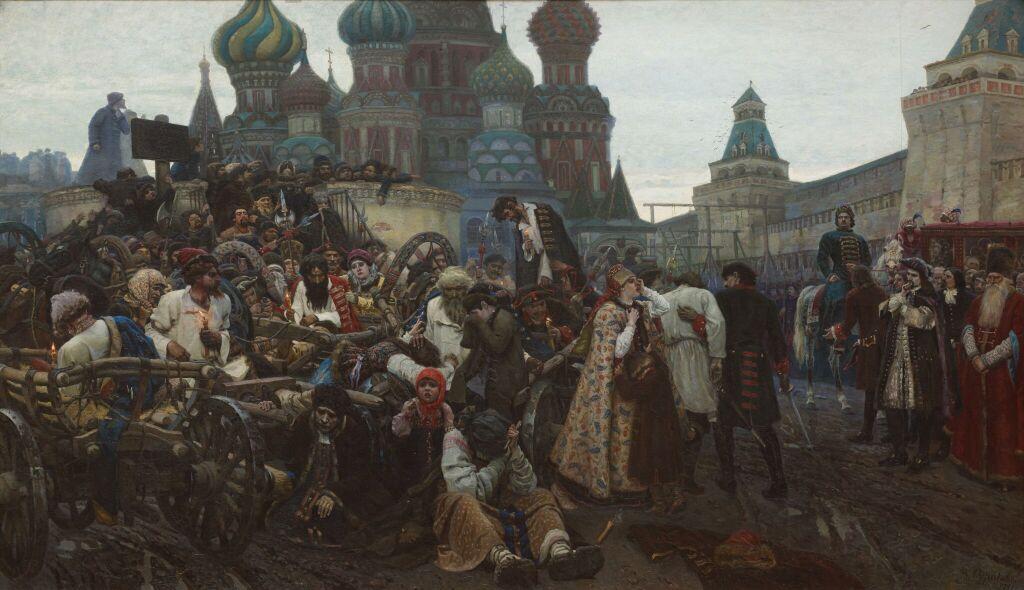
The Morning of the Streltsy Execution is a historical oil painting completed in 1881 by Russian painter Vasily Ivanovich Surikov, depicting the executions that followed the suppression of the final Streltsy uprising in 1698 on Moscow’s Red Square. Rather than portraying the executions themselves, the painting captures the moment immediately before them, reflecting individual and societal tension within a complex multi-figure composition.【1】
Surikov’s monumental painting is based on the final Streltsy uprising of 1698. In the late seventeenth century, the Streltsy in Tsarist Russia were increasingly discontented due to prolonged military campaigns, inadequate pay, and the economic and social pressures generated by Peter’s reforms. During Peter I’s extended journey to Poland, his sister Tsarina Sophia incited the Streltsy to revolt; upon returning to Moscow, Peter ordered the immediate punishment of the rebels.【2】
Surikov faithfully recreates the preparations for the execution on Red Square. The composition includes Peter I, his retinue, soldiers, boyars, and foreign observers. The Austrian envoy Gvarient and the chronicler Johann Korb are among the depicted figures. The artist drew upon Korb’s diary to reconstruct the atmosphere of the period in meticulous detail.【3】
The Morning of the Streltsy Execution is an oil painting on canvas. The composition features a broad horizontal arrangement, with figures organized to create a multi-layered narrative structure. Spatial differentiation between foreground, middle ground, and background is achieved through the density of figure groupings and architectural elements.
Lighting in the painting is distributed to enhance the dramatic effect of the scene. Illumination highlights the facial expressions and postures of the figures, while the architectural and crowd elements in the background are rendered with more subdued light. The color palette is dominated by dark and muted tones, with selective use of bright and contrasting colors on specific figures and objects to create visual focal points.
The anatomical proportions and clothing details of the figures are rendered with great precision. Tension in the scene is conveyed through facial expressions and bodily gestures. The architectural background is treated as a defining historical element, structured to deepen the composition’s spatial dimension. These technical elements are regarded as the primary visual components that unify the painting’s narrative.
The painting emphasizes not the act of execution itself but the moments preceding it. The composition reflects a multi-layered social cross-section comprising Streltsy, their families, soldiers, nobles, and onlookers. Each figure, though embedded within the crowd, maintains its own emotional and psychological integrity.
Surikov arranges the figures in layered tiers across the width and height of the canvas, establishing spatial continuity between the family groups in the foreground, the carts carrying the Streltsy, and the architectural elements in the background. This arrangement intensifies the sense of crowd density while maintaining visual control.
The Streltsy are distinguished from the crowd by their white shirts, the candles they hold, and their positions on the carts. Each Streltsy forms a central node in the composition alongside his gathered family. The contrast between the grief and helplessness of the family members and the withdrawn, introspective demeanor of the Streltsy is particularly emphasized.
The composition’s left-to-right progression mirrors the stages of the impending execution. Figures on the left have not yet reached their turn, while on the right, a Streltsy is being led to the scaffold, signifying the point of no return. Discarded clothing and flickering candles serve as visual symbols of the transition from life to death.
On the right side of the painting, Peter I and his entourage are arranged in a disciplined, sparse composition. Peter is the only figure depicted on horseback, underscoring his absolute authority. The Preobrazhensky soldiers, boyars, and foreign observers surrounding him represent the military and political foundations of the new state order.
Surikov portrays Peter neither as a hero nor as a villain. He presents him as a resolute historical actor committed to establishing a disciplined army and a new state structure. In contrast, the Streltsy appear on the scene as victims of the economic and social pressures unleashed by the reforms.
The small girl figure in the foreground carries special symbolic weight. As the youngest figure in the painting, she is positioned closest to the viewer and turns her gaze directly toward them. Her left hand resting on the shoulder of an elderly woman conveys a search for protection and comfort, while her gaze toward the viewer establishes her as one of the painting’s central points of meaning.
The bright red covering on the girl’s head is one of the painting’s most powerful color accents. This red, alongside the candle flames and other reddish tones, contributes to the overall chromatic balance. Her placement along the central axis of the cathedral creates a symbolic link between the sacred space and the site of execution.
Surikov treats historical painting not as an arrangement based on academic conventions but as a narrative shaped by meaning and content. The multi-figure composition is structured through the grouping of characters within a chain of sequential actions. The architectural background is linked to the nature of the conflicting historical forces. St. Basil’s Cathedral and the Kremlin walls are incorporated into the composition as elements representing divergent trajectories in Russian history.
Efimova, Nurguyaana Andreevna. "Analiz kartin Vasiliya Surikova 'Utro streletskoy kazni', 'Poseshcheniye tsarevnoy zhenskogo monastyrya'." Yakutsk: Severo-Vostochnyy Federal'nyy Universitet imeni M. K. Ammosova, 2021. Accessed March 23, 2026. https://elibrary.ru/download/elibrary_48330016_38208444.pdf
Icarus & Daedalus. "Surikov Vasiliy Ivanovich (1848–1916)." Icarus & Daedalus, no. 6 (July 2018): 97–98. Accessed March 23, 2026. https://elibrary.ru/download/elibrary_47373015_56795937.pdf
Shishin, Mikhail Yurievich. “Obraz devochki v kartine V.I. Surikova 'Utro streletskoy kazni': opyt interpretatsii.” *İskusstvo Evrazii* 1, no. 28 (2023): 110–119. Accessed March 23, 2026. https://elibrary.ru/download/elibrary_50451631_26251199.pdf
Tretyakov Gallery. "Surikov Vasiliy (1848–1916) – Utro Streletskoy Kazni – 1881." *my.tretyakov.ru.* Accessed March 23, 2026. https://my.tretyakov.ru/app/masterpiece/8414
[1]
Mikhail Yurievich Shishin, “Obraz devochki v kartine V.I. Surikova 'Utro streletskoy kazni': opyt interpretatsii," İskusstvo Evrazii 1, no. 28 (2023): 117. https://elibrary.ru/download/elibrary_50451631_26251199.pdf
[2]
Tretyakov Gallery, ''Surikov Vasiliy (1848–1916) – Utro Streletskoy Kazni – 1881,'' my.tretyakov.ru, Accessed 23 March 2026, https://my.tretyakov.ru/app/masterpiece/8414
[3]
Tretyakov Gallery, ''Surikov Vasiliy (1848–1916) – Utro Streletskoy Kazni – 1881,'' my.tretyakov.ru, Accessed 23 March 2026, https://my.tretyakov.ru/app/masterpiece/8414

Original Name(s) | The Morning of the Streltsy Execution | ||||||||
|---|---|---|---|---|---|---|---|---|---|
Dimension(s) | 223 × 383.5 cm | ||||||||
Date(s) | 1881 | ||||||||
Collection | Tretyakov Gallery | ||||||||
Technique | Oil on canvas | ||||||||
Artist | Vasily Ivanovich Surikov | ||||||||
No Discussion Added Yet
Start discussion for "The Morning of the Streltsy's Execution (Painting)" article
Subject and Historical Context
Technical Features
Composition and Narrative
Streltsy Figures and Social Tension
Peter and the Representation of the New Order
The Girl Figure
Artistic Approach and Historical Painting