


This article was automatically translated from the original Turkish version.
The history of humanity is, in essence, a story of transmission. From bison figures carved into cave walls to trade notes inscribed on clay tablets; from papyrus scrolls to the invention of the printing press, each milestone has transformed the “space” of thought. Today, we stand at one of the sharpest turns in this journey: on one side, our ancient companions of paper and pen; on the other, glass screens offering interaction at the speed of light.
Are we merely witnessing a change in tools, or is our very way of thinking also being reshaped by this transformation?
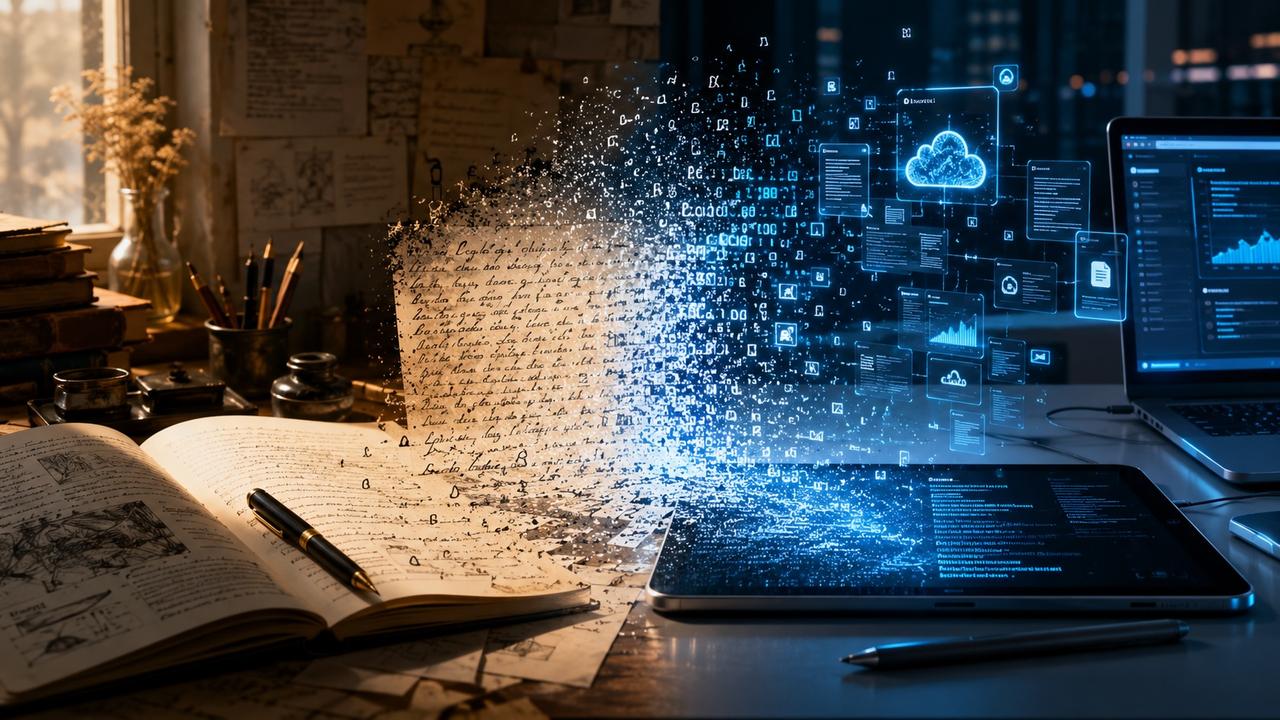
Generated by Artificial Intelligence
Writing on paper begins with physical resistance. The slight friction as the pen touches the page sends a signal to our minds: “You are here, and you are building something right now.”
Cognitive Retention: Research shows that handwriting deepens the process of information processing. While we can “record” dozens of words per second on a keyboard, handwriting forces us to slow down. This slowdown enables the mind to summarize and synthesize information.
Sensory Connection: The texture of paper, the scent of ink, and the movement of the hand across the page transform writing from a mental act into a bodily experience. When you make a mistake and cross it out, the mark remains as a visible “trace”—an imperfect but authentic part of the process.
Fortress of Focus: Paper has no notifications. When you sit down with a notebook, you are far removed from the endless void of the internet. This makes it an invaluable sanctuary for deep work.
On the other hand, the digital world offers a kind of “flexibility” and “infinity” that paper can never provide. Touching a screen means letting thoughts escape their static form and become fluid.
In truth, this is not a race with a winner, but a story of collaboration. In the modern world, these two media complement rather than exclude each other.
The initial sparks of creativity often emerge as scribbles on a napkin in a café or in a stylish notebook; yet it is at a screen that these sparks evolve into projects, articles, or code. Writing on tablets with a stylus serves as a “hybrid” bridge between these two worlds, uniting the natural motion of the hand with the power of digital technology.
The journey of writing reflects humanity’s enduring desire to express itself. Whether you cherish the slow, heavy penetration of ink into paper or the boundless speed of a screen’s smooth surface, what ultimately matters is the courage to face the blank page—or the blinking cursor.
Paper offers depth; the screen offers breadth. Perhaps the best approach is to commit important decisions to paper and build world-changing projects on screens.
What is your preference? The rustle of a pen on paper, or the rhythmic click of a keyboard?
The Weight of Ink: The Meditative Power of Writing on Paper
The Speed of Light: The Dynamic World of Touchscreen Interaction
Who Is Winning?