


This article was automatically translated from the original Turkish version.
+1 More
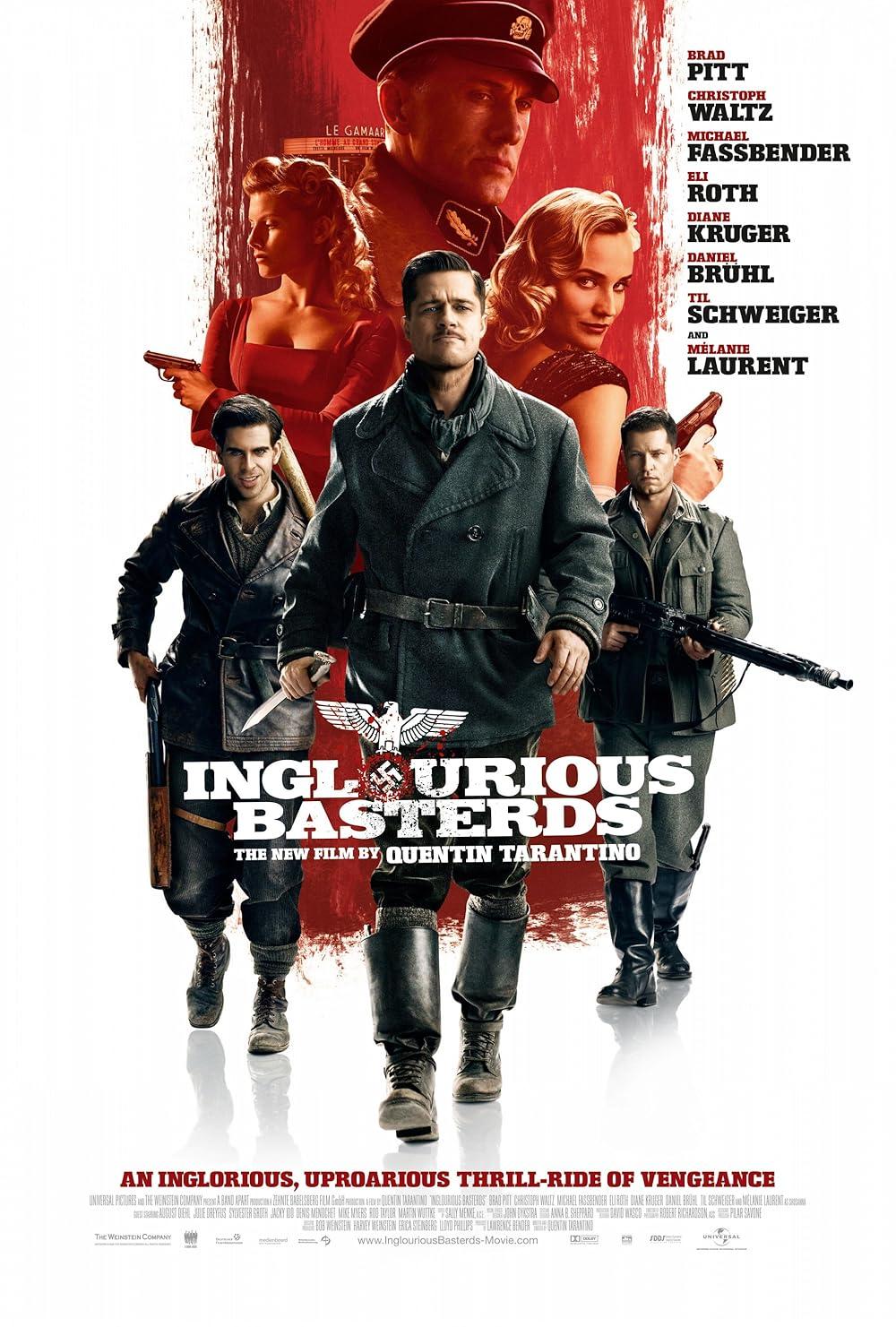
Soysuzlar Çetesi Movie Poster
Original Name | Inglourious Basterds | ||||||||
|---|---|---|---|---|---|---|---|---|---|
Director | Quentin Tarantino | ||||||||
Screenplay | Quentin Tarantino | ||||||||
Production Year | 2009 | ||||||||
Country | Germany United States | ||||||||
Genre | War Adventure Alternate History Drama | ||||||||
Budget | Approximately 70 million dollars | ||||||||
Box Office Revenue | Approximately 320 million dollars (worldwide) | ||||||||
Languages | Italian English German French | ||||||||
Actor | Christoph Waltz (Hans Landa) Brad Pitt (Lieutenant Aldo Raine) Mélanie Laurent (Shosanna Dreyfus) Diane Kruger (Bridget von Hammersmark) Daniel Brühl (Fredrick Zoller) | ||||||||
Inglourious Basterds (English: Inglourious Basterds) is a 2009 war and drama film written and directed by Quentin Tarantino. Set during the Second World War, the film is based on a fictional alternate history scenario. The international production was filmed in various regions of Europe, primarily in France and Germany. Its world premiere took place at the 2009 Cannes Film Festival and it was released in theaters the same year.
The film tells the intersecting stories of two distinct groups operating against Nazi Germany during the Second World War. The first is a special unit known as the “Inglourious Basterds,” composed of Jewish-American soldiers led by Lieutenant Aldo Raine. This group carries out operations using guerrilla tactics targeting Nazi officers.
The other focal point is Shosanna Dreyfus, whose family was murdered by the Nazis and who now runs a cinema in Paris under a false identity. Shosanna attempts to carry out her revenge plan during a film gala attended by high-ranking Nazi officials. These two independent narratives converge at a point with the potential to alter the course of the war.
Quentin Tarantino worked on the screenplay for many years, and the production process went through several stages. The film features a multilingual dialogue structure incorporating German, French, English and Italian among other languages. Principal shooting locations include Babelsberg Studios in Germany and various regions in France.

Inglourious Basterds (IMDb)
The character of Hans Landa, portrayed by Christoph Waltz, stands out for its multilingualism, manipulation and intellect. Waltz received widespread acclaim for this performance and was honored with numerous prestigious awards.
Inglourious Basterds offers an alternative approach to classic war narratives by deliberately altering historical reality. The film emphasizes tense dialogue, a segmented narrative structure and temporal transitions. Cinema functions both as a physical space and a metaphorical vehicle within the film. Thematically, it explores concepts such as revenge, identity, representation and propaganda. The director emphasizes cinema’s transformative power over historical events.
The film received generally positive reviews from critics. Its screenplay structure, dialogue writing, acting performances and directing style were widely praised. While some critics found the film’s historical deviations problematic, many interpreted Tarantino’s choices as artistically and fictionally meaningful. In academic literature, the film is analyzed within the frameworks of “alternate history narrative” and “metafilm,” as an example of how the Second World War has been reimagined through cinema.

Christoph Waltz – SS Colonel Hans Landa (IMDb)
Inglourious Basterds was nominated in eight categories at the 82nd Academy Awards and won the Oscar for Best Supporting Actor (Christoph Waltz). It also received awards at the Cannes Film Festival for Best Actor, as well as from various other organizations including BAFTA, Golden Globes and the Screen Actors Guild. The film was also a commercial success, earning approximately $320 million worldwide against a budget of $70 million.
Events such as the killing of Adolf Hitler and other high-ranking Nazi commanders in a movie theater at the film’s climax do not align with historical reality. The director deliberately crafted this deviation to present an alternative “what if” narrative in opposition to conventional historical storytelling. This approach underscores the film’s fictional rather than historical nature.
Inglourious Basterds holds a significant place in Quentin Tarantino’s filmography as an important work both commercially and artistically. Through its fictional narrative, multilingual structure, performances and stylized storytelling, it offers a unique contribution to the war film genre. The film is regarded as one of the prominent examples of alternate history narratives in cinema.
Beyazperde. "Soysuzlar Çetesi." Accessed April 8, 2025.
Can, İpek. "Soysuzlar Çetesi – Inglourious Basterds." Accessed April 8, 2025.
Ebert, Roger. "To Hell with the History Books, This Is Tarantino’s Own War." RogerEbert.com. August 20, 2009. Accessed April 8, 2025.
IMDb. Inglourious Basterds (2009) – Awards. Accessed April 8, 2025.
IMDb. Inglourious Basterds (2009). Accessed April 8, 2025.
Rotten Tomatoes. "Inglourious Basterds." Accessed April 8, 2025.https://www.rottentomatoes.com/m/inglourious_basterds.
Sinefil. "Soysuzlar Çetesi." Accessed April 8, 2025.
Sinemalar.com. "Soysuzlar Çetesi." Sinemalar.com. Accessed April 8, 2025.https://www.sinemalar.com/film/20539/soysuzlar-cetesi.

Soysuzlar Çetesi Movie Poster
Original Name | Inglourious Basterds | ||||||||
|---|---|---|---|---|---|---|---|---|---|
Director | Quentin Tarantino | ||||||||
Screenplay | Quentin Tarantino | ||||||||
Production Year | 2009 | ||||||||
Country | Germany United States | ||||||||
Genre | War Adventure Alternate History Drama | ||||||||
Budget | Approximately 70 million dollars | ||||||||
Box Office Revenue | Approximately 320 million dollars (worldwide) | ||||||||
Languages | Italian English German French | ||||||||
Actor | Christoph Waltz (Hans Landa) Brad Pitt (Lieutenant Aldo Raine) Mélanie Laurent (Shosanna Dreyfus) Diane Kruger (Bridget von Hammersmark) Daniel Brühl (Fredrick Zoller) | ||||||||
No Discussion Added Yet
Start discussion for "The Gang of Scoundrels (Film)" article
Plot Summary
Production Process
Cast
Thematic Structure and Narrative Features
Criticism and Academic Interpretations
Awards and Achievements
Historical Fiction and Reality