


This article was automatically translated from the original Turkish version.

İnci Kefali (Alburnus tarichi) is an endemic and miraculous fish species belonging to the Cyprinidae family that can survive only in the extreme water conditions of the Van Gölü Basin. Also known locally as "Van Fish," this species forms the cornerstone of the region’s approximately three-thousand-year-old culinary culture, economy, and ecosystem. It has served as the most important protein source for local communities from the Assyrians to the present day and has evolved into a gastronomic heritage through unique preservation and cooking methods developed over time.
Van Gölü, with a surface area of 3712 km² and a maximum depth of 451 meters, is the largest lake in Türkiye. Its water has a pH of approximately 9.8 and contains high levels of soda, rendering it uninhabitable for most aquatic life. However, the İnci Kefali is the only vertebrate species adapted to this "soda lake" environment.
The most remarkable feature of the İnci Kefali is its annual spawning migration, which takes place from early April to the end of July. Although it lives in the lake, its eggs cannot survive in the saline waters, so the fish migrate in large schools to freshwater rivers.
During this migration, the fish remain near river mouths for a period to adapt to the sharp chemical change in water composition (osmotic adjustment). They leap over waterfalls, spawn, and then return to the lake. The fry reach the lake within one to two weeks, completing their life cycle. A fishing ban enforced between 15 April and 15 July is vital for the species’ survival.
Salt has historically been the most strategic preservative against bacterial spoilage. In Van, "Tuzlu Balık" is not merely a dish but an ancient preservation technology developed to meet dietary needs during fishing ban periods.
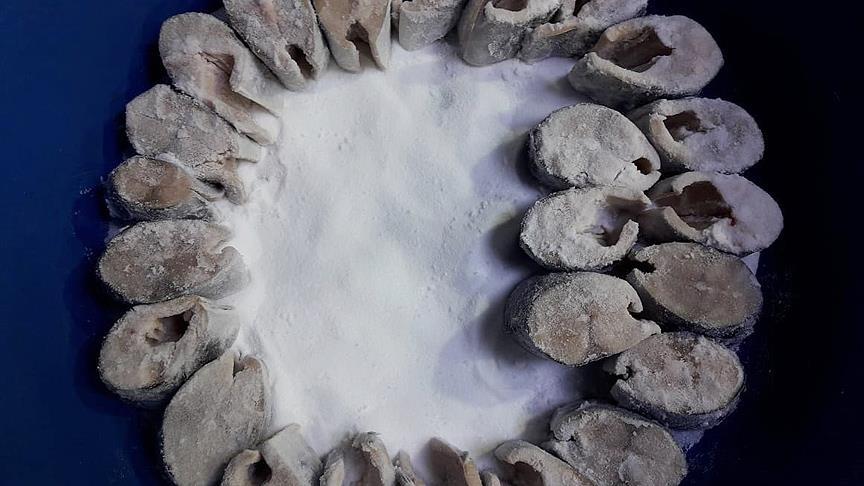
Tuzlu Balık. (AA)
For salted fish production, İnci Kefali caught outside the spawning season are preferred because their flesh contains less water during this time, allowing for longer preservation with less salt.
Research on salted fish samples has revealed a water content of 40–49 percent, protein content of 19–27 percent, and salt content of 15–18 percent. The pH ranges between 5.78 and 6.76. This nutrient-rich food is especially high in minerals but should be consumed in moderation by individuals with hypertension or heart conditions due to its high sodium content.
In Van’s culinary culture, while fresh fish holds its own distinct place, the consumption of salted fish follows a specific ritual.
İnci Kefali accounts for approximately 30 percent of Türkiye’s inland freshwater fish production and has become a national asset. This sector supports around 15,000 people and generated approximately 50 million Turkish Liras in revenue in 2023.
To promote conservation and awareness, the "International İnci Kefali Migration Culture and Art Festival" is held annually.
Furthermore, "Van Gölü İnci Kefali" was officially registered as a Geographical Indication Product on 10.04.2025. This registration enhances the fish’s economic value and ensures the traditional salting method is preserved and passed on to future generations in its authentic form.
"Inci Kefali (Chalcalburnus tarichi Pallas, 1811)'nde Tuzlamanın Bazı Kalite Parametreleri Üzerine Etkisi." Iğdır Üniversitesi Fen Bilimleri Enstitüsü Dergisi 3, no. 4 (2013): 63-68. Accessed April 7, 2026. https://dergipark.org.tr/tr/pub/jist/article/389747
"Tuzlanmış İnci Kefali (*Chalcalburnus tarichi*, Pallas 1811) Balığının Bazı Fiziksel ve Kimyasal Özellikleri." *Gıda* 21, no. 5 (1996): 331-335. Accessed April 7, 2026. https://search.trdizin.gov.tr/tr/yayin/detay/30818.
"Tuzlu Balık," Kültür Portalı, Türkiye Kültür Envanteri, Accessed April 7, 2026. https://www.kulturportali.gov.tr/turkiye/van/neyenir/tuzlu-balik
"Tuzlu Balık,"İpekyolu Belediyesi City Guide, Accessed April 7, 2026. https://kentrehberi.ipekyolu.bel.tr/ne-yenilir/yoresel-yemek/tuzlu-balik/52
"Van Gölü İnci Kefali," Türkiye Turizm Ansiklopedisi. Accessed April 7, 2026. https://turkiyeturizmansiklopedisi.com/van-golu-inci-kefali
"İnci Kefali," Turkish Ministry of Agriculture and Forestry,Van İl Directorate, Accessed April 7, 2026. https://van.tarimorman.gov.tr/Sayfalar/Detay.aspx?SayfaId=22.
Habitat and Biological Characteristics
The Sacred Migration: A Struggle for Survival
A Traditional Conservation Art: Salted Fish
Salting Process and Technical Details
Scientific Analysis and Nutritional Value
Ceremony and Presentation in the Kitchen
Socio-Economic Impact and Future