


This article was automatically translated from the original Turkish version.
The End of History thesis is a political philosophy argument made famous by American political scientist Francis Fukuyama through his 1989 article titled "The End of History?" and his 1992 expanded book "The End of History and the Last Man". This thesis argues that with the end of the Cold War, Western-style liberal democracy has become universalized as the final endpoint of humanity’s ideological evolution and the ultimate form of government. According to the thesis, “the end of history” does not mean the cessation of events or conflicts but rather the absence of any other universal and coherent ideological alternative to liberal democracy. With this argument, Fukuyama claims that the most ideal form of human, political and economic institutions is liberal democracy combined with a free market economy, and that this form has achieved global victory.
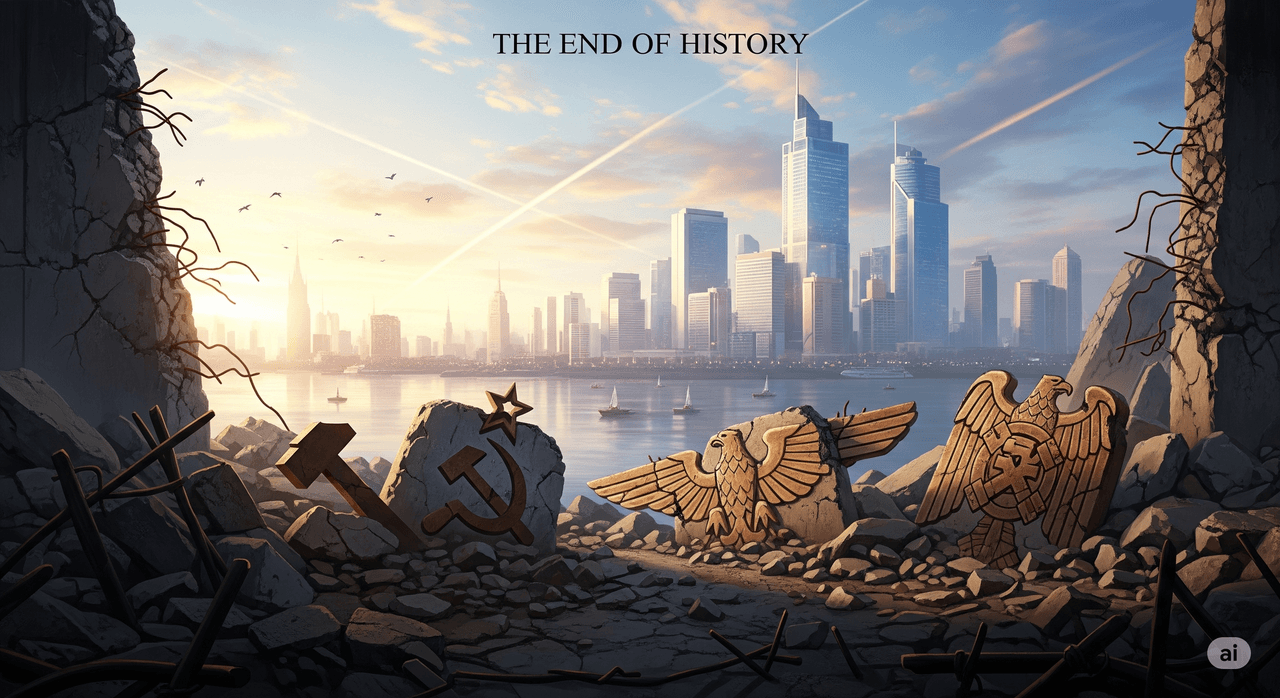
The Collapse of Ideologies and the Victory of Liberalism (Generated by Artificial Intelligence)
Fukuyama’s conceptualization of “the end of history” rests on the assumption that human history constitutes a unique and interconnected evolutionary process with a definite purpose and direction. The central claim of the thesis is that, following the failure of alternative systems such as monarchy, fascism and communism due to their internal contradictions, a global consensus has emerged regarding the legitimacy of liberal democracy.
This “end” does not imply that all countries have in fact transitioned to liberal democracy, but rather that liberal democracy has decisively defeated all other alternatives that claim universal validity. According to Fukuyama, since material developments originate primarily in the realm of consciousness, this ideological victory signals that liberal democracy will eventually spread throughout the world in the long term.
Fukuyama grounds his thesis in the ideas of the German philosopher Georg Wilhelm Friedrich Hegel and his 20th-century interpreter Alexandre Kojève. Within this framework, he proposes two fundamental mechanisms to explain the progression of history.
Hegel viewed history as a dialectical process through which reason and freedom ascend to higher stages. For him, this process reaches its logical conclusion—the “end of history”—when humanity achieves absolute self-consciousness. Hegel identified the liberal state that emerged after the French Revolution as representing this endpoint.
Alexandre Kojève revived this concept by arguing that history ended with the Battle of Jena in 1806, because this event marked the spread of the universal and homogeneous principles of freedom and equality from the French Revolution across all of Europe. Fukuyama adopted Kojève’s interpretation and adapted the Hegelian dialectic to the post–Cold War era.
According to Fukuyama, two primary motors determine the direction of history:
The cumulative and progressive nature of modern science creates uniform effects across all societies. States are compelled to adopt the latest technologies and to build the social structures necessary to enable them—centralized states, free markets, universal education, and so on—due to military necessities and economic development ambitions. Fukuyama argues that this mechanism, on its own, does not necessarily lead to liberal democracy but rather has the potential to produce market-oriented authoritarian regimes.
This is the primary mechanism explaining the emergence of democracy. Fukuyama defines the Platonic concept of thymos as the human desire to have one’s own worth recognized by others. This “struggle for recognition” is explained through Hegel’s “master-slave dialectic.” In this dialectic, neither the master (recognized only by a slave he considers inferior) nor the slave (not recognized as human) achieves full satisfaction. History advances as the slave, through labor, transforms his own nature and the world, and ultimately challenges the master. This contradiction can only be resolved through “universal and mutual recognition,” in which every individual recognizes others as equal and free. The institutionalized form of this resolution is the liberal democratic state.
Together, these two mechanisms explain the logic of capitalist economies (the desire mechanism) and democratic politics (the struggle for recognition), thereby grounding the claim that liberal democracy is the final system.
According to Fukuyama, liberal democracy occupies the end of history because it is the only system capable of resolving fundamental human contradictions.
Fascism destroyed itself through militaristic aggression and racism. Communism collapsed because centralized planning could not cope with the complexity of the information age and suppressed the human desire for recognition, rendering it illegitimate.
Fukuyama engages with Friedrich Nietzsche’s concept of the “last man” as a potential critique of his thesis. The “last man” is a citizen of liberal democracy who lives in an environment of peace and prosperity, lacks grand ambitions or risks, is solely concerned with personal comfort, and is devoid of thymos. Fukuyama acknowledges that such a life may generate profound dissatisfaction, and that people might, out of boredom alone, embark on meaningless struggles to restart history. However, he argues that fields such as economic entrepreneurship, competitive sports, and politics can provide nonviolent channels to satisfy the desire for superiority (megalothymia), thereby mitigating this threat.
Fukuyama’s thesis has provoked intense debate since its publication. Major criticisms include:
Over time, Fukuyama has responded to criticisms and refined his views. Upon recognizing the global emergence of ideologies such as Asian values, fundamentalism, and nationalism, he admitted that his original thesis was mistaken. In particular, he viewed the Russia-Ukraine War as an opportunity to reevaluate his thesis, framing the conflict as a historical struggle between the liberal world and authoritarian regimes.
In his later works—including Trust, The Great Disruption, and Our Posthuman Future—he has focused on issues such as the erosion of social capital necessary for liberal societies to function and the potential of biotechnology to alter human nature and restart history. This shift can be interpreted as a revision of “the end of history,” viewing it not as an absolute conclusion but as a contingent and potentially reversible condition.
Aydın, Habib. "Tarihin Sonu Tezi ve Liberal Dünya Düzeninin Krizi." *Yönetim Bilimleri Dergisi* 23, no. 56 (2025): 1056–76. Accessed August 7, 2025. https://dergipark.org.tr/en/download/article-file/4430361.
Ceylan Şahin, Şule. "Francis Fukuyama ve Tarihin Sonu Tezi." *İstanbul Ticaret Üniversitesi Sosyal Bilimler Dergisi* 5, no. 10 (Fall 2006): 233–52. Accessed August 7, 2025. https://acikerisim.ticaret.edu.tr/server/api/core/bitstreams/76155bbc-1e94-4370-af2b-baf0d660707d/content.
Doğan, Kadir Caner. "The Concepts of the End of History, Ideology and Trust in Francis Fukuyama: Fitting the Ombudsman on the Axis." *New Era International Journal of Interdisciplinary Social Researches* 8, no. 18 (2023): 1–18. Accessed August 7, 2025. https://doi.org/10.5281/zenodo.7952520.
Turan, Bülent. "Fukuyama’nın Tarihin Sonu Tezi." *Akademik Sosyal Araştırmalar Dergisi* 3, no. 21 (December 2015): 485–502. Accessed August 7, 2025. https://asosjournal.com/index.jsp?mod=makale_tr_ozet&makale_id=33489#.
Yang, Chan-young. "Revisiting Fukuyama: The End of History, the Clash of Civilizations, and the Age of Empire." (2010). Accessed August 7, 2025. https://www.academia.edu/73063389/Revisiting_Fukuyama_The_End_of_History_the_Clash_of_Civilizations_and_the_Age_of_Empire_by.

No Discussion Added Yet
Start discussion for "The End of History Thesis" article
Definition and Scope
Theoretical Approaches and Philosophical Origins
Philosophical Origins: Hegel and Kojève
Two Fundamental Mechanisms
Modern Natural Science (The Desire Mechanism)
The Struggle for Recognition (Thymos)
Core Arguments of the Thesis
The Failure of Alternative Ideologies
The Problem of the “Last Man”
Criticisms and Challenges to the Thesis
Fukuyama’s Reassessment of the Thesis