


This article was automatically translated from the original Turkish version.
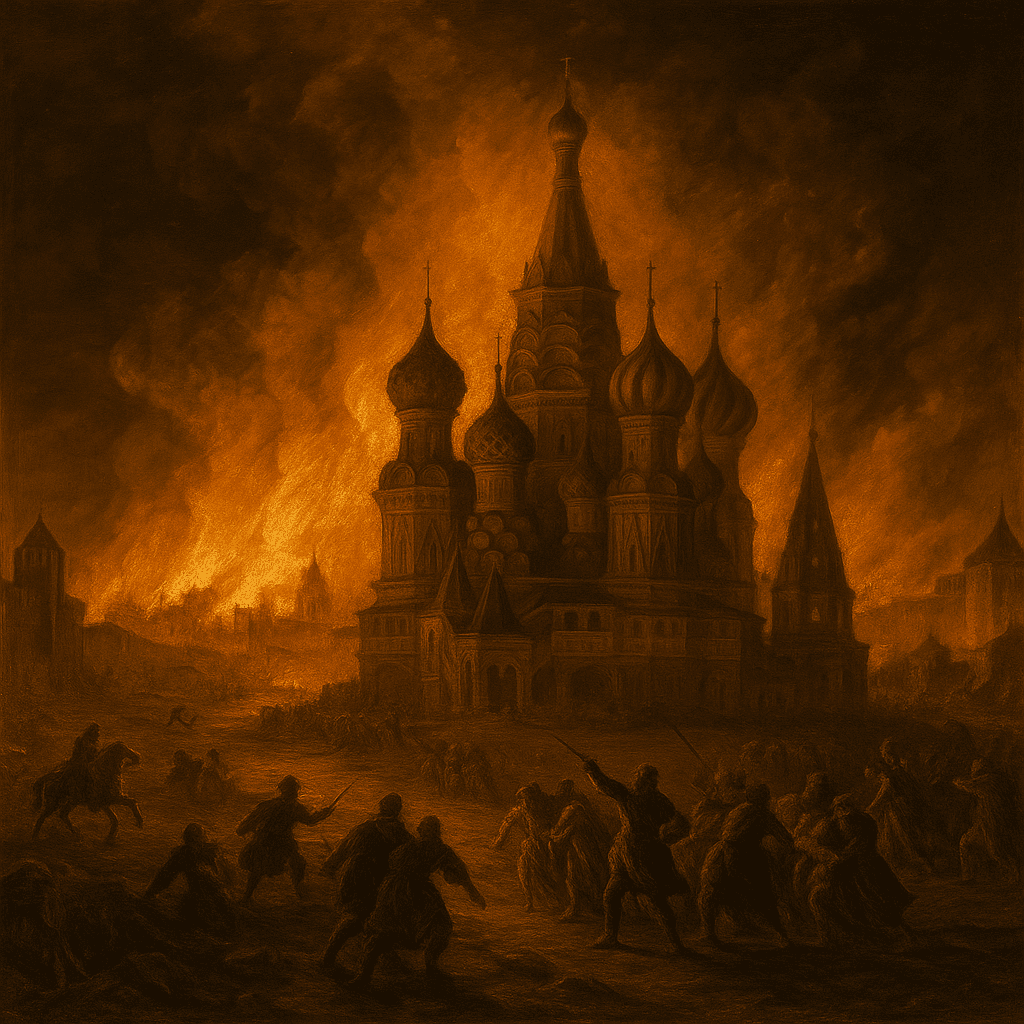
The Crimean Khanate's Burning of Moscow
History | 24 May 1571 | ||||||||
|---|---|---|---|---|---|---|---|---|---|
Place | Tsardom of Russia Moscow | ||||||||
Side | Defender: Tsardom of Russia Attacker: Crimean Khanate | ||||||||
Commander | Crimea: Devlet I Giray, Russia: Ivan IV (Ivan the Terrible) | ||||||||
Result | Destruction of much of Moscow Military victory of the Crimean Khanate | ||||||||
The Burning of Moscow by the Crimean Khanate was a major destruction and fire event that occurred during a campaign led by Crimean Khan Devlet I Giray against Russia on 24 May 1571. This historical event is regarded as one of the most effective military successes achieved by the Crimean Khanate against the Russian Tsardom.
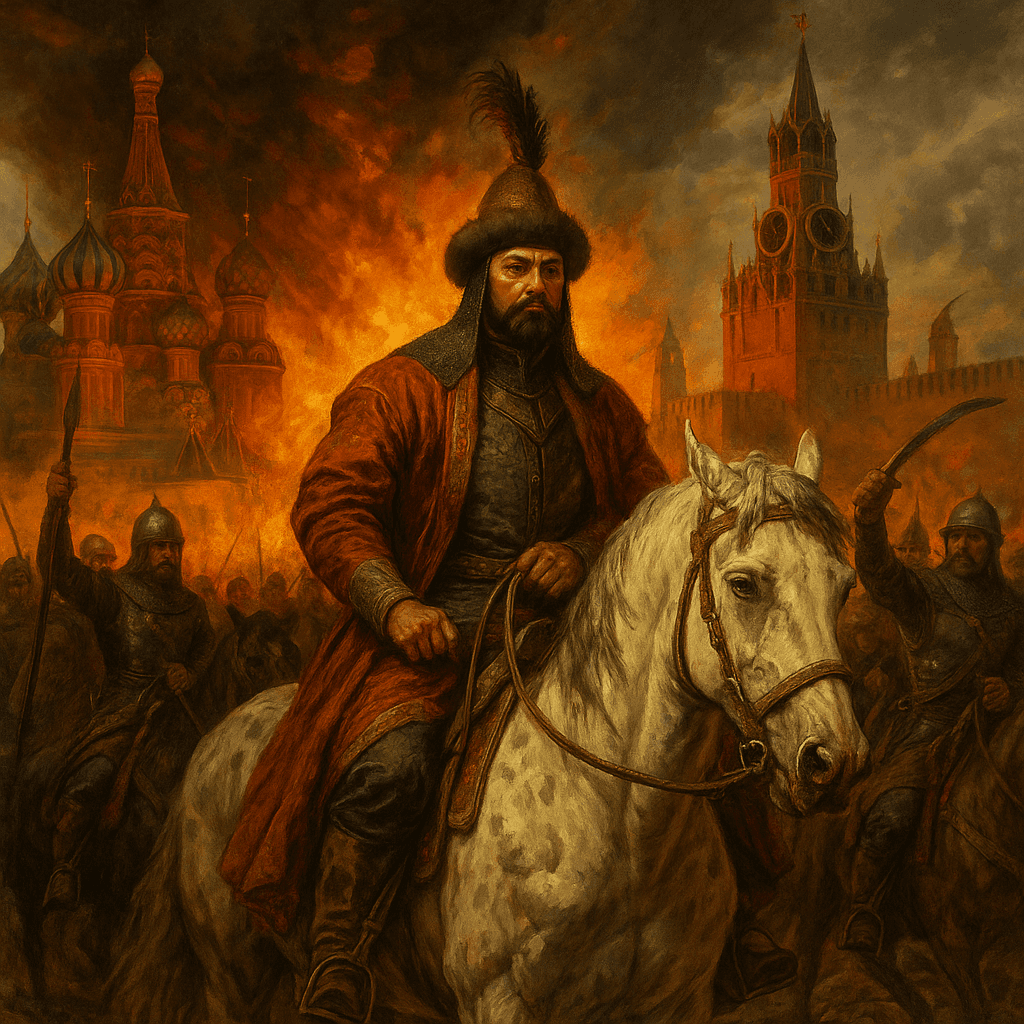
Olayı Anlatan Temsili Görsel (Yapay Zekâ ile Oluşturulmuştur)
The Golden Horde, following its dissolution, gave rise to several successor khanates including the Crimean Khanate which ruled semi-independently under the protection of the Ottoman State. Meanwhile, the Principality of Moscow had eliminated the Muslim Turkic presence along the Volga River by conquering the Khanate of Kazan in 1552 and the Astrahan Khanate in 1556.
In 1569 the Ottoman State launched a military campaign against Astrahan but it ended in failure due to various reasons including supply shortages, adverse climatic conditions, and lack of Tatar cooperation. In response, Crimean Khan Devlet Giray decided on his own initiative to launch a campaign against Moscow in 1571.
Devlet Giray marched on Moscow in May 1571 with a large Tatar army. The inability of Tsar Ivan IV (Ivan the Terrible) to field a strong army at the time and the weakness of Russia’s border defenses increased the chances of success for the campaign.
On 24 May 1571 the Crimean forces reached the outskirts of Moscow and set fire to its suburbs. Fueled by strong winds the fire spread rapidly and nearly the entire city was consumed.
The area around the Kremlin suffered extensive damage; the city’s infrastructure collapsed, thousands of buildings were reduced to ashes, and a large portion of the population was killed or taken captive. According to accounts the number of dead in Moscow and its vicinity alone approached 100,000.【1】 During the 18-day period of fire and plunder Devlet Giray destroyed the Kremlin and Tsar Ivan IV escaped the palace to save his life.
The campaign was a decisive military victory. Devlet Giray gained great prestige within the Ottoman sphere and was granted the title “Taht Algan”. Ottoman Sultan Selim II, expressing his satisfaction with this success, sent Devlet Giray a letter of praise. However this major military triumph did not translate into political gain. In 1572 Devlet Giray launched another campaign against Moscow but was decisively defeated by the now-prepared Russian army. As a result the 1571 campaign became the last major victory the Crimean Khanate achieved against Russia.
The 1571 Moscow campaign holds three key historical significances:
1. Military Success: Russia suffered a severe blow as the entire city was devastated by fire.
2. Ottoman-Crimean Alliance: The Ottoman State’s strategy of using the Crimean Khanate as its proxy rather than intervening directly reflected a classic Ottoman foreign policy approach.
3. Strengthening of Russian Centralism: The destruction and chaos provided Tsar Ivan IV with justification to establish a more authoritarian centralized administration.
The Burning of Moscow by the Crimean Khanate has secured its place in history as a military and symbolic act within the context of Ottoman-Crimean-Russian relations in the 16th century. Devlet Giray’s campaign in Moscow is interpreted as the last major resistance against Russia’s process of assimilating Turkic-Islamic presence in Central Asia and the Volga-Ural region.
Acar, Serkan. “Kırım Hanı Devlet Giray’ın 1571 Rusya Seferi ve Moskova Yangını.” *Karadeniz Araştırmaları* 39 (Fall 2013): 95–110.https://www.proquest.com/openview/e49b15a1cbb964295e61fffa1b89af7c/1?pq-origsite=gscholar&cbl=237821
Ünal, Fatih. “Geçmişten Günümüze As-Tarhan (Astrahan/Hacı Tarhan).” A.Ü. Türkiyat Araştırmaları Enstitüsü Dergisi 38 (2008): 227–252.https://dergipark.org.tr/tr/pub/ataunitaed/issue/2877/39566.
[1]
Bu sayıya ihtiyatla yaklaşmak gerekir. Rus kaynaklarının düşmanın büyüklüğünü göstermek için Türk kaynaklarının ise zaferin büyüklüğünü vurgulamak için sayıyla oynamış olmaları olasıdır. 16. yüzyıl için 100.000 kişilik bir nüfusun sadece Moskova çevresinde bulunması oldukça zordur.

The Crimean Khanate's Burning of Moscow
History | 24 May 1571 | ||||||||
|---|---|---|---|---|---|---|---|---|---|
Place | Tsardom of Russia Moscow | ||||||||
Side | Defender: Tsardom of Russia Attacker: Crimean Khanate | ||||||||
Commander | Crimea: Devlet I Giray, Russia: Ivan IV (Ivan the Terrible) | ||||||||
Result | Destruction of much of Moscow Military victory of the Crimean Khanate | ||||||||
No Discussion Added Yet
Start discussion for "The Crimean Khanate's Burning of Moscow" article
Historical Background
The 1571 Moscow Campaign
Military Victory Political Failure