


This article was automatically translated from the original Turkish version.
"Imaginative play" is one of the distinctive creative narrative forms in children’s literature, referring to the process by which the power of imagination is structured through play within literary texts. This concept functions as an instrument that enhances the aesthetic depth of the text while stimulating the child’s cognitive processes. Imaginative play transforms the child’s relationship with reality, fostering abstraction skills and simultaneously reinforcing the artistic quality of the literary work. In this context, imagination constitutes a plane where reality is reconfigured, and play provides a space of freedom within that plane.
Children’s literature is not merely a field for delivering instructional and educational content; it also offers an aesthetic structure that supports the child’s cognitive, emotional and creative development. According to Jean Piaget’s theory of cognitive development, children, especially during the preoperational stage (2–7 years), make sense of the world through symbolic play and imagination-based activities. Therefore, creative storytelling in children’s literature contributes to the child’s mental exploration and interpretation of the world.
According to Bruno Bettelheim, fairy tales and fantastical narratives enable the symbolic expression and processing of the child’s inner fears, conflicts and desires. Within this framework, imaginative play carries not only an aesthetic but also a psychological function.
Creative storytelling in children’s literature allows narrative to transcend mere event transmission and acquire a multilayered structure. Metaphors, allegories, fantastical elements and temporal-narrative disruptions within the text expand the child’s imaginative world and develop critical thinking skills.
For instance, in Lewis Carroll’s Alice’s Adventures in Wonderland or Michael Ende’s The Neverending Story, the concept of imaginative play emerges as a fundamental building block of the plot. In such works, although the fiction may appear detached from reality, the child establishes logical connections within the text and develops abstract thinking skills.
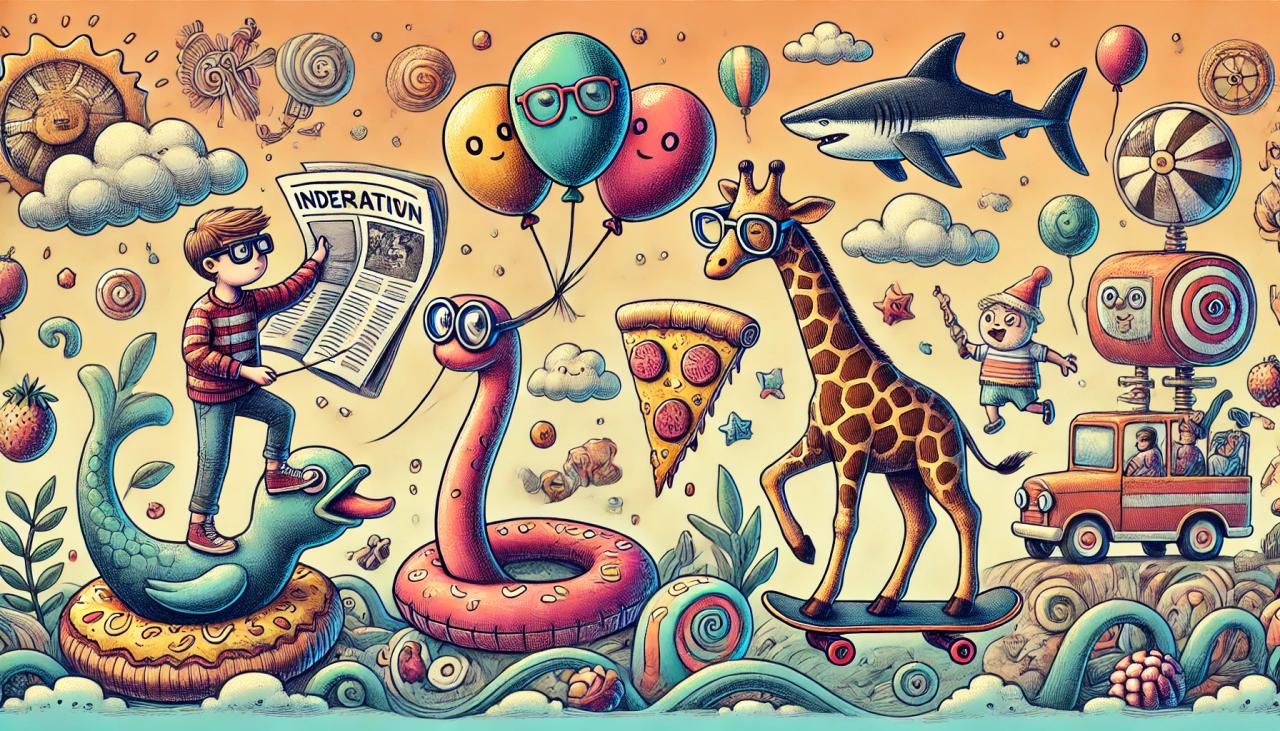
(This image was generated by artificial intelligence)
Playfulness also transforms narrative in children’s literature into a kind of "performance." Through this performative structure, the reader does not remain merely an external observer but enters into interaction with the text. This experience is shaped by the text’s multilayered structure, character transformations, the flexibility of time-space networks and the multiplicity of narrative voices. Playfulness is further reinforced by elements such as surprise, paradox, absurdity and humor, which sustain the child’s attention and enhance reading motivation.
For many years, children’s literature was defined by moralistic, prescriptive and didactic texts. However, from the mid-20th century onward, with the changing conception of childhood, literary production also underwent transformation. Today, contemporary children’s literature is shaped by a child-centered approach that values subjectivity and places imagination at its core.
This shift reveals that children’s literature is not merely an educational domain but rather a field where aesthetic experience, emotional expression and multidimensional thinking skills are cultivated. In this context, the concept of imaginative play has become one of the foundational aesthetic pillars of contemporary children’s literature, occupying a central position in creative storytelling. This concept simultaneously enhances the aesthetic value of literary texts and fosters the child’s imagination, cognitive abilities and inner world. The synergy between creative storytelling and imaginative play in children’s literature contributes to the child’s development not only as a reader but as a thinking, questioning and re-creating individual.
Gültekin, Mustafa. "Çocuk Edebiyatında Yaratıcılığın Rolü ve Kurgu Dinamikleri." Türkoloji Dergisi 35, no. 2 (2020): 189–204.
Hunt, Peter, ed. Understanding Children's Literature. London: Routledge, 2005.
Nikolajeva, Maria. Children's Literature Comes of Age: Toward a New Aesthetic. London: Routledge, 2014.
Rodari, Gianni. Düş Kurma Kuralları. İstanbul: Günışığı Kitaplığı, 2021.

No Discussion Added Yet
Start discussion for "The Concept of "Play with Dreams" in Children's Literature" article
The Role of Imagination in Children’s Literature
"Imaginative Play" in the Context of Creative Storytelling and Narrative Techniques
The Transition from Didactic to Aesthetic Narrative