This article was automatically translated from the original Turkish version.
+1 More
Author(s) | Tahsin Yücel | ||||||||
|---|---|---|---|---|---|---|---|---|---|
Number of Pages | 184 | ||||||||
Publisher(s) | Can Yayınları | ||||||||
Type(s) | Novel | ||||||||
First Publication Date(s) | 1995 | ||||||||
Language of Work | Turkish | ||||||||
The Legend of the Mustache is a novel that tells the tragicomic story of a man caught between individual identity and societal expectations, through the symbol of the “mustache.” The work satirically examines how social perceptions and myth-making can transform an ordinary individual.
The novel recounts the story of Cumali, who returns to his hometown after completing his military service. Seeking to shave, Cumali visits the barber Ziya intending to have his mustache trimmed. However, barber Ziya argues that these mustaches are “promising” and refuses to cut them. Under the persistent insistence of Ziya and Cumali’s blood brother Tuzsuz Vaysal, Cumali decides to let his mustache grow. This decision quickly draws attention in the town. Over time, the mustache becomes the subject of legend; young girls believe it flies at night. The townspeople no longer speak of Cumali himself, but only of his mustache. This phenomenon obscures Cumali’s character, alienates him even from himself, and ultimately leads to him being given the nickname “Kara Pala.”
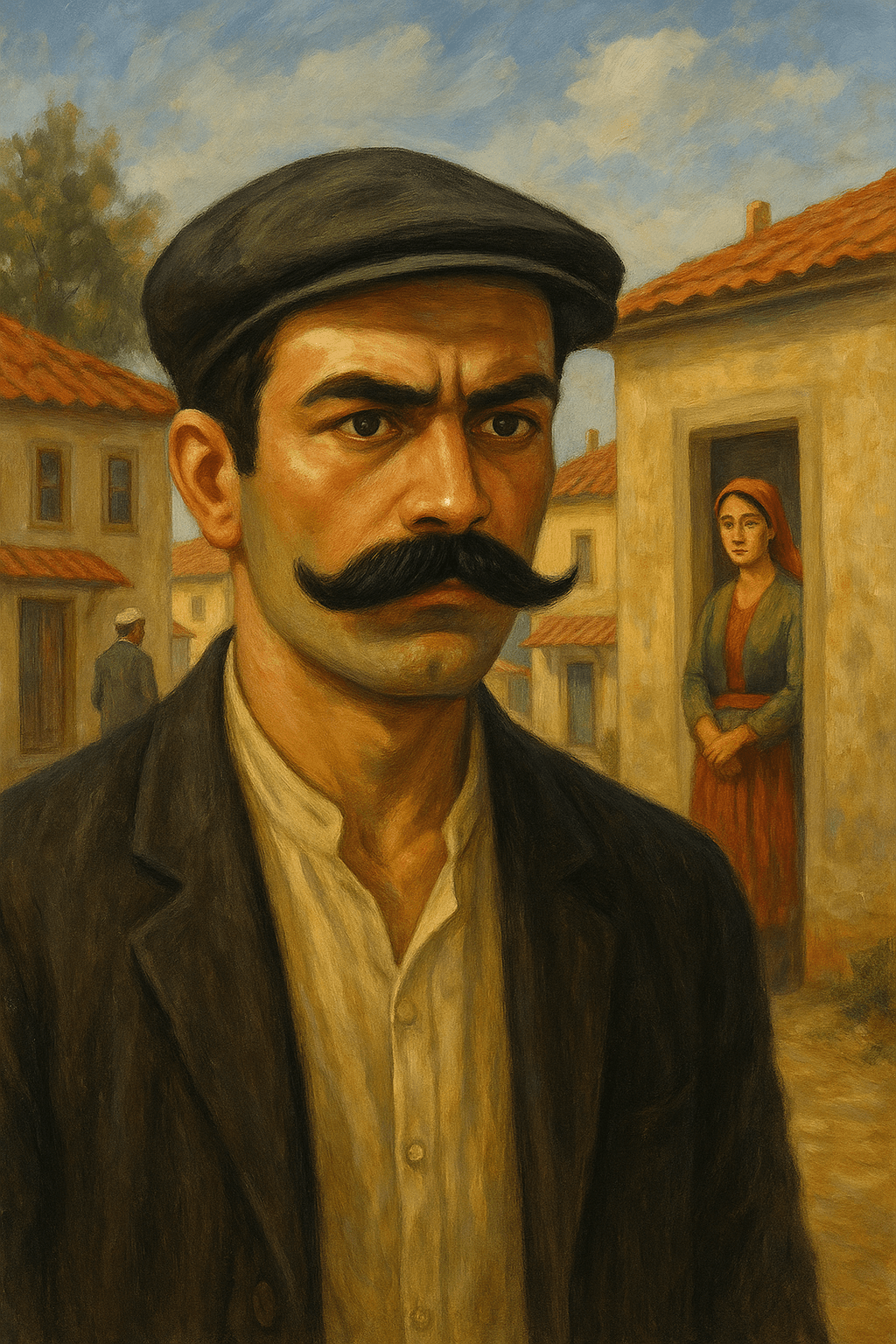
Cumali Character (Generated by Artificial Intelligence)
Cumali: The protagonist of the novel. A young man from the countryside who becomes alienated from himself as his mustache is transformed into a legend.
Sadi Bey: One of the town’s prominent figures. He holds social respect as an elderly bureaucrat or educated intellectual. Although he initially approaches the mustache issue with distance and rationality, he eventually succumbs to the influence of the mustache legend. His character illustrates how even rationality can be undermined by myth.
Kırtasiyeci Halit: An active member of the town’s gossip network. He knows everyone’s affairs in detail and delights in telling and spreading stories. He is one of those who shapes the legends surrounding Cumali’s mustache. Halit embodies the archetype of the “gossip figure” in rural life.
Bedriye Abla: Cumali’s fiancée. Initially repelled by the mustache, she later comes to admire it.
İmam Efendi: One of the figures representing religious authority. He may offer religious or moral critiques against the exaggerated glorification of the mustache. However, his stance typically proves ineffective against the public’s fascination with the legend. This character symbolizes the helplessness of traditional moral authority in the face of modern myths.
Barber Ziya: The man who opposes cutting the mustache and meticulously observes its growth.
Tuzsuz Vaysal: Cumali’s blood brother and one of the key figures in spreading the mustache legend.
Hacarifa: Cumali’s father.
Identity and Alienation: Cumali’s gradual estrangement from himself symbolizes how an individual can be shaped by a collective identity imposed by society.
Rural Life: The novel shows how ordinary events in a small town are exaggerated and transformed into legends.
Obsession and Fixation: In Tahsin Yücel’s novel The Legend of the Mustache, the obsessive passion a person develops for an object—in this case, the “mustache”—forms the central structure of the narrative. The protagonist Cumali does not view his mustache merely as an aesthetic or traditional element, but as a symbol of masculinity, identity, and existence. This symbolic attribution gradually replaces his personal identity with an all-consuming obsession, detaching him from reality. As the intensity of this passion grows, its destructive impact on Cumali’s life becomes increasingly evident.
Dedication and Identity Crisis: The novel exposes the identity crisis that can arise when an individual dedicates himself to an ideal or symbol. Cumali’s devotion to his mustache undermines his social relationships, family ties, and societal roles. Yücel critiques this devotion with ironic irony, revealing the tragic consequences that can occur when one’s search for meaning is misdirected toward false objects.
The Relationship Between Object and Individual: Throughout the novel, the “mustache” ceases to be merely a physical feature and becomes an object that reflects the individual’s inner world, desires, and fears. The bond formed between object and person evolves into an identity relationship. Tahsin Yücel explores this connection with an ironic and occasionally absurdist approach, offering a critical perspective on the modern individual’s quest for meaning and belonging.
Social Norms and Perceptions of Masculinity: The meaning Cumali attaches to his mustache can also be read as a critique of society’s perception of masculinity. To him, the mustache is not merely a personal preference but a symbol of respect and power within society. This dynamic illustrates how an individual may surrender his true self by conforming to social norms. Yücel addresses this distorted understanding of masculinity within the rural atmosphere through satire and parody elements.
Antakyalı, Banu. “Yıl 2019, Sayı: 22, 1–23, 01.12.2019.” *Yeni Türk Edebiyatı Araştırmaları* 22 (2019): 1–23. https://dergipark.org.tr/tr/pub/ytea/issue/50410/653592.
Yücel, Tahin. Bıyık Söylencesi. Can Yayınları, 2024.

Author(s) | Tahsin Yücel | ||||||||
|---|---|---|---|---|---|---|---|---|---|
Number of Pages | 184 | ||||||||
Publisher(s) | Can Yayınları | ||||||||
Type(s) | Novel | ||||||||
First Publication Date(s) | 1995 | ||||||||
Language of Work | Turkish | ||||||||
No Discussion Added Yet
Start discussion for "The Beard Legend (Book)" article
Plot
Characters
Themes