


This article was automatically translated from the original Turkish version.
+2 More

Test-tube baby
History of In Vitro Fertilization Worldwide | First successful IVF birth: 25 July 1978, England/Oldham | ||||||||
|---|---|---|---|---|---|---|---|---|---|
History of In Vitro Fertilization in Türkiye | Performed by the Department of Gynecology and Obstetrics at Ege University First successful IVF birth: 18 April 1989/Izmir | ||||||||
Success Rates | Higher in women under 35 years of age Overall success rate: 30–50% | ||||||||
Embryo Selection with Artificial Intelligence | In 2024, an AI model named DeepEmbryo was developed | ||||||||
Test-tube baby is a fertility treatment in medicine known as in vitro fertilization (IVF). This method involves fertilizing a female reproductive cell (egg) with a male reproductive cell (sperm) outside the body in a laboratory environment, followed by transferring the resulting embryo into the uterus. Developed for couples unable to conceive naturally, this technique has become one of the most common and effective approaches in the treatment of infertility today.
The test-tube baby (IVF) process first came to prominence in the 1930s through animal studies conducted in the USA. Gregory Pincus was among the pioneering figures in this field, claiming success in fertilizing rabbit eggs in a laboratory setting. In the 1940s, Rock and Menkin worked with human eggs obtained through surgical intervention and observed signs of fertilization; however, these efforts did not result in live births. Although various scientists conducted research on human IVF throughout the 1950s and 1960s, success was not achieved due to technical shortcomings and insufficient scientific knowledge.
The turning point occurred in 1968 with the collaboration of British embryologist Robert Edwards and gynecologist Patrick Steptoe. Through this partnership, focus was placed on key steps such as ovarian stimulation, sperm preparation, fertilization, and embryo transfer, and numerous technical challenges were overcome over the years.
The contribution of nurse-technician Jean Purdy within the team was also significant. After a decade of scientific and clinical research, on July 25, 1978, a healthy baby girl named Louise Brown was born in Oldham, England. This birth became the world’s first successful test-tube baby birth and is recognized as a revolution in modern reproductive medicine.
Test-tube baby applications in Türkiye began to develop in the late 1980s, with the first successful birth occurring on April 18, 1989 in İzmir. This birth was carried out at the Test-tube Baby Center within the Department of Gynecology and Obstetrics at Ege University under the leadership of Professor Dr. S. Aricioglu, resulting in the birth of twins named Evren and Ece Erol. This event is regarded as one of the pivotal milestones in the history of assisted reproductive technologies in Türkiye.
The Ege University Test-tube Baby Center is one of the first such centers established within a public university in Türkiye. Founded in 1988, the center played a leading role in the widespread adoption of test-tube baby procedures across the country following its first birth in 1989. The center conducts not only clinical treatments but also research and educational activities.
The Ege University Test-tube Baby Center continues to provide active services with advanced laboratory infrastructure and a multidisciplinary team of specialists.

Image depicting a girl and a boy baby born in a cradle at Ege University Hospital in İzmir. (Generated by artificial intelligence.)
The test-tube baby method is recommended for individuals and couples who are unable to conceive naturally due to specific conditions. These include blocked fallopian tubes, reduced ovarian reserve due to advanced age, low sperm count or poor sperm quality, endometriosis, and unexplained infertility.
Additionally, IVF is often chosen for couples who have not achieved success with prior treatments such as intrauterine insemination.
The IVF treatment process generally consists of four main stages:
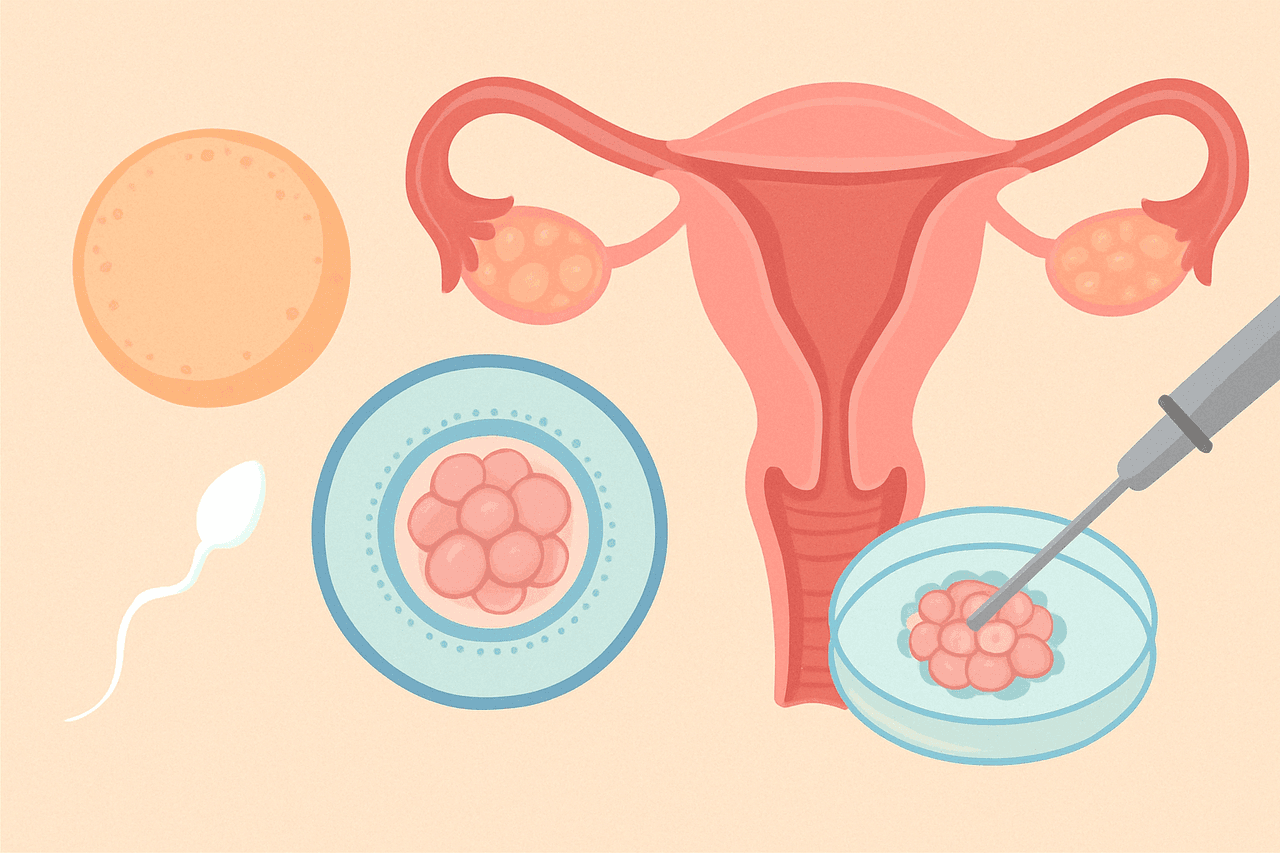
Representative image of the IVF treatment process. (Generated by artificial intelligence.)
One of the most important factors influencing the success of IVF treatment is laboratory conditions. Advanced techniques such as fertilization in vitro, embryo culture, embryo quality assessment, embryo freezing (cryopreservation), preimplantation genetic testing (PGT), and time-lapse embryo monitoring systems are employed. These applications enhance the selection of healthy embryos and increase the chances of pregnancy.
Some potential difficulties and side effects associated with IVF treatment include ovarian hyperstimulation syndrome (OHSS), failure to retrieve eggs or embryos, failure of the embryo to implant in the uterus, and pregnancy loss through miscarriage. Additionally, emotional and psychological pressure can cause significant stress for couples. For this reason, psychological support during the treatment process is also recommended.
A woman’s age is a direct factor affecting the success of IVF treatment. Advanced age (typically 35 years and older) is associated with a decline in both the number and quality of eggs. In such cases, higher-dose hormone therapies may be applied, and methods such as egg donation may be recommended. In addition, specific clinical conditions such as polycystic ovary syndrome (PCOS) and endometriosis also influence the treatment plan.

Image of a baby in the mother’s lap. (Generated by artificial intelligence.)
The success rate of IVF treatment varies depending on numerous factors including age, egg quality, sperm parameters, embryo quality, and uterine conditions. Success rates are higher in younger women and decrease with advancing age. Overall, success rates typically range between 30% and 50%.
IVF treatments have also generated social and ethical debates. This method has sparked diverse interpretations from religious, cultural, and social perspectives, and issues such as embryo freezing, embryo selection, and surrogacy occasionally enter public discourse. At the same time, as awareness of infertility increases in society, understanding and acceptance of IVF treatments have also risen.
Artificial intelligence (AI) and machine learning (ML) technologies are being developed to make embryo selection in IVF treatments more objective, faster, and more accurate. Embryo quality is traditionally assessed by embryologists using morphological criteria under a microscope. However, this method is subjective and can vary between experts. Therefore, AI-based models offer alternative approaches to make embryo selection more consistent and scientifically grounded.
In 2024, a study developed by Borna, Sepehri and Maleki and published in the journal Frontiers in Artificial Intelligence introduced a new AI algorithm called DeepEmbryo for embryo selection. DeepEmbryo is designed to predict pregnancy outcomes by analyzing images of embryos captured at three different time points (19, 44, and 68 hours after fertilization). This algorithm operates compatibly with existing laboratory infrastructure without requiring time-lapse systems, offering broad applicability.

Image illustrating AI-based embryo selection. (Generated by artificial intelligence.)
DeepEmbryo first segments embryo images using a U-Net architecture, removing background elements and isolating only the region containing the embryo for analysis. Subsequently, each of the three images taken at different developmental stages is processed through convolutional neural networks (CNNs) to extract feature vectors. These vectors are combined to produce a single output predicting pregnancy probability. The model uses transfer learning, leveraging pre-trained deep networks to achieve high accuracy even with limited data.
The DeepEmbryo algorithm can predict pregnancy outcomes from embryo images with a 75% accuracy rate. This success rate is significantly higher than the 48.41% accuracy achieved by experienced embryologists using majority consensus in the same study. Furthermore, all variants of the algorithm delivered more consistent and successful results compared to human experts.
Warning: The content in this article is provided solely for general encyclopedic information purposes. The information here should not be used for diagnosis, treatment, or medical advice. Always consult a physician or qualified healthcare professional before making any decisions regarding health. Neither the author of this article nor KÜRE Encyclopedia assumes any responsibility for consequences arising from the use of this information for diagnostic or therapeutic purposes.
Anatolia Tüp Bebek Merkezi. *Sorularla Tüp Bebek*. Ankara: Anatolia Tüp Bebek ve Kadın Sağlığı Merkezi, n.d.https://www.anatoliatupbebek.com.tr
Bal, Nazar. Tüp Bebek Konusuna Sosyolojik Bir Bakış: Temellendirilmiş Kuram Çalışması. Master's thesis,Ankara Üniversitesi Institute of Social Sciences, 2014.
Borna, Mahdi-Reza, Mohammad Mehdi Sepehri, and Behnam Maleki. “An Artificial Intelligence Algorithm to Select Most Viable Embryos Considering Current Process in IVF Labs.” *Frontiers in Artificial Intelligence* 7 (2024): 1375474. https://doi.org/10.3389/frai.2024.1375474.
Ege University In Vitro Fertilization Center. "Tarihçe." Ege Üniversitesi, Accessed April 17, 2025.https://egetupbebek.ege.edu.tr/tr-5592/tarihce.html.
Martin H. Johnson, *A Short History of In Vitro Fertilization (IVF)*, *The International Journal of Developmental Biology* 63, no. 2–3 (2019): 83–92,https://doi.org/10.1387/ijdb.180364mj.
PRP Tüp Bebek Merkezi. "Tüp Bebek Tedavisi Nasıl Yapılır?" PRP Tüp Bebek. Accessed April 17, 2025.https://www.prptupbebek.com/tup-bebek-tedavisi-nasil-yapilir/.

Test-tube baby
History of In Vitro Fertilization Worldwide | First successful IVF birth: 25 July 1978, England/Oldham | ||||||||
|---|---|---|---|---|---|---|---|---|---|
History of In Vitro Fertilization in Türkiye | Performed by the Department of Gynecology and Obstetrics at Ege University First successful IVF birth: 18 April 1989/Izmir | ||||||||
Success Rates | Higher in women under 35 years of age Overall success rate: 30–50% | ||||||||
Embryo Selection with Artificial Intelligence | In 2024, an AI model named DeepEmbryo was developed | ||||||||
History and First Birth of Test-tube Baby Worldwide
History and First Birth of Test-tube Baby in Türkiye
Ege University Test-tube Baby Center
Conditions for Test-tube Baby Treatment
Test-tube Baby Treatment Process and Stages
Laboratory Techniques and Technological Advancements
Challenges in Test-tube Baby Treatment
Test-tube Baby in Advanced Age and Special Cases
Success Rates and Influencing Factors
Ethical Debates and Social Perception
Artificial Intelligence and Machine Learning in Embryo Selection