


This article was automatically translated from the original Turkish version.
Tentenecilik, or more commonly known as lace-making, is one of the original and elegant branches of Turkish folk arts. This traditional handcraft, typically executed using tools such as hooks, needles, bobbins, and combs with cotton thread, is based on the chain stitch technique and enriched with auxiliary methods such as openwork, filling, and trellis patterns.
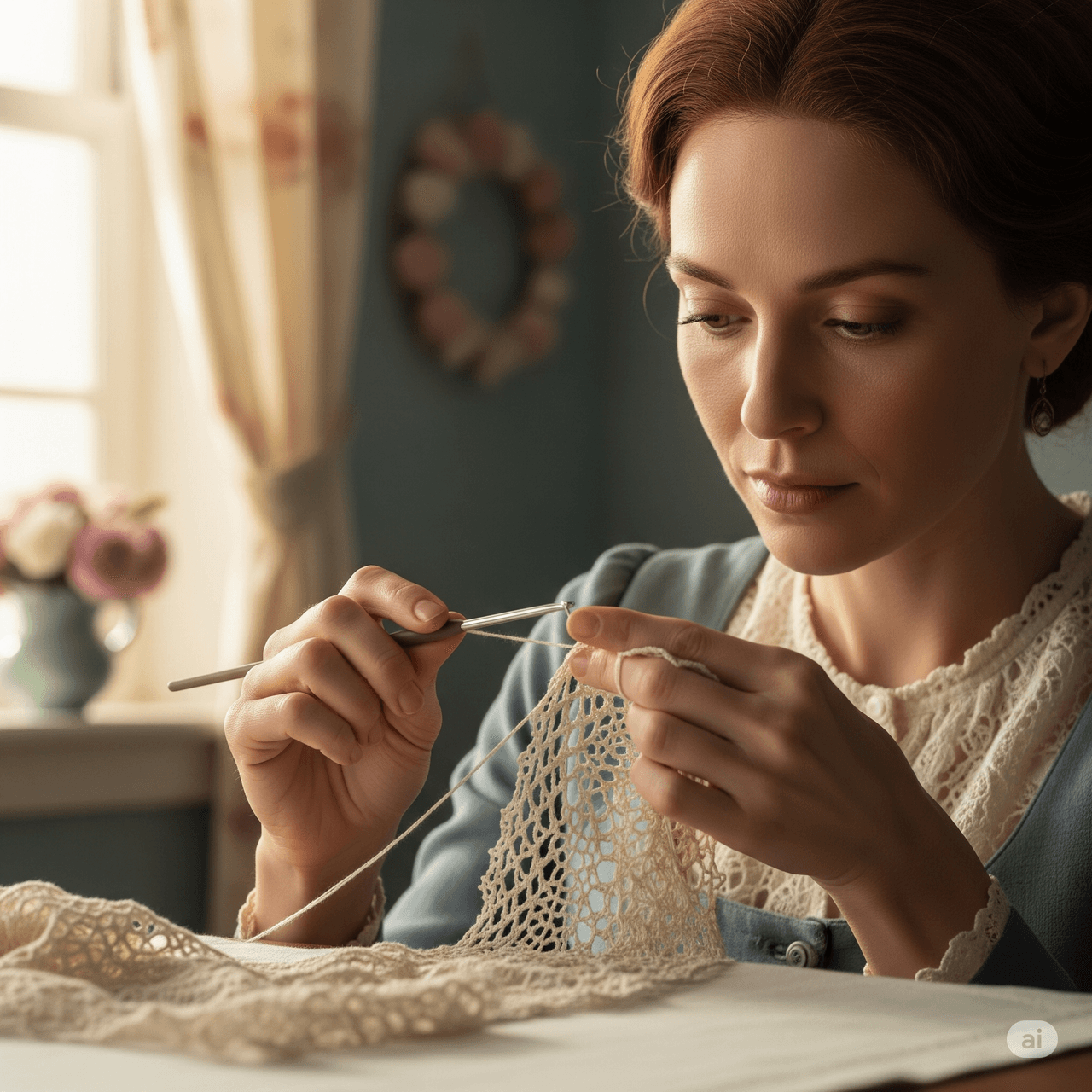
A woman making tentene. (Generated by artificial intelligence.)
Tentenecilik begins fundamentally with the chain stitch, from which various stitch types such as single crochet, trellis, and loop stitches are derived through different tension techniques. Hook-made tentene is the most common form. The threads used in these applications vary in thickness, but white cotton thread remains the traditional preference. Depending on the tool employed, tentene types include:
Tentene is not only used to embellish clothing but also features in household textiles such as mattress covers, tablecloths, curtains, bedspreads, and pillow edges. In traditional homes, the covers of wooden chests often feature embroidered and tentene-decorated surfaces.
Lace-making is one of the artistic traditions known and practiced by the Turks throughout history. Ottoman miniatures depict garments, collars, and hair ornaments adorned with tentene. According to art historians, the earliest examples of lace-making appear in Central Asian, Chinese, and Egyptian civilizations, later spreading to Europe via the Mediterranean. Particularly from the 17th century onward, with the arrival of cotton thread in Europe, intensive work on “white lace” emerged.
In Anatolia, tentenecilik also holds a central place in the dowry tradition. Within Turkish culture, the concept of “a girl’s dowry begins in the cradle and is stored in the dowry chest” means that dowry items are prepared from an early age. Lace-making is regarded as one of the most emotional and aesthetic components of this process.
Lace-making is not merely a decorative activity; it also carries significant sociocultural meaning. It is linked to multiple social dimensions including family solidarity, neighborhood relationships, and personal relaxation. Even today, handmade laces can still be found in dowry shops, just as they were in the past.
Traditional lace motifs are now being reinterpreted through modern technology, particularly in textile design using laser cutting techniques. Laser cutting enables the digitalization of motifs and their precise transfer onto fabric surfaces. Motifs drawn in software can be meticulously applied to faux leather or crepe fabric via automated machines.
This method allows for the creation of lace samples with diverse textures within contemporary textile design. The flexibility offered by laser technology plays a crucial role in translating classical motifs into modern aesthetic languages.
Tentenecilik is not merely a decorative technique; it is a cultural memory, a familial transmission practice, and an aesthetic production method. This folk art, which has persisted through the centuries in various forms, continues to be an essential component of both traditional dowry culture and contemporary textile design.
"Tentenecilik." Konya Deneyim Platformu. Accessed July 1, 2025. https://gokonya.com/tr/tentenecilik-1.
Akpınarlı, H. Feriha, and Esra Seçim. "Geleneksel Dantel Motiflerinin Lazer Kesim Yöntemi ile Tekstil Yüzeyine Aktarılması." *Kesit Akademi Dergisi* 4, no. 15 (June 2018): 192–202. Accessed July 1, 2025. https://dergipark.org.tr/en/download/article-file/1519527.

Technical Characteristics and Applications
Historical Development and Cultural Origins
Social and Emotional Dimensions
Modern Approaches