This article was automatically translated from the original Turkish version.
+1 More
Full Name | Tenryu-ji (天龍寺) | ||||||||
|---|---|---|---|---|---|---|---|---|---|
Location | Kyoto Japan Arashiyama | ||||||||
Foundation Year | 1339 | ||||||||
Founding Shogun (Hamisi) | Ashikaga Takauji | ||||||||
Founding High Priest | Muso Soseki (1275-1351) | ||||||||
Gozan Ranking | First among Kyoto's Five Great Zen Temples (Kyoto Gozan) | ||||||||
Important Architecture | Hatto (Dharma Hall), Kuri (Temple Living Area), Hojo (Abbot's Quarters: Daihojo and Kohojo), Tahoden | ||||||||
Tenryu-ji Temple is located on the western foothills of Kyoto, in the Arashiyama area. This region is known as a historic Zen center. Geographically significant, the temple’s southern side is bordered by the Katsura River, which originates from the Hozu Pass and intersects with the Togetsu-kyo (Moon-Ascending Bridge), one of the area’s iconic landmarks. Immediately to the west of the temple lies Kameyama Park.
The foundation of Tenryu-ji dates to 1339, when Shogun Ashikaga Takauji established it to honor the memory of Emperor Go-Daigo. Muso Soseki, a renowned Zen master, was appointed as the temple’s founding abbot. Initially, land grants were made to finance the construction, but the income proved insufficient. Muso Soseki and Ashikaga Tadayoshi then implemented a plan to send two ships to trade with China, using the profits from this commerce to complete the construction.【1】 This commercial venture succeeded and enabled the temple’s formal consecration in 1345. After its founding, Tenryu-ji was ranked first among Kyoto’s Five Great Zen Temples (Kyoto Gozan), a position it retains to this day.
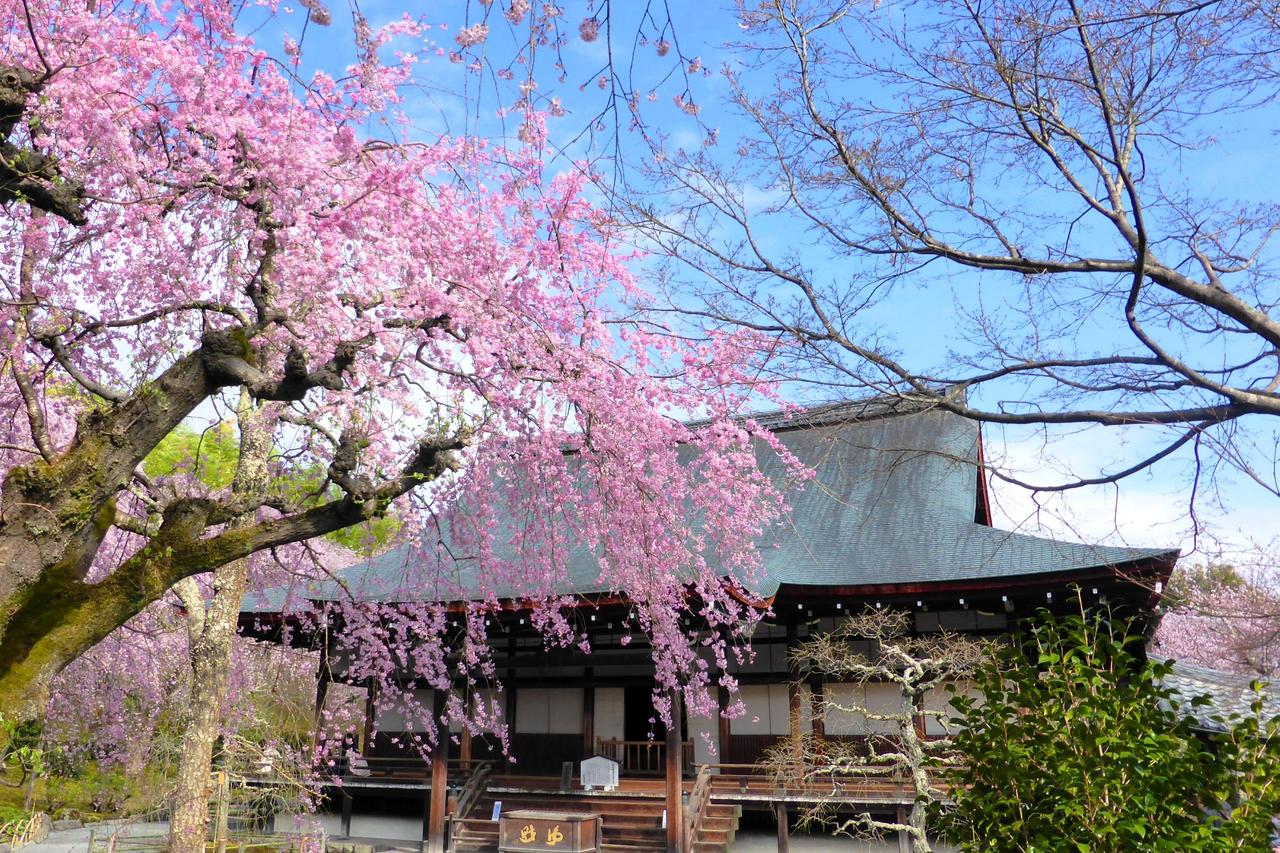
Tenryu-ji Temple (Flickr)
Since its founding, Tenryu-ji has endured difficult periods due to destructive fires. A total of eight major fires occurred in 1358, 1367, 1373, 1380, 1447, 1468, 1815, and 1864. The fires of 1445 and 1468 were especially severe, but the temple was rebuilt in 1585 with financial support from Shogun Toyotomi Hideyoshi.【2】
The great fire of 1815 was followed by another major fire in 1864 during the conflicts at the end of the feudal era, which inflicted further damage on the temple.【3】 Following this destruction, in 1877 the Meiji government seized most of the temple’s approximately four square kilometers of arable land in the Sagano region, reducing its landholdings to less than one-tenth of their former size.
Despite all these events, reconstruction efforts continued at the end of the 19th century. The only structure to survive the 1864 fire, the Zendo (Zen meditation hall), was relocated to serve as the new Hatto (lecture hall) and Butsuden (Buddha hall). The Hojo (abbot’s quarters) and Kuri (monastic living quarters) were completed in 1900, and the reconstruction of the Kohojo (reception hall) was finished in 1924. The consecration of the Tahoden in 1934, along with the construction of the Shoun-kaku and Kan'u-tei tea houses, gave Tenryu-ji its present appearance.【4】
The main buildings of the Tenryu-ji complex exemplify the essential elements of Zen monastery architecture. These include:
Originally the place where Muso Soseki delivered sermons and taught the Buddha’s Dharma to monks, the Hatto is now used for ceremonial purposes. The original Hatto was destroyed in the 1864 fire and was rebuilt after the Meiji Restoration of 1868 by relocating the large Zendo (Meditation Hall) to this site. A large plaque above the entrance, inscribed with “Senbutsujo,” indicates its former function. In 1899, the ceiling was decorated with a cloud dragon painting by artist Suzuki Shonen; this was replaced in 1997 with a new cloud dragon painting by renowned nihonga artist Kayama Matazo, commemorating the 650th anniversary of Muso Soseki’s death. Inside are statues of Shakyamuni Buddha and his disciples Manjusri and Samantabhadra, as well as statues and memorial plaques of the founding abbot Muso Soseki and his patron Ashikaga Takauji.【5】
One of the seven main halls of a traditional Zen monastery, this structure was built in 1899 and renovated in 2013. It houses the temple’s main kitchen and administrative offices. Known for its half-timbered, white-plastered facade and high, gently sloping triangular roof, it is considered one of the temple’s iconic symbols. In the entrance hall, a large portrait of Bodhidharma, the Indian monk who brought Zen teachings to China, painted by the late abbot Hirata Seiko, is displayed. This painting, in a style unique to Tenryu-ji, is regarded as the temple’s “face.”【6】
Comprising two main sections: the Daihojo (Great Hojo) and the Kohojo (Small Hojo). The Daihojo was completed in 1899 and the Kohojo in 1924, both used for ceremonies and major events.【7】 The Daihojo features wide verandas on its front and rear, facing the Sogen Pond. Inside is a statue of Shakyamuni Buddha dating from the late Heian period, predating the temple itself and surviving all eight major fires unscathed; it is designated as an Important Cultural Property. Large cloud dragon paintings by artist Wakasa Butsugai adorn the sliding doors of the Daihojo. The Kohojo serves as a reception and meeting space for guests.【8】
Located at the end of a covered corridor that begins at the northwest corner of the Kohojo and runs alongside the tea houses up the slope. The building consists of a place of worship, a shrine housing a statue of Emperor Go-Daigo, and an antechamber. The current structure was built in 1934 by Abbot Seki Seisetsu on the site where Emperor Go-Daigo lived as a child with his grandfather, Emperor Kameyama. It is thought to resemble the design of the Shishinden in the Southern Court of Yoshino.【9】
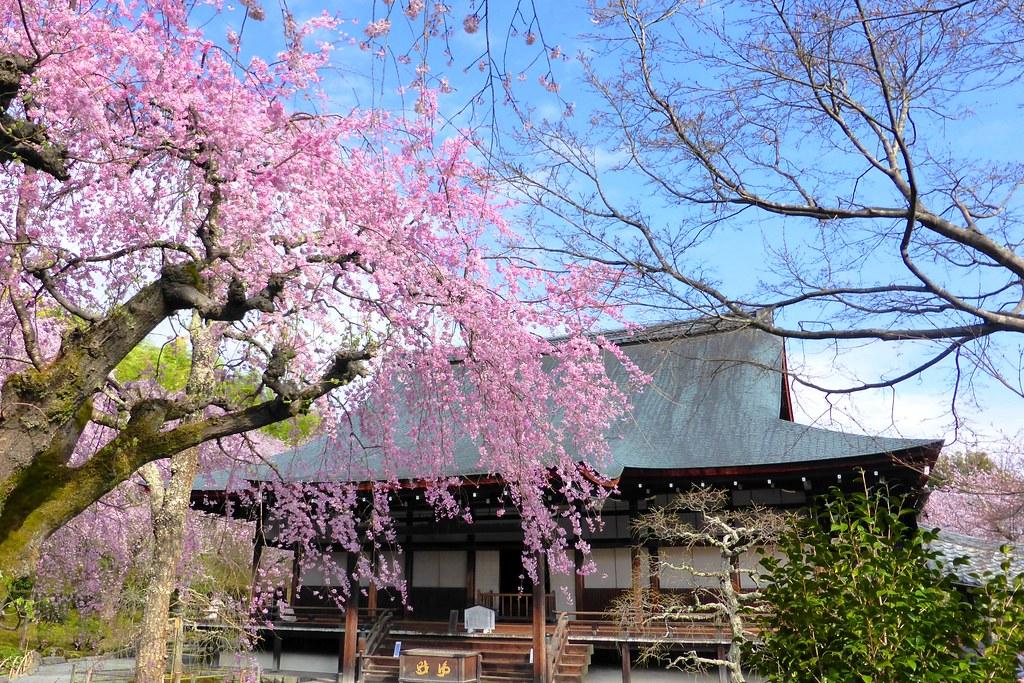
Tenryu-ji, Tahoden (Flickr)
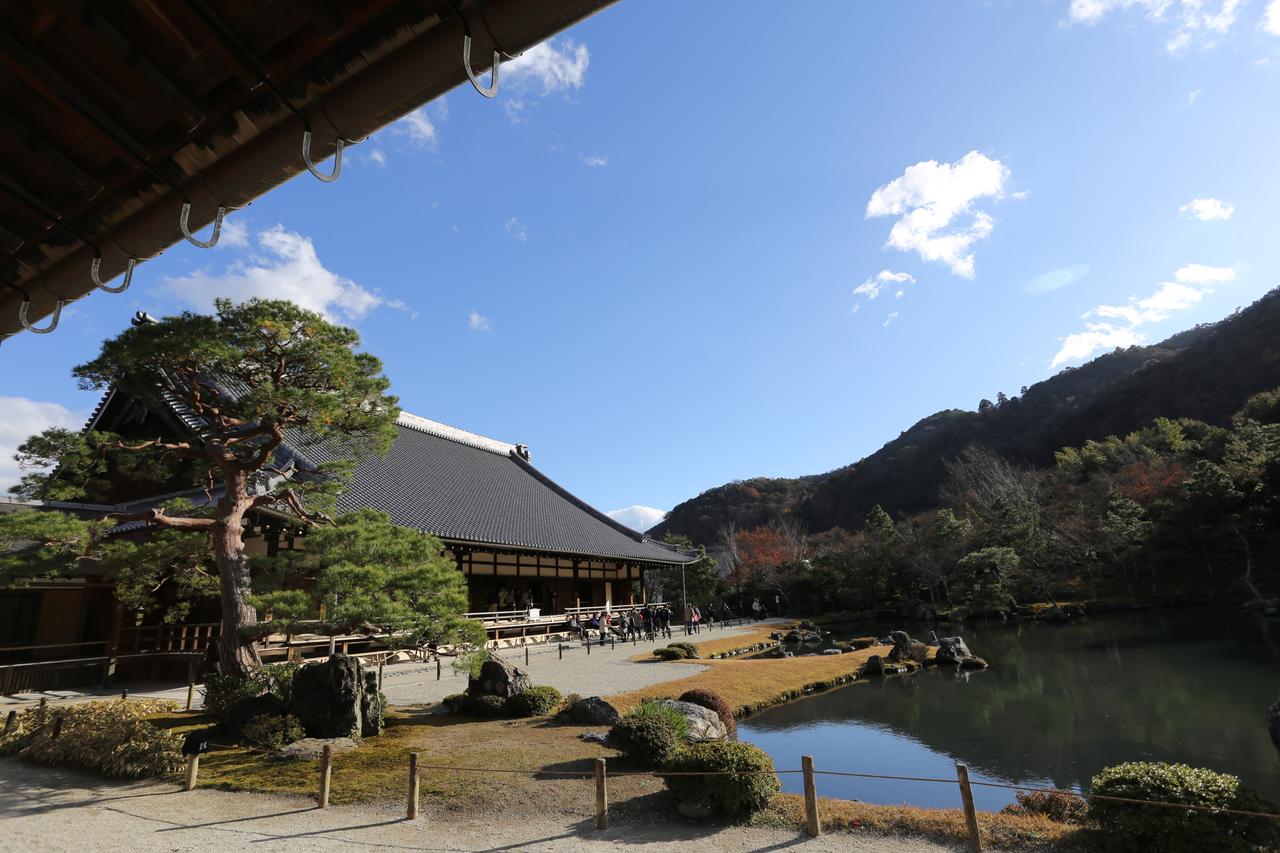
Designed by Muso Soseki approximately seven hundred years ago and preserving its original layout, the Sogenchi Garden was the first site in Japan to be designated by the Japanese government as a Special Historic and Scenic Site (Shiseki, Tokubetsu Meisho).【10】 It is a strolling pond garden (chisen kaiyu shiki teien), featuring a flat path encircling a picturesque pond, allowing visitors to experience the landscape from multiple perspectives.
Viewed from the center of the Hojo’s veranda, the arrangement of large upright stones symbolizes the Dragon Gate Waterfall from Chinese legend, where carp that climb the waterfall are said to transform into dragons—a metaphor for enlightenment in Zen.【11】 The placement of the carp stone at the edge of the waterfall in Sogenchi differs from traditional Zen gardens, where such stones typically represent carp already transformed into dragons. The pond derives its name from a stone tablet inscribed with “Sogen itteki” that Muso Soseki discovered while cleaning.
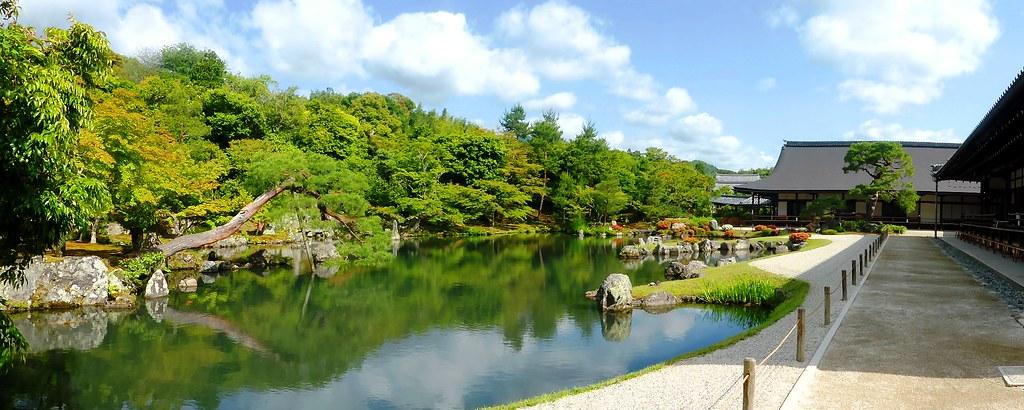
Tenryu-ji, Sogenchi Teien (Flickr)
Located at one of the ten special scenic viewpoints designated by Muso Soseki, this pavilion houses the temple’s Zen vegetarian restaurant, Shigetsu. The current structure was completed in 2000.
A complex of buildings located east of Ryumontei. It served as the temple’s training monastery until the early 1990s and is now used for lectures, meetings, and workshops. Monthly public zazenkai (Zen meditation gatherings) are held here.
Teahouses located on the right side of the path leading from the Kohojo to the Tahoden. Shoun-kaku is a replica of Zangetsu-tei, the central teahouse of the Omotesenke tea family, and features a twelve-tatami mat tea room with two recessed alcoves. Kan'u-tei is a five-and-a-half-tatami mat tea room. Both teahouses were constructed in 1934 to commemorate the reconstruction of the Tahoden.
Located north of the Tahoden along the path to the North Gate, this garden was established in 1983 with the construction of the North Gate. It features flowering trees, shrubs, and grasses. The garden path provides visitors with a route from the temple to nearby tourist sites such as the Sagano bamboo forest and the Okochi Sanso Villa and Jojakko-ji.
Closed to the public, the Sodo is a training hall offering a communal lifestyle of study and meditation for those seeking to become Zen monks or masters.
Built in 2000 as part of the commemorative projects for the 650th anniversary of Muso’s death, it houses the Tenryu-ji Historical Institute, which holds an extensive collection of works on philosophy and religion.
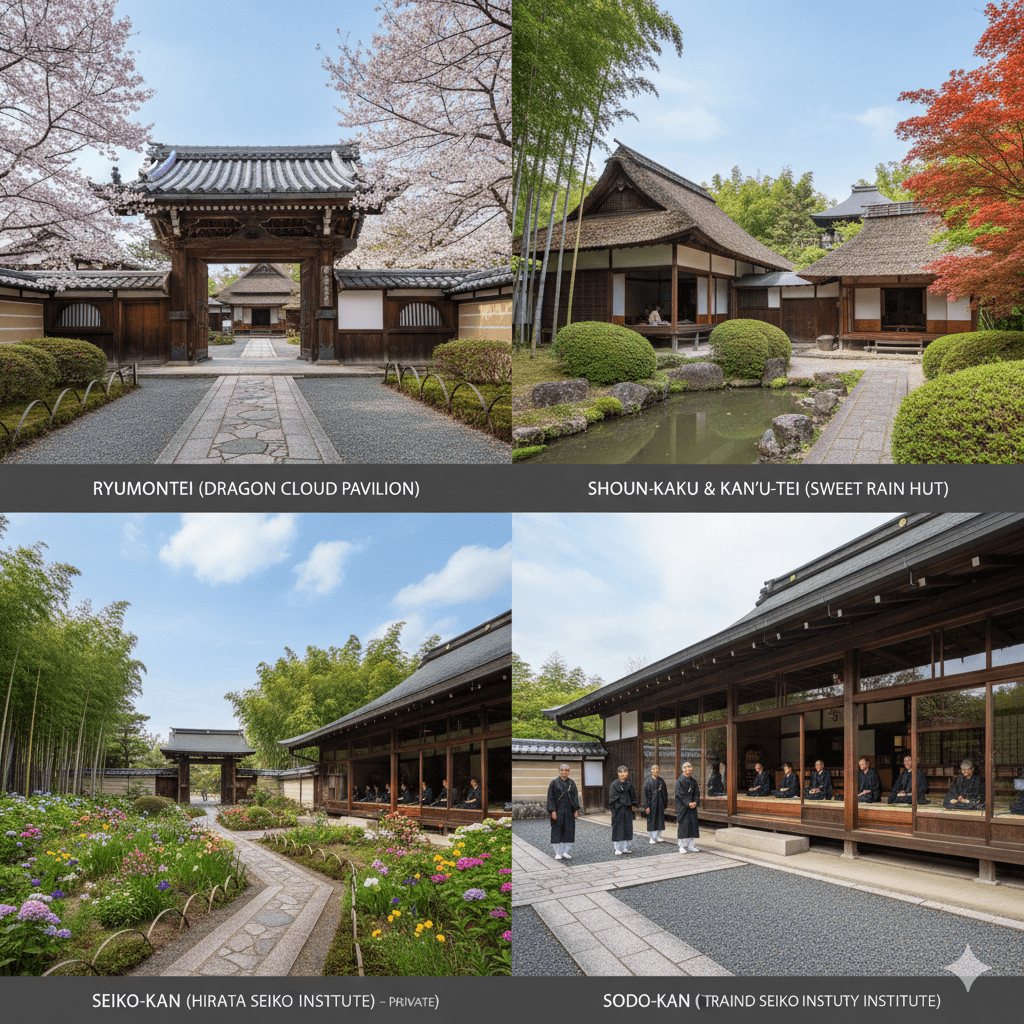
Visual Depicting Ryumontei, Yu'un-an, Shoun-kaku, and Sodo Structures (Generated by Artificial Intelligence.)
Tenryu-ji is open to the public year-round. Visiting hours are from 08:30 to 17:00, with the last entry at 16:50. Admission fees are set separately for the garden only and for the garden and buildings combined; for high school students and above, the garden-only fee is 500 yen. An additional 300 yen is required for access to the buildings. Buildings may occasionally be closed without notice due to special ceremonies. Access to the special cloud dragon painting in the Hatto requires a separate fee of 500 yen and is open only on Saturdays, Sundays, public holidays, and during special spring and autumn periods. Tickets can be purchased at three locations: the garden entrance, the main building entrance, and the North Gate entrance.【12】
Various regular and annual events are held throughout the year at the temple.
Regular Events: On the second Sunday of every month except February, July, and August, a free and reservation-free public Tenryu-ji Zazen-kai (Zen meditation session) is held at Yu'un-an from 09:00 to 10:00. Immediately following this, a Ryumon-kai (Dragon Gate Seminar) takes place from 10:00 to 11:00. These sessions can be scheduled in advance for a fee of 1,800 yen.
Annual Events: Important religious and commemorative days are observed annually. These include tea, Shuku-shin, and Daihannya ceremonies on January 1; the Setsubun ceremony (end of the lunar year) on February 3; the Hanamatsuri (Buddha’s birthday celebration) on April 8; a commemorative ceremony for Emperor Go-Daigo and the Hachiman Festival Hojoe (release of captive animals) on September 15; and the Jodo’e ceremony (celebration of Buddha’s enlightenment) on December 8.
Gordon Cheung. "Tenryu-ji." Flickr. Accessed December 1, 2025.https://www.flickr.com/photos/gordoncheungkw/27288406909/in/photostream/
Tenryū-ji. "Activities and Events." Tenryuji.com. Accessed December 1, 2025.https://www.tenryuji.com/en/event/
Tenryū-ji. "Admission / Access." Tenryuji.com. Accessed December 1, 2025.https://www.tenryuji.com/en/visit/
Tenryū-ji. “About Tenryū-ji.” Tenryuji.com. Accessed December 1, 2025.https://www.tenryuji.com/en/about/index.html
Tenryū-ji. “What to See at Tenryū-ji (Precincts).” *Tenryuji.com*. Accessed December 1, 2025.https://www.tenryuji.com/en/precincts/.
Tetsuhiro Terada. "Tenryu-ji, Sogenchi Teien." Flickr. Accessed December 1, 2025.https://www.flickr.com/photos/ttshr1970/34951234672/
Tetsuhiro Terada. "Tenryu-ji, Tahoden." Flickr. Accessed December 1, 2025.https://www.flickr.com/photos/ttshr1970/25604739884/in/photostream/
[1]
Tenryū-ji, “ About Tenryū-ji.” Tenryuji.com, erişim 1 Aralık 2025,
[2]
Tenryū-ji, “ About Tenryū-ji.” Tenryuji.com, erişim 1 Aralık 2025, https://www.tenryuji.com/en/about/index.html
[3]
Tenryū-ji, “ About Tenryū-ji.” Tenryuji.com, erişim 1 Aralık 2025,
[4]
Tenryū-ji, “ About Tenryū-ji.” Tenryuji.com, erişim 1 Aralık 2025,
[5]
Tenryū-ji, “What to See at Tenryū-ji (Precincts),” Tenryuji.com, erişim 1 Aralık 2025, https://www.tenryuji.com/en/precincts/.
[6]
Tenryū-ji, “What to See at Tenryū-ji (Precincts),” Tenryuji.com, erişim 1 Aralık 2025,
[7]
Tenryū-ji, “What to See at Tenryū-ji (Precincts),” Tenryuji.com, erişim 1 Aralık 2025,
[8]
Tenryū-ji, “What to See at Tenryū-ji (Precincts),” Tenryuji.com, erişim 1 Aralık 2025,
[9]
Tenryū-ji, “What to See at Tenryū-ji (Precincts),” Tenryuji.com, erişim 1 Aralık 2025,
[10]
Tenryū-ji, “What to See at Tenryū-ji (Precincts),” Tenryuji.com, erişim 1 Aralık 2025,
[11]
Tenryū-ji, “What to See at Tenryū-ji (Precincts),” Tenryuji.com, erişim 1 Aralık 2025,
[12]
Tenryū-ji, “ Admission / Access,” Tenryuji.com, erişim 1 Aralık 2025. https://www.tenryuji.com/en/visit/

Full Name | Tenryu-ji (天龍寺) | ||||||||
|---|---|---|---|---|---|---|---|---|---|
Location | Kyoto Japan Arashiyama | ||||||||
Foundation Year | 1339 | ||||||||
Founding Shogun (Hamisi) | Ashikaga Takauji | ||||||||
Founding High Priest | Muso Soseki (1275-1351) | ||||||||
Gozan Ranking | First among Kyoto's Five Great Zen Temples (Kyoto Gozan) | ||||||||
Important Architecture | Hatto (Dharma Hall), Kuri (Temple Living Area), Hojo (Abbot's Quarters: Daihojo and Kohojo), Tahoden | ||||||||
Foundation and History
Fires and Reconstruction
Key Structures and Architecture
Hatto (Dharma Hall)
Kuri (Monastic Living Quarters)
Hojo (Abbot’s Quarters)
Tahoden (Hall of Many Treasures)
Sogenchi Teien (Sogen Pond Garden)
Ryumontei (Dragon Gate Pavilion)
Yu'un-an (Floating Cloud Hermitage)
Shoun-kaku (Lucky Cloud Pavilion) and Kan'u-tei (Sweet Rain Pavilion)
Hyakka'en (Garden of One Hundred Flowers)
Sodo (Training Monastery)
Seiko-kan (Hirata Seiko Institute)
Visit Information and Events
Events