This article was automatically translated from the original Turkish version.
+1 More
Name(s) | 47 Ursae Majoris b | ||||||||
|---|---|---|---|---|---|---|---|---|---|
Official Name(s) | Taphao Thong | ||||||||
Type(s) | Giant gas exoplanet | ||||||||
Constellation | Ursa Major | ||||||||
Distance | 46 light years | ||||||||
Year of Discovery | 1996 | ||||||||
Discovery Location | California Lick Observatory | ||||||||
Naming | IAU NameExoWorlds (2015) | ||||||||
Minimum Mass | 2.53 M♃ | ||||||||
Structure(s) | Hydrogen-helium composition | ||||||||
Orbital Period | 1.078 days (~2.95 years) | ||||||||
Distance from Star | 2.10 AU | ||||||||
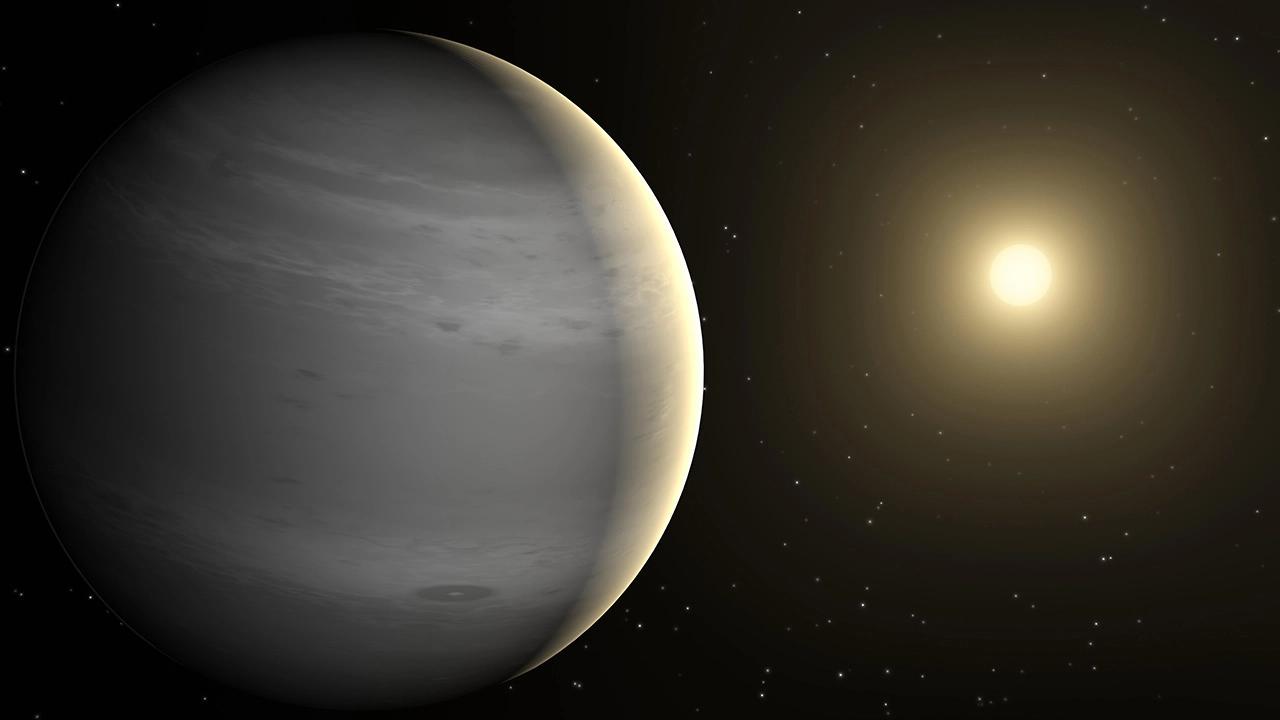
Taphao Thong (47 Ursae Majoris b), discovered in 1996 by Geoffrey Marcy and R. Paul Butler. The discovery was made using the radial velocity method at the Lick Observatory in California. This technique detects periodic oscillations in the host star caused by the gravitational influence of an orbiting planet, observed as Doppler shifts in the star’s spectrum.
Unlike the “hot Jupiters” commonly found at the time of its discovery, 47 Ursae Majoris b orbits its star at a much greater distance, making it one of the first known exoplanets with such a configuration. Because of this, it is regarded as one of the earliest significant examples suggesting that some planetary systems beyond the Solar System may have architectural similarities to our own.
In December 2015, as part of the NameExoWorlds project conducted by the International Astronomical Union (IAU), official names were assigned to the planet and its host star. Following a proposal by the Thai Astronomical Society, the planet was named Taphao Thong, after one of two siblings in Thai folk tales, and the star was named Chalawan, after a mythical crocodile king.
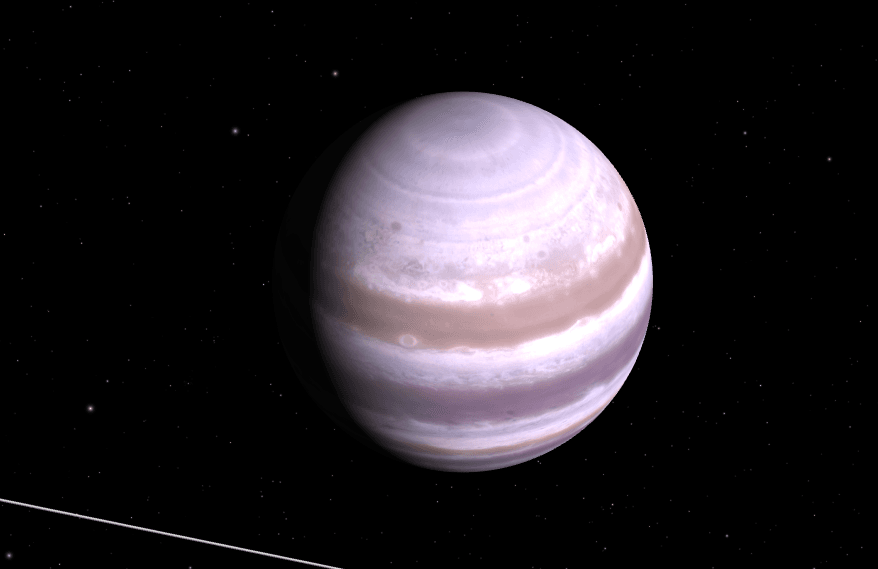
47 Ursae Majoris b (NASA)
47 Ursae Majoris is a yellow dwarf star of spectral class G1V, closely resembling the Sun. Its mass has been measured at approximately 1.03 times that of the Sun (1.03 M☉), and its radius at about 1.13 times (1.13 R☉). Its surface temperature is approximately 5,855 Kelvin, very close to the Sun’s temperature of 5,778 K.
The star’s metallicity ([Fe/H]) is determined to be 0.00 ± 0.04 dex, indicating that its chemical composition is nearly identical to that of the Sun. Its age is estimated at about 6 billion years, slightly older than the Sun. The similarity of 47 Ursae Majoris to the Sun provides an important comparative framework for understanding the structure and habitability potential of its planetary system.
Because 47 Ursae Majoris b was discovered via the radial velocity method, only its minimum mass can be directly determined. This value is at least 2.53 times the mass of Jupiter. This places the planet firmly in the category of a gas giant significantly more massive than Jupiter, the largest planet in the Solar System. Since the inclination of its orbital plane is not precisely known, its true mass is likely higher than this minimum value.
As the planet does not transit its host star, its radius, atmospheric composition, and internal structure cannot be directly observed. However, based on its mass, it is assumed to have a dense gaseous envelope composed primarily of hydrogen and helium, similar to Jupiter, and to lack a solid surface.
47 Ursae Majoris b completes one full orbit around its host star in approximately 1,078 days (about 2.95 years). Its average distance from the star, or semi-major axis, is 2.10 astronomical units (AU). This distance corresponds to the region between the orbits of Mars and Jupiter in the Solar System.
The eccentricity of the planet’s orbit is very low, indicating that its path is nearly circular. This feature shows a significant similarity to the orbits of the giant planets in the Solar System and suggests that the 47 Ursae Majoris system may be dynamically stable.
47 Ursae Majoris is a system known to host at least two, and possibly three, planets:
This multi-planet architecture, with increasing orbital periods at greater distances from the star, mirrors the structure of the Solar System. This characteristic makes the system an important example for studying its evolutionary history and dynamical stability.
47 Ursae Majoris b, being a gas giant, cannot support life as it is conventionally understood. However, its orbital position opens up intriguing scenarios regarding the system’s habitability potential. The habitable zone around a Sun-like star is estimated to lie between approximately 1.1 and 2.1 astronomical units (AU). 47 Ursae Majoris b’s orbit lies just beyond this outer boundary, at 2.1 AU.
This positioning raises the possibility that large, rocky moons (exomoons) orbiting the planet could harbor liquid water on their surfaces. If such a moon, with a mass comparable to Earth or Mars and a stable orbit, exists around 47 Ursae Majoris b, it could receive sufficient energy from the star and benefit from the planet’s strong magnetic field, which would shield it from stellar winds.
The existence of such exomoons remains purely theoretical. Nevertheless, gas giants like 47 Ursae Majoris b, located near the habitable zone, are considered prime targets for future observational studies aimed at testing these hypotheses.
Butler, R. Paul, and Geoffrey W. Marcy. "A Planet Orbiting 47 Ursae Majoris." *The Astrophysical Journal Letters* 464, no. 2 (June 1996): L153–L156. Accessed July 20, 2025. https://iopscience.iop.org/article/10.1086/310102.
Fischer, Debra A., et al. "A Second Planet Orbiting 47 Ursae Majoris." *The Astrophysical Journal* 564, no. 2 (January 2002): 1028–1034. Accessed July 20, 2025. https://iopscience.iop.org/article/10.1086/324336.
Laughlin, Gregory, et al. "Dynamical Analysis of the 47 Ursae Majoris Planetary System." *The Astronomical Journal* 134, no. 3 (September 2007): 1276–1284. Accessed July 20, 2025. https://iopscience.iop.org/article/10.1086/342746.
Lick Observatory. "Welcome to Lick Observatory." University of California Observatories. Accessed July 20, 2025. https://www.lickobservatory.org/.
NASA NASA. "47 Ursae Majoris b." NASA Science: Exoplanet Catalog. Accessed July 20, 2025. https://science.nasa.gov/exoplanet-catalog/47-ursae-majoris-b/.

Name(s) | 47 Ursae Majoris b | ||||||||
|---|---|---|---|---|---|---|---|---|---|
Official Name(s) | Taphao Thong | ||||||||
Type(s) | Giant gas exoplanet | ||||||||
Constellation | Ursa Major | ||||||||
Distance | 46 light years | ||||||||
Year of Discovery | 1996 | ||||||||
Discovery Location | California Lick Observatory | ||||||||
Naming | IAU NameExoWorlds (2015) | ||||||||
Minimum Mass | 2.53 M♃ | ||||||||
Structure(s) | Hydrogen-helium composition | ||||||||
Orbital Period | 1.078 days (~2.95 years) | ||||||||
Distance from Star | 2.10 AU | ||||||||
No Discussion Added Yet
Start discussion for "Taphao Thong (47 Ursae Majoris b)" article
Host Star: 47 Ursae Majoris (Chalawan)
Physical Properties
Orbital Characteristics
The 47 Ursae Majoris Planetary System
Habitability Potential of the System