This article was automatically translated from the original Turkish version.
Team(s) | Artiodactyla | ||||||||
|---|---|---|---|---|---|---|---|---|---|
Conservation Status | IUCN Red List: Vulnerable | ||||||||
Specie(s) | Budorcas taxicolor | ||||||||
Genus | Budorcas | ||||||||
Subtribe | Caprinae | ||||||||
Tribe | Bovidae | ||||||||
Class | Mammalia | ||||||||
Geographic Distribution | Myanmar India Bhutan Tibet Eastern Himalayas | ||||||||
Takin is a large-bodied herbivorous mammal adapted to high-altitude mountainous regions and belongs to the subfamily Caprinae within the family Bovidae. Four subspecies have been taxonomically defined: the golden takin, Sichuan takin, Mishmi takin, and Bhutan takin. Although mitochondrial genome analyses suggest a closer relationship between the takin and goats, whole-genome phylogenetic studies indicate that this species is morphologically, ecologically, and karyotypically more closely related to the musk ox and should be classified within the tribe Ovibovini.
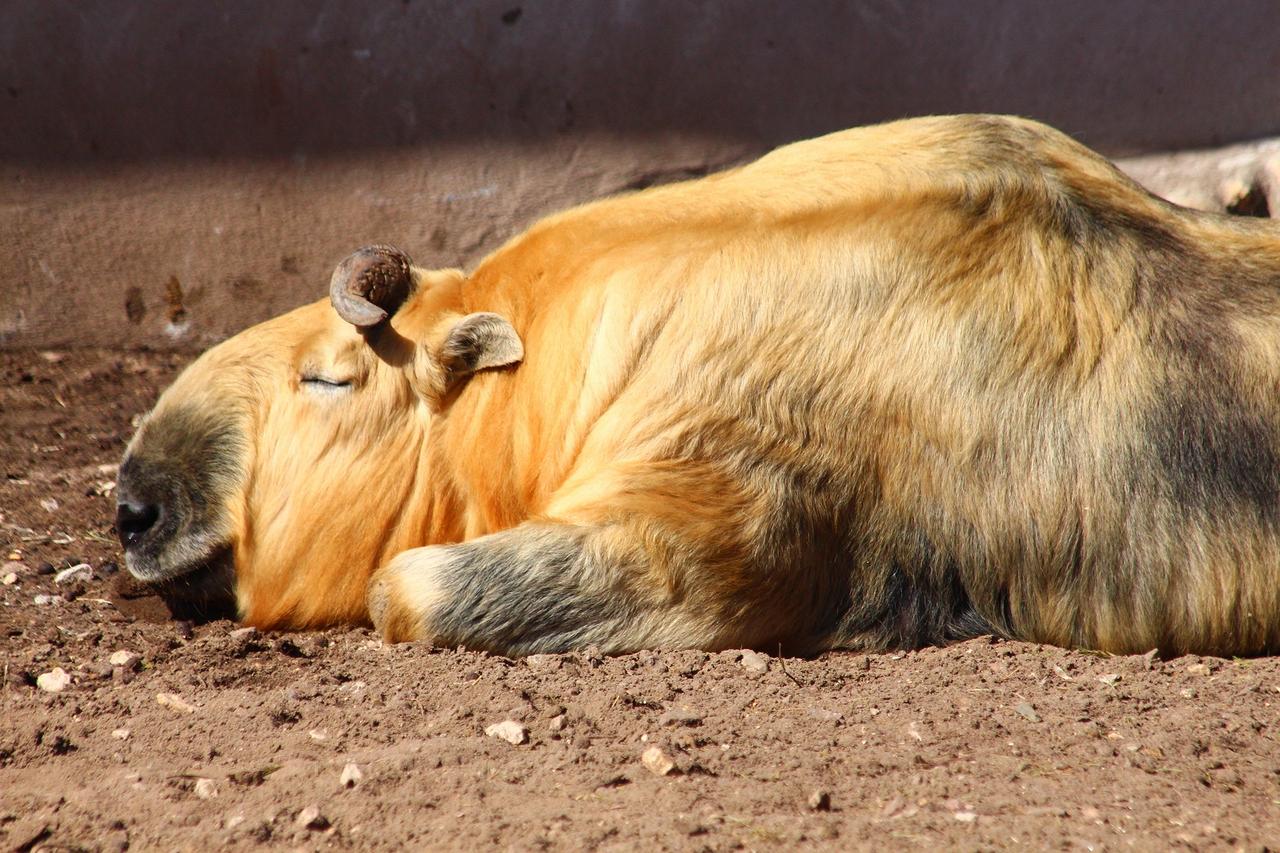
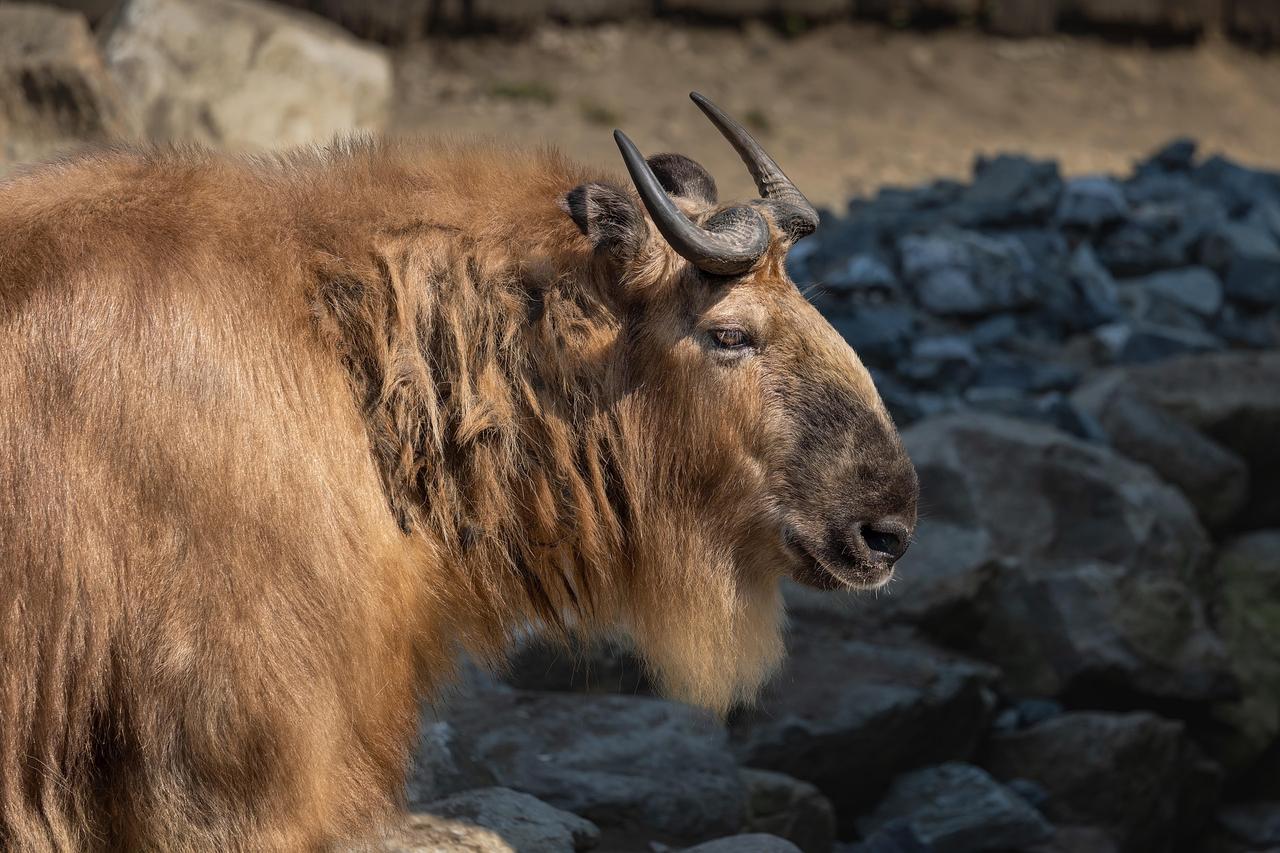
Takin (Pixabay)
The takin is one of Asia’s largest ruminants, with a live weight ranging from 150 to 400 kg and a body length reaching up to 220 cm.【1】 Its physical appearance has been described as a “cattle antelope” or “gnu goat.” It possesses a arched mouth structure, a broad and naked nose, and transversely ridged horns that curve outward and backward from the center, present in both sexes. Coat color varies from whitish-yellow to golden-yellow and reddish-brown depending on the subspecies, with a dark stripe running along the dorsal midline. Its short, powerful legs end in highly developed, spade-shaped, cloven hooves that enable agile movement across rocky terrain.
The geographic range of the species encompasses a broad area including the Eastern Himalayas, Tibet, Bhutan, India, Myanmar, and southern and central China. Habitat use varies between 1000 and 4250 meters in elevation, spanning a gradient from steep forested areas to alpine shrublands and meadows. Studies on the Bhutan takin have revealed that coniferous forests dominated by juniper, nyin, and fir, as well as willow shrublands and graminoid-forb dominated alpine meadows, are utilized as summer ranges. During winter months, the species is observed to prefer mid-elevation bamboo forests both as a food source and thermal refuge.
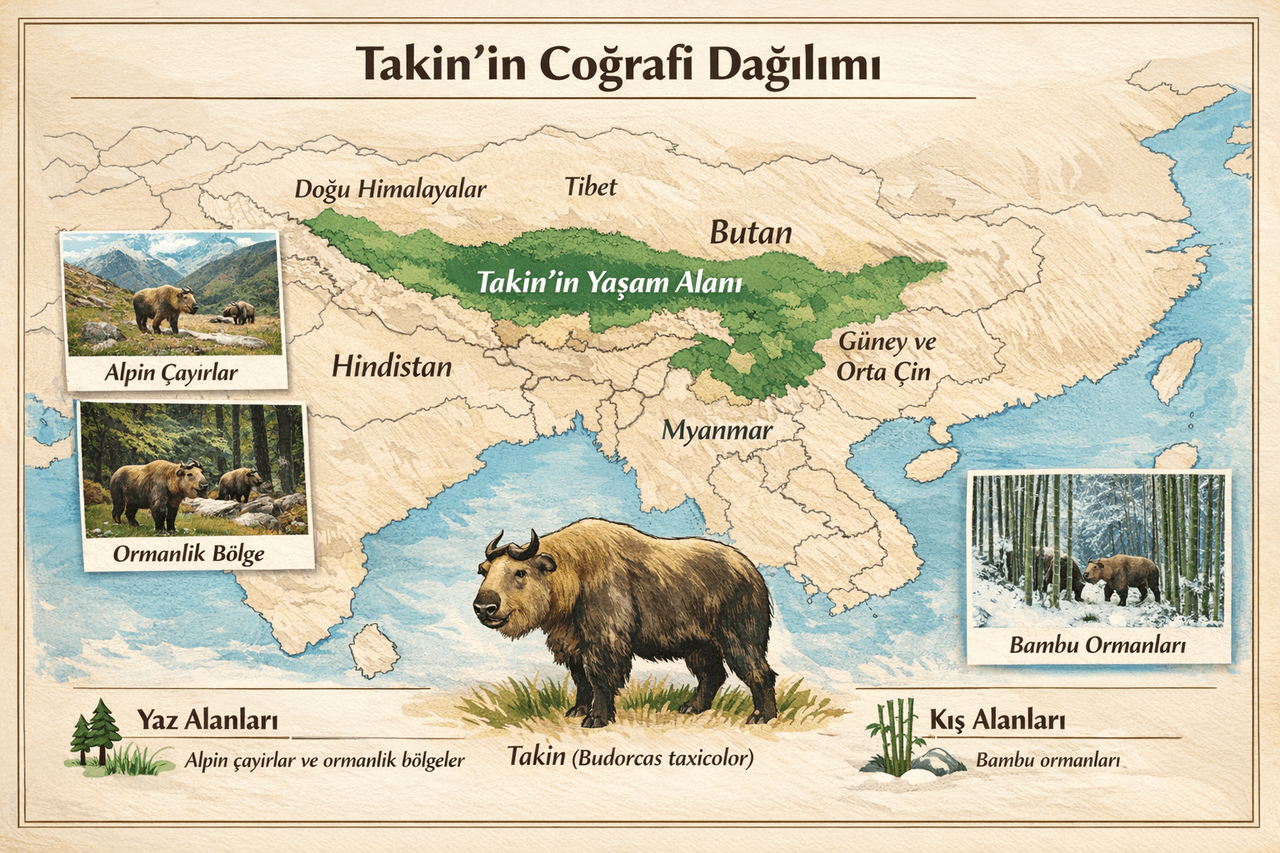
Budorcas Taxicolor Geographic Distribution (Image Generated with AI Support)
The takin is a generalist herbivore that primarily feeds on tree and shrub leaves. Although more than 68 plant species have been identified in its diet, the majority consists of a few dominant species such as willow, Potentilla fruticosa, and Ribes orientale. During winter, dietary preference shifts to young shoots and evergreen leaves. Metagenomic analyses of the gut microbiota show that over 90% of the digestive system is dominated by the phyla Firmicutes and Bacteroidetes, a configuration well adapted to fermenting high-fiber plant material. The microbial community structure varies by season and sex, with increased species richness observed in spring, likely enhancing the takin’s resistance to environmental stressors.
Takins exhibit vertical seasonal migrations to adapt to plant phenology and solar radiation patterns. Animals typically ascend from low-elevation valleys to high alpine meadows in spring and return to lower forested areas by late summer. During this migratory cycle, the species displays a bimodal activity pattern, with peak activity occurring at dawn and dusk, and minimal activity during nighttime. Social structure shifts seasonally, with large herds of up to 300 individuals in summer reducing to smaller groups of around 20 in winter, while adult males are generally observed to be solitary. When threatened, takins emit a cough-like alarm call to alert herd members and prefer to conceal themselves beneath dense vegetation.
Reproductive activity typically occurs in July and August. After a gestation period of approximately 210 to 240 days, females give birth to a single calf, usually in March, at wintering grounds. Calves attain the mobility necessary to follow their mothers within three days of birth and begin transitioning to solid food within one to two months. Sexual maturity is reached at approximately 30 months of age.【2】
Takins are listed as "Vulnerable" on the IUCN Red List, with their survival threatened by overhunting, habitat loss, and deforestation. Genetic studies have revealed that the species, particularly populations of the golden takin, exhibit extremely low nucleotide diversity and high inbreeding coefficients. This indicates that the species faces severe inbreeding depression and a genetic bottleneck, with effective population size having declined sharply over the past 10,000 years. The species is legally protected in Bhutan and China and requires long-term monitoring programs and habitat conservation strategies to ensure its survival.
Chen, J., H. Zhang, X. Wu, and others. "Characterization of the gut microbiota of the Golden takin (*Budorcas taxicolor bedfordi*)." *AMB Express* 7, no. 81 (2017). Accessed April 13, 2026. https://doi.org/10.1186/s13568-017-0374-5
Guan, T. P., B. M. Ge, W. J. McShea, G. B. Shen, J. C. Li, and P. J. Xia. "Seasonal migration by a large forest ungulate: a study on takin (*Budorcas taxicolor*) in Sichuan Province, China." *European Journal of Wildlife Research* 59, no. 1 (2013): 81–91. Accessed April 13, 2026. https://doi.org/10.1007/s10344-012-0650-2
Li, A., Q. Yang, R. Li, X. Dai, K. Cai, Y. Lei, K. Jia, Y. Jiang, and L. Zan. "Chromosome-level genome assembly for takin (*Budorcas taxicolor*) provides insights into its taxonomic status and genetic diversity." *Molecular Ecology* 32, no. 6 (2023): 1323–34. Accessed April 13, 2026. https://doi.org/10.1111/mec.16483
Li, J., Y. Xue, Y. Zhang, W. Dong, G. Shan, R. Sun, C. Hacker, B. Wu, and D. Li. "Spatial and temporal activity patterns of Golden takin (Budorcas taxicolor bedfordi) recorded by camera trapping." PeerJ 8 (2020): e10353. Accessed April 13, 2026. https://doi.org/10.7717/peerj.10353
Marceau, J. "Budorcas taxicolor" Animal Diversity Web. 2000. Accessed April 13, 2026. https://animaldiversity.org/accounts/Budorcas_taxicolor/
Pixabay. "almak hayvan sığır memeli." Accessed April 13, 2026. https://pixabay.com/tr/photos/almak-hayvan-s%c4%b1%c4%9f%c4%b1r-memeli-9194654/
Pixabay. "almak sığır güderi gnu keçisi." Accessed April 13, 2026. https://pixabay.com/tr/photos/almak-s%c4%b1%c4%9f%c4%b1r-g%c3%bcderi-gnu-ke%c3%a7isi-374458/
Pixabay. "takin budorcas taxicolor tırtıklı." Pixabay. Accessed April 13, 2026. https://pixabay.com/tr/photos/takin-budorcas-taxicolor-t%c4%b1rt%c4%b1kl%c4%b1-5331280/
Wangchuk, T. R., P. Wegge, and T. Sangay. "Habitat and Diet of Bhutan Takin *Budorcas taxicolor whitei* During Summer in Jigme Dorji National Park, Bhutan." *Journal of Natural History* 50, no. 11–12 (2016): 759–770. Accessed June 7, 2026. https://doi.org/10.1080/00222933.2015.1079658
[1]
T. R. Wangchuk, P. Wegge ve T. Sangay, "Habitat and Diet of Bhutan Takin Budorcas taxicolor whitei During Summer in Jigme Dorji National Park, Bhutan," Journal of Natural History 50, no. 11–12 (2016): 762, accessed 7 June 2026, https://doi.org/10.1080/00222933.2015.1079658
[2]
J. Marceau, "Budorcas taxicolor," Animal Diversity Web, 2000, accessed 13 April 2026, https://animaldiversity.org/accounts/Budorcas_taxicolor/

Team(s) | Artiodactyla | ||||||||
|---|---|---|---|---|---|---|---|---|---|
Conservation Status | IUCN Red List: Vulnerable | ||||||||
Specie(s) | Budorcas taxicolor | ||||||||
Genus | Budorcas | ||||||||
Subtribe | Caprinae | ||||||||
Tribe | Bovidae | ||||||||
Class | Mammalia | ||||||||
Geographic Distribution | Myanmar India Bhutan Tibet Eastern Himalayas | ||||||||
No Discussion Added Yet
Start discussion for "Takin (Budorcas taxicolor)" article
Morphological Structure and Physical Characteristics
Habitat Distribution and Ecological Preferences
Feeding Ecology and Digestive Physiology
Seasonal Migration and Behavioral Patterns
Reproductive Biology and Population Dynamics
Conservation Status and Genetic Threats