


This article was automatically translated from the original Turkish version.
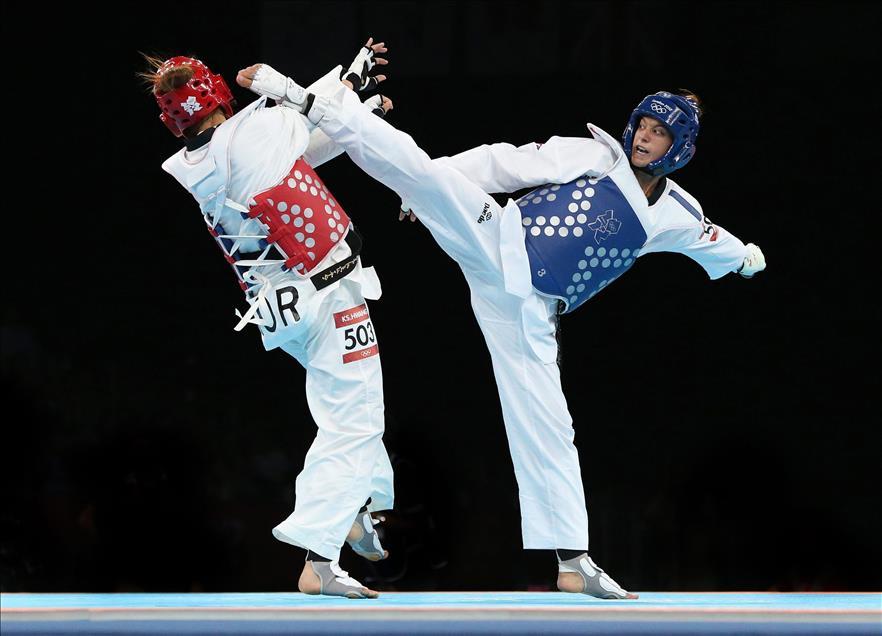
Taekwondo
Sport Discipline | Taekwondo | ||||||||
|---|---|---|---|---|---|---|---|---|---|
Competition Sport Formation | 1905 | ||||||||
Origin | Korea | ||||||||
Taekwondo is a martial art originating from Korea that combines hand and foot techniques to cultivate moral values. The term "Tae" means foot, "Kwon" refers to hand or fist, and "Do" signifies the practice and philosophy of the art. Taekwondo aims not only to develop athletes' physical skills but also to support their mental and moral growth.
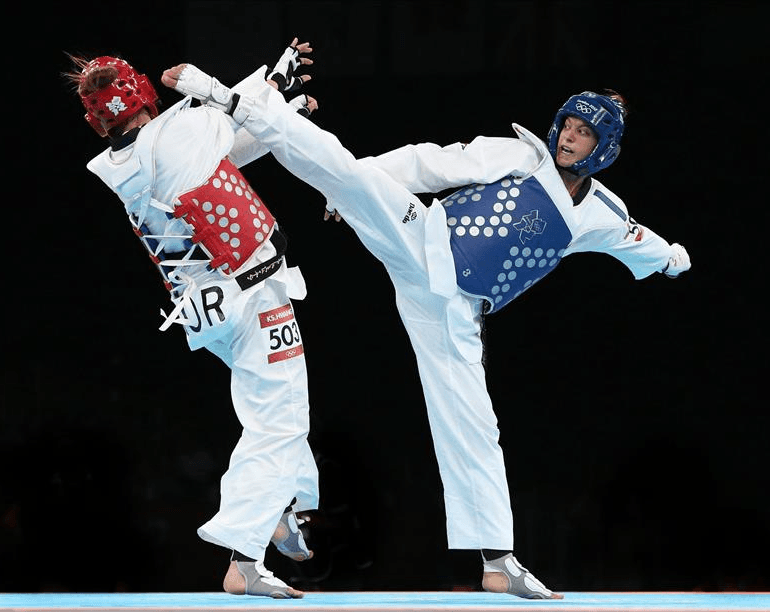
2012 London Olympics, Nur Tatar, Source: Anadolu Ajansı
The foundations of Taekwondo are rooted in ancient Korean warrior techniques developed for self-defense. It evolved from older Korean defense systems such as like "Taegyon" and "Kwonpop". During the 600s when the Korean Peninsula was divided into three kingdoms, the young warriors of the Silla Kingdom refined these techniques and unified them under the name Taek-Kyon. In the 20th century, Taekwondo became an international sport and the International Taekwondo Federation was established in 1966.
Taekwondo was introduced to Türkiye in the 1960s and began its activities in 1968 under the umbrella of the Judo Federation. In 1976, Türkiye participated in the European Championship and finished second as a team. In 1981, the Taekwondo Federation was established as an independent federation.
The fundamental techniques of Taekwondo consist of kicks, punches, blocks, strikes, and stances. Kicks, known as "Chagi", are categorized into types such as ap chagi (front kick), dollyo chagi (roundhouse kick), yop chagi (side kick), and dwi chagi (back kick). "Jirugi" encompasses punching techniques including ap jirugi (front punch), dubeon jirugi (double punch), and dwitbal jirugi (reverse punch). Defensive techniques called "Makgi" include arae makgi (low block), momtong makgi (middle block), and eolgul makgi (high block). Strike techniques, referred to as "Deokki", involve movements such as sonnal deokki (knife-hand strike) and palkup deokki (elbow strike).
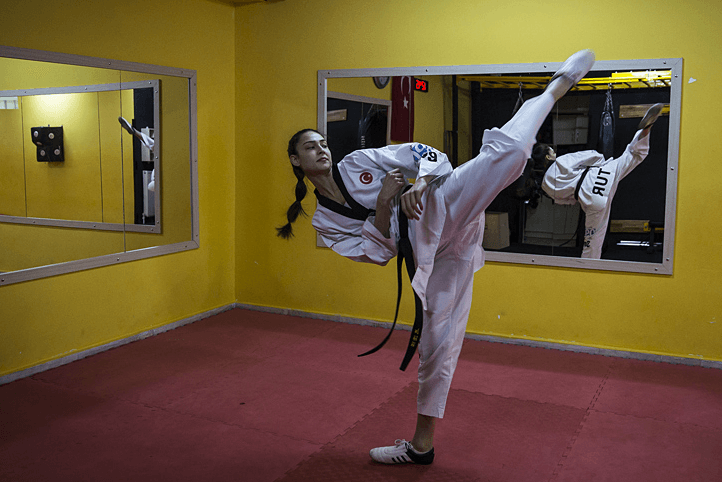
2018 Taekwondo Sport, Source: Anadolu Ajansı
In Taekwondo, combinations of techniques are called "poomsae". Poomsae facilitate the practical application of techniques and promote development in both defensive and offensive skills.
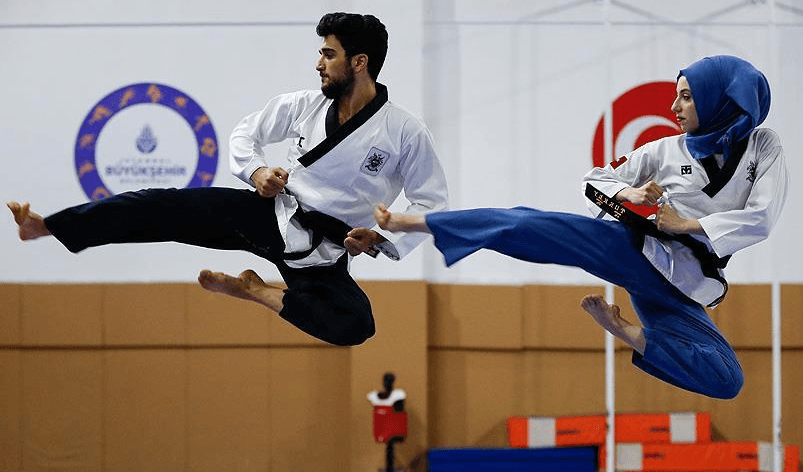
2016 Taekwondo Poomsae World Championship, Source: Anadolu Ajansı
One of the most important aspects of Taekwondo is its philosophy. The concept of "Do" (path) aims for athletes to learn moral values alongside physical techniques. Taekwondo is not merely a combat sport but is regarded as a path that encourages personal development and disciplined living. According to Taekwondo, the most important qualities of an athlete include respect, discipline, patience, and perseverance. While strengthening athletes physically, Taekwondo also seeks to contribute to their moral and spiritual development. In this context, the goal of Taekwondo is not only to learn how to fight but also to cultivate inner peace, confidence, and respect.
Anadolu Ajansı. "Tekvandoda Gümüş Madalya." August 11, 2012. Accessed March 5, 2025.Link
Anadolu Ajansı. "Tekvandoyu Dünyaya İrem Yaman Tanıtacak." February 2, 2018. Accessed March 5, 2025.Link
Anadolu Ajansı. “Türkiye Avrupa Şampiyonası’nda Altın Madalyaların Peşinde.” March 5, 2025.Link
Macfit. "Tekvando Nedir? En Temel Tekvando Hareketleri Nelerdir?" Accessed March 5, 2025.https://www.macfit.com/blog/spor/tekvando-nedir-en-temel-tekvando-hareketleri-nelerd
Sakin Taekwondo. "Taekwondo Nedir?" Accessed March 5, 2025.http://www.sakintaekwondo.com/taek-giris/TeakWondo_Nedir/taeknedir.htm.
Türkiye Tekvando Federation. "Tekvando Tarihçesi." Accessed March 5, 2025.https://turkiyetaekwondofed.gov.tr/tarihce/

Taekwondo
Sport Discipline | Taekwondo | ||||||||
|---|---|---|---|---|---|---|---|---|---|
Competition Sport Formation | 1905 | ||||||||
Origin | Korea | ||||||||
History and Development
Introduction and Development of Taekwondo in Türkiye
Basic Movements and Techniques
Poomsae (Forms)
Philosophy and Values