


This article was automatically translated from the original Turkish version.
The term surre is used as Word to refer to the “money bag” and denotes gifts sent during pilgrimage times to Mecca and Medina. The money and gifts sent annually to the sayyids and sharifs residing in Mecca and Medina, to the poor, and to the pilgrims along the pilgrimage routes are known as surre. This tradition of gift-giving began during the Abbasid period and ended in 1926.
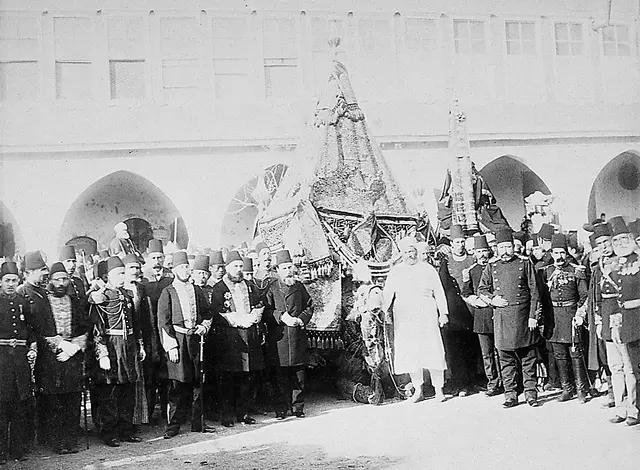
A surre-i hümâyun from the late nineteenth century (İÜ Ktp., Album, no. 91313)
The Abbasid caliph al-Muktedir Billah regularized the sending of gifts to the people of Mecca and Medina and officially initiated the tradition of annual monetary and gift deliveries in 924. After the Abbasids, states established in Egypt also showed interest in sending surre to the Two Holy Sanctuaries. Beginning in the thirteenth century, these states pursued political objectives, including gaining recognition within the Islamic world and securing the favor of the Sharif of Mecca, by sending the earliest form of surre, the mahmil — a ceremonial vehicle placed atop a camel — to the Haramayn.
The first Ottoman sultan to send surre was Bâyazid. After the Ottomans consolidated their authority in the Haramayn, surre was sent regularly every year.
The surre caravan was prepared under the supervision of the Darüssaade Ağası and departed from Istanbul in a ceremonial procession on the twelfth day of the month of Rebiülevvel. The ceremony first took place in the presence of the sultan at Topkapı Sarayı, after which the caravan, under the care of a respected and elderly official known as the surre emini, traveled from Beşiktaş to Üsküdar. Another ceremony was held there before the caravan set off toward Mecca and Medina. Until 1864, the surre caravan was transported by donkeys and camels; after this date, it began to be sent by sea. Following the construction of the Hejaz Railway, it was transported by train.
The surre caravan was received with ceremonies first in Üsküdar and later in Mecca and Medina. On its return journey after the Hajj, the caravan was again ceremonially dispatched from Mecca and Medina to Üsküdar. Upon arriving in Istanbul, the caravan would halt at Kartal and request permission to proceed to Üsküdar; once granted, it moved forward and was received with another ceremony in Üsküdar. In addition to the mahmil sent from Istanbul, another mahmil was also dispatched from Cairo during the Ottoman period. The sultan’s mahmil was called Mahmil-i Süleymani, while the viceroy of Egypt’s was known as Mahmil-i Mısrî.
After Mecca was occupied by the Wahhabis in the early nineteenth century, surre was temporarily suspended. However, after the defeat of the Wahhabis, the custom was revived, particularly during the reign of Kavalalı Mehmet Ali, when the Egyptian mahmil regained its former prestige. Following the First World War, disputes arose between the House of Saud and the Egyptian government over the mahmil. The conflict between Egyptian and Saudi troops in 1926 led to the end of this tradition.
Afyoncu, E. (2014). Sorularla Osmanlı İmparatorluğu, Yeditepe Yayınevi, İstanbul.
Buzpınar, Ş.T. (2009). "SURRE" TDİA, Volume 37, pp. 567-569.

History of surre
Surre in the Ottoman Empire
The End of the surre Tradition