


This article was automatically translated from the original Turkish version.
+1 More
Supercapacitors store electrical energy between two conductive plates separated by an insulator (dielectric), similar to conventional capacitors such as. However, in supercapacitors these plates are typically made from porous carbon-based materials, resulting in an enormously large surface area. This extensive surface area allows them to store more charge. Additionally, instead of a dielectric, a very thin electrolyte layer is used, which increases the energy storage capacity storage.
Another key feature is their ability to charge and discharge rapidly. Unlike batteries, they do not rely on chemical reactions; instead, they store energy through a physical process. This enables them to deliver energy very quickly and withstand millions of charge-discharge cycles. On the other hand, they do not achieve the same energy density as batteries—that is, the amount of energy stored per unit volume—so they are typically used for short-term energy bursts rather than continuous energy storage long additional short power.
Supercapacitors are classified into three categories based on their energy storage mechanisms:
Electrochemical double-layer capacitors (EDLC) store energy solely through physical surface adsorption using activated carbon-based electrodes. Since they do not involve chemical reactions, they offer fast charge/discharge rates and long cycle life. However, their energy density is low and they exhibit a high self-discharge rate.
Pseudocapacitors perform reversible redox reactions on the surface of electrode materials such as transition metal oxides. Thanks to Faradaic processes, they provide higher energy density and capacitance than EDLCs, but have a shorter cycle life in comparison.
Hybrid supercapacitors combine both Faradaic and physical adsorption mechanisms by using different anode and cathode materials. This results in higher energy and power density than EDLCs, but with some limitations in terms of cycle life.
Supercapacitors have several advantages and disadvantages that determine their applications:
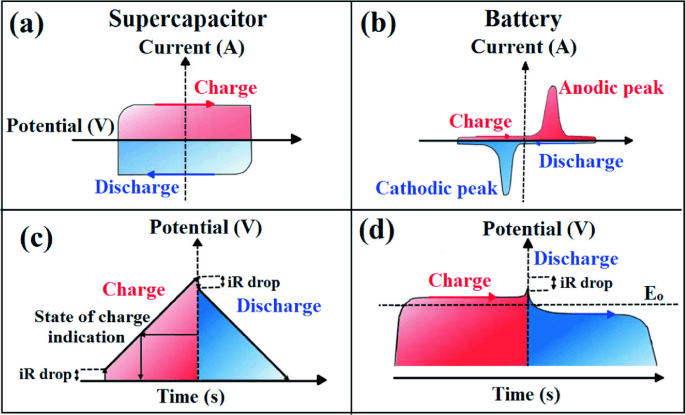
Supercapacitor and Battery Voltage-Current Curves
EDLCs represent the most mature technology among supercapacitors and are among the most cost-accessible solutions. Cost estimates for 2025 indicate that an EDLC system with a power rating of 1 MW and a discharge duration of 45 seconds has a storage cost of approximately $19,200/kWh. Such supercapacitors are particularly suitable for short-term energy needs and are used in grid stabilization, regenerative braking systems, and electric vehicles.
Various innovations are being developed to reduce the cost and enhance the performance of supercapacitors. These include alternative activated carbon sources, high-voltage electrolytes, advanced packaging methods, and automated manufacturing processes place. According to analyses by the U.S. Department of Energy (DOE), implementing these innovations could reduce supercapacitor costs by 23–26%, bringing them down to $0.39/kWh. In the longer term, significant research and development (R&D) support is required to achieve cost reductions to $0.05/kWh.
Supercapacitors occupy a crucial position among energy storage technologies due to their rapid charge and discharge characteristics. Electrochemical double-layer capacitors, pseudocapacitors, and hybrid supercapacitors each offer distinct advantages and disadvantages tailored to different applications. In the future, material innovations and improvements in manufacturing processes are expected to significantly lower the cost of supercapacitor energy storage. These advancements will expand the range of applications for supercapacitors and contribute to sustainable energy solutions.
Analog Devices. "RAQ Issue 179: Supercapacitors: The Basics." *Analog Dialogue*. Accessed February 24, 2025. https://www.analog.com/en/resources/analog-dialogue/raqs/raq-issue-179.html.
Arrow Electronics. "Understanding Supercapacitors and Their Applications." Last modified February 23, 2025. Accessed February 24, 2025. https://www.arrow.com/en/research-and-events/articles/understanding-supercapacitors-and-their-applications.
Battery University. "BU-209: How Does a Supercapacitor Work?" *Battery University*. Accessed February 24, 2025. https://batteryuniversity.com/article/bu-209-how-does-a-supercapacitor-work.
Schneider Electric. "Understanding Supercapacitors: Types, Working & Applications Explained." *Schneider Electric E-Shop*. Accessed February 24, 2025. https://eshop.se.com/in/blog/post/understanding-supercapacitors-types-working-applications-explained.html?srsltid=AfmBOorHb0l-mLLLLrz4fHVvm1gHlzfKKNwgMj4am7x8tdFnyA92R-6l.
Sinha, P., and K.K. Kar. "Characteristics of Supercapacitors." In *Handbook of Nanocomposite Supercapacitor Materials II*, edited by K. Kar, 49–77. Springer Series in Materials Science, vol. 302. Cham: Springer, 2020. https://doi.org/10.1007/978-3-030-52359-6_3.
U.S. Department of Energy. *Technology Strategy Assessment – Supercapacitors*. July 2023. Accessed February 24, 2025. https://www.energy.gov/sites/default/files/2023-07/Technology%20Strategy%20Assessment%20-%20Supercapacitors.pdf.

Types of Supercapacitors
Electrochemical Double-Layer Capacitors (EDLC)
Pseudocapacitors (PC)
Hybrid Supercapacitors (HEC)
Advantages and Disadvantages of Supercapacitors
Advantages
Disadvantages
Supercapacitors vs Batteries
Cost and Applications of Supercapacitors
Future Perspectives and Cost Reduction Strategies