This article was automatically translated from the original Turkish version.
Branch | Chordata | ||||||||
|---|---|---|---|---|---|---|---|---|---|
Team(s) | Squamata | ||||||||
Family | Corytophanidae | ||||||||
Conservation Status | Low risk (LC – Least Concern) | ||||||||
Specie(s) | Basiliscus basiliscus | ||||||||
Genus | Basiliscus | ||||||||
Class | Reptilia | ||||||||
Geographic Distribution | South America Central America | ||||||||
The striped basilisk is a lizard species belonging to the phylum Chordata and class Reptilia, within the family Corytophanidae. Its natural habitat extends along the Pacific slopes from southwestern Nicaragua in Central America to northwestern Colombia in South America. These animals are among the most commonly encountered large lizard species in western Costa Rica. Ecologically, they exhibit concentrated populations at elevations between 0 and 600 meters, primarily in lowland dry and moist forests adjacent to rivers and other waterways.
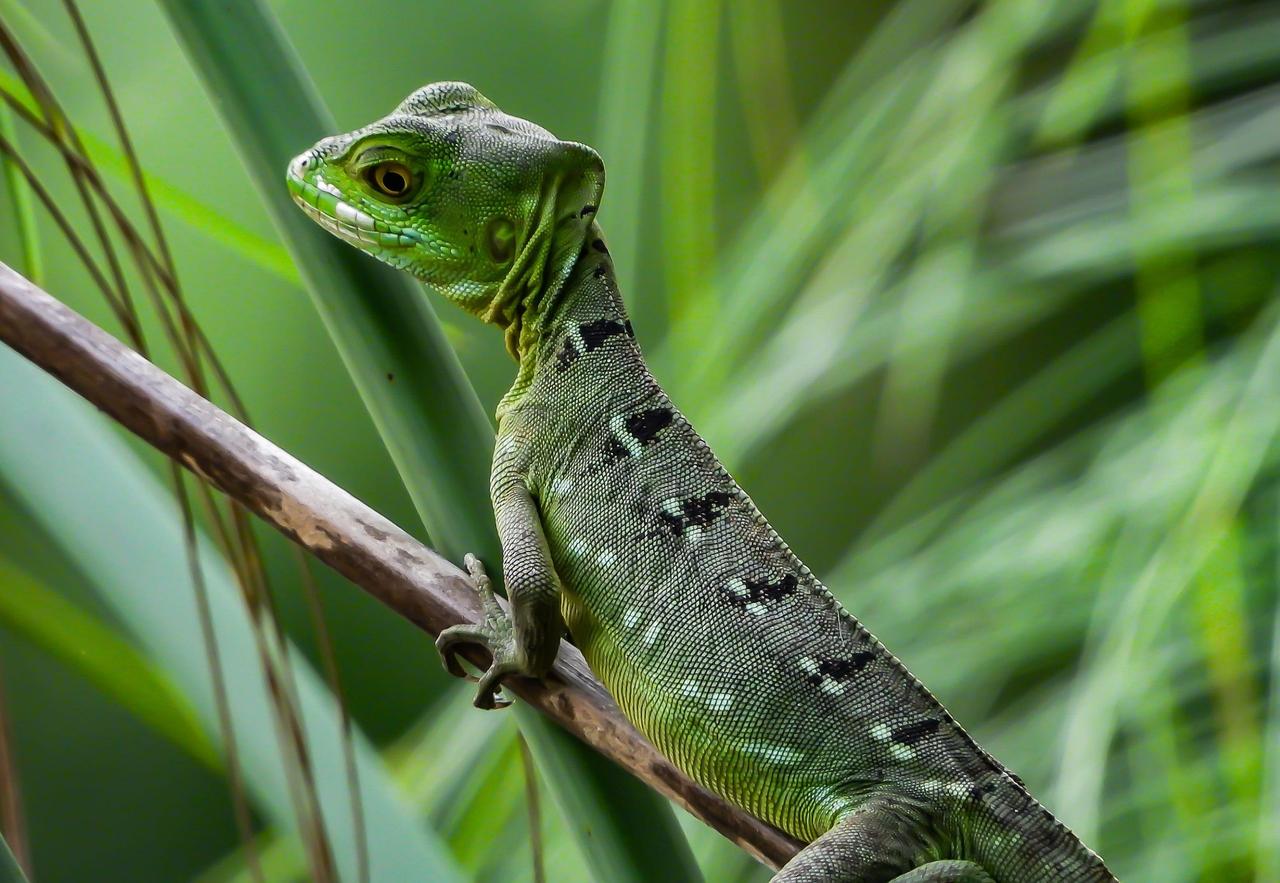
Adult striped basilisks are morphologically large lizards, with snout-vent lengths reaching up to 203 mm and total body lengths extending to 800 mm. Their body weight varies between 200 and 500 grams. The tail, which constitutes approximately 70 to 75 percent of the total length, plays a critical role in maintaining balance during locomotor activities. Color pigmentation is typically in brown or olive-green tones, though variations ranging from bright green to bronze can occur. Dark transverse bands are present along the body, accompanied by cream or yellow lateral and labial stripes.
Pronounced sexual dimorphism is observed in this species. Males are larger than females and possess sail-like crests on the head, back, and tail, supported by neural spines. Both adults and juveniles have irises in shades of brown and bronze. Additionally, they possess elongated fingers with sharp claws specialized for climbing.
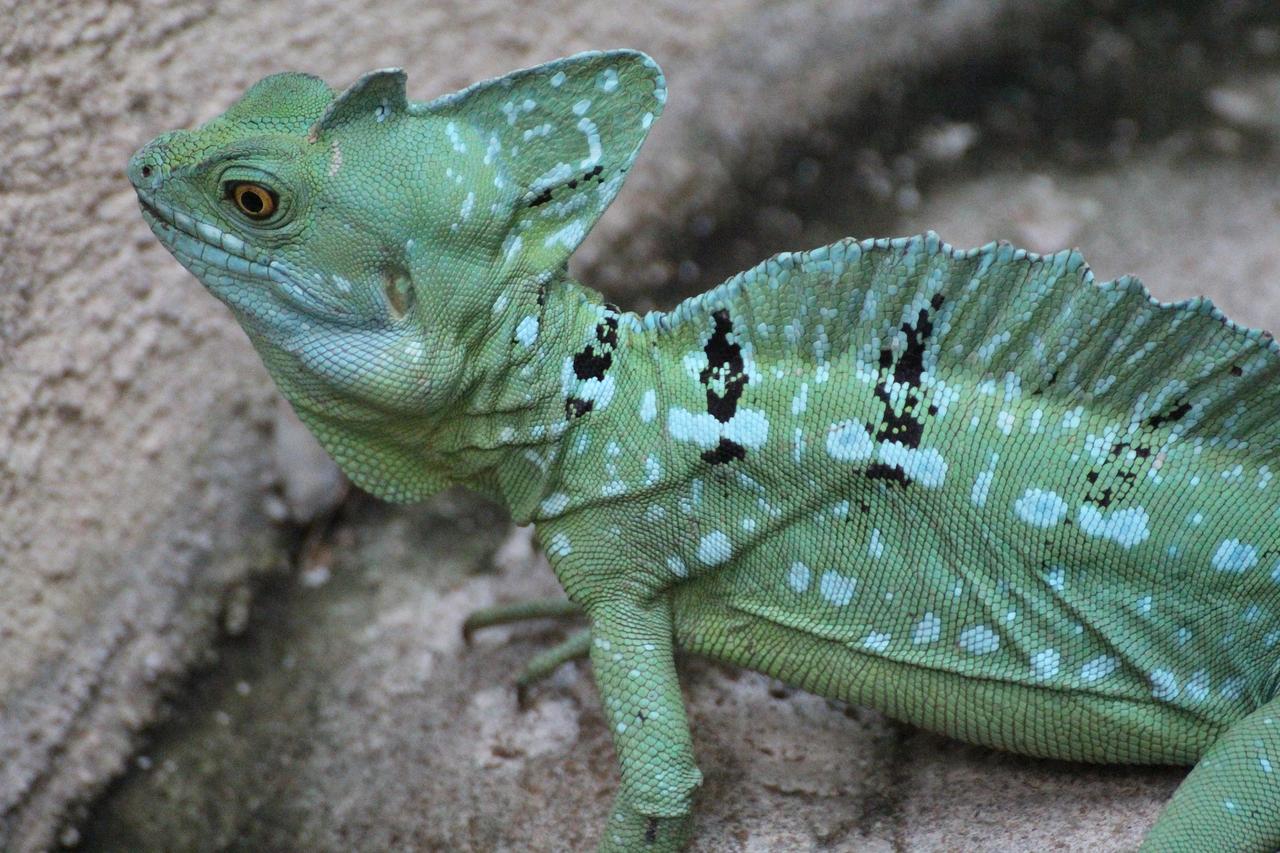
Striped Basilisk (Pixabay)
Basiliscus basiliscus has been a focal point of biomechanical studies due to its ability to run bipedally across water surfaces when threatened. This capability is enabled by enlarged skin flaps and specialized scales on the hind feet. During movement on water, two distinct phases occur: foot strike and foot pull. In the first phase, the foot strikes the water vertically, generating a high vertical reaction force that supports body weight; in the second phase, the backward motion of the foot provides propulsive force.
Biomechanical analyses have shown that these lizards generate large lateral forces ranging from 37 to 79 percent of their body weight to maintain dynamic stability on water. These forces prevent the lizard from sinking or tipping over by stabilizing its center of mass. Furthermore, research on the anatomical mechanical advantages of the hind limb muscles has revealed that the knee joint is optimized for both force and speed, enabling high performance in both terrestrial and aquatic locomotion.
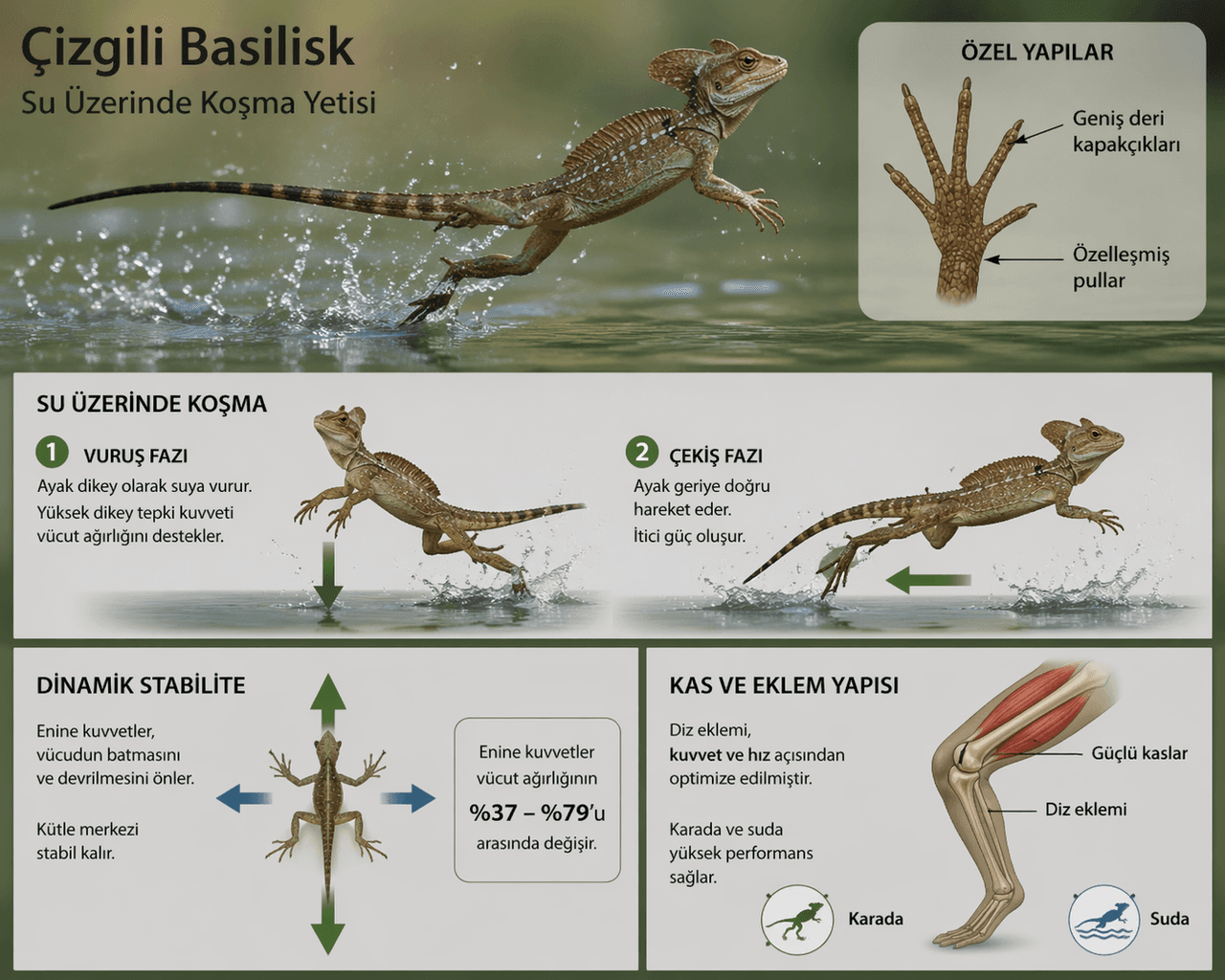
Representative Image of the Striped Basilisk Running on Water (AI-Generated Visual)
The striped basilisk exhibits a generalist omnivorous diet. Studies conducted in Panama indicate that 78 percent of its diet consists of animal matter and 22 percent of plant material. In juveniles, insectivorous feeding is dominant, while herbivory increases with age.【1】
The species plays dual roles in its ecosystem as both prey and predator. Its eggs and hatchlings serve as an important food source for raptors, opossums, and certain snake species. The brown-olive coloration of adults provides camouflage among tree branches and shrubs, aiding in protection from predators. In the wild, lifespan typically ranges from 2 to 6 years, while in captivity it can exceed 9 years.
Reproductive activity begins annually in March and continues for the following ten months. Females reach sexual maturity at approximately 20 months of age, while males begin maturing in their second year; however, due to size-based hierarchical dominance among males, many do not participate in breeding until they are 3 to 4 years old. Male courtship behavior includes head-bobbing movements typical of iguanid lizards.
Females dig nesting burrows approximately 1 meter above water level in moist soil, with depths reaching up to 10 cm. They lay between 2 and 18 eggs per clutch, characterized by leathery shells and cream to white coloration. After laying, the female uses her forelimbs to fill the burrow with soil and compresses it with her snout; no parental care follows. Incubation lasts between 60 and 90 days, during which the eggs absorb water from the soil and increase in volume. Although the population status is currently considered stable, habitat destruction in tropical regions is identified as the greatest conservation threat.【2】
Bergmann, Philip J., and Meredith Hare-Drubka. "Hindlimb muscle anatomical mechanical advantage differs among joints and stride phases in basilisk lizards." *Zoology* 118, no. 4 (2015): 291–98. Accessed April 23, 2026. https://doi.org/10.1016/j.zool.2015.03.002
Hsieh, S. T., and G. V. Lauder. "Running on water: Three-dimensional force generation by basilisk lizards." *Proceedings of the National Academy of Sciences of the United States of America* 101, no. 48 (2004): 16784–88. Accessed April 23, 2026. https://doi.org/10.1073/pnas.0405736101
Lieberman, Alan. "Nesting of the Basilisk Lizard (*Basiliscus basiliscus*)." *Journal of Herpetology* 14, no. 1 (1980): 103–5. Accessed April 23, 2026. https://doi.org/10.2307/1563894
Pixabay. "frontal lobe basilisk iguana." Accessed April 23, 2026. https://pixabay.com/photos/frontal-lobe-basilisk-iguana-1273592/
Pixabay. "frontal lobe basilisk reptile lizard." Accessed April 23, 2026. https://pixabay.com/photos/frontal-lobe-basilisk-reptile-lizard-417404/
Pixabay. "reptile animal basiliscus species." Pixabay. Accessed April 23, 2026. https://pixabay.com/photos/reptile-animal-basiliscus-species-7485967/
Wethington, A. "Basiliscus basiliscus." Animal Diversity Web. 2014. Accessed April 23, 2026. https://animaldiversity.org/accounts/Basiliscus_basiliscus/
[1]
A. Wethington, "Basiliscus basiliscus," Animal Diversity Web, 2014, accessed 23 April 2026, https://animaldiversity.org/accounts/Basiliscus_basiliscus/
[2]
A. Wethington, "Basiliscus basiliscus," Animal Diversity Web, 2014, accessed 23 April 2026, https://animaldiversity.org/accounts/Basiliscus_basiliscus/

Branch | Chordata | ||||||||
|---|---|---|---|---|---|---|---|---|---|
Team(s) | Squamata | ||||||||
Family | Corytophanidae | ||||||||
Conservation Status | Low risk (LC – Least Concern) | ||||||||
Specie(s) | Basiliscus basiliscus | ||||||||
Genus | Basiliscus | ||||||||
Class | Reptilia | ||||||||
Geographic Distribution | South America Central America | ||||||||
No Discussion Added Yet
Start discussion for "Striped Basilisk (Basiliscus basiliscus)" article
Morphological Structure and Sexual Dimorphism
Locomotor Biomechanics and Water-Running Ability
Feeding Habits and Ecological Interactions
Reproductive Biology and Developmental Process