


This article was automatically translated from the original Turkish version.
Break-even point is the level of production and sales at which a business neither makes a profit nor incurs a loss, where total revenues exactly equal total costs. At this point, the income generated from business activities covers all associated costs; if sales volume falls below this level, a loss occurs, and if it exceeds this level, a profit is generated.
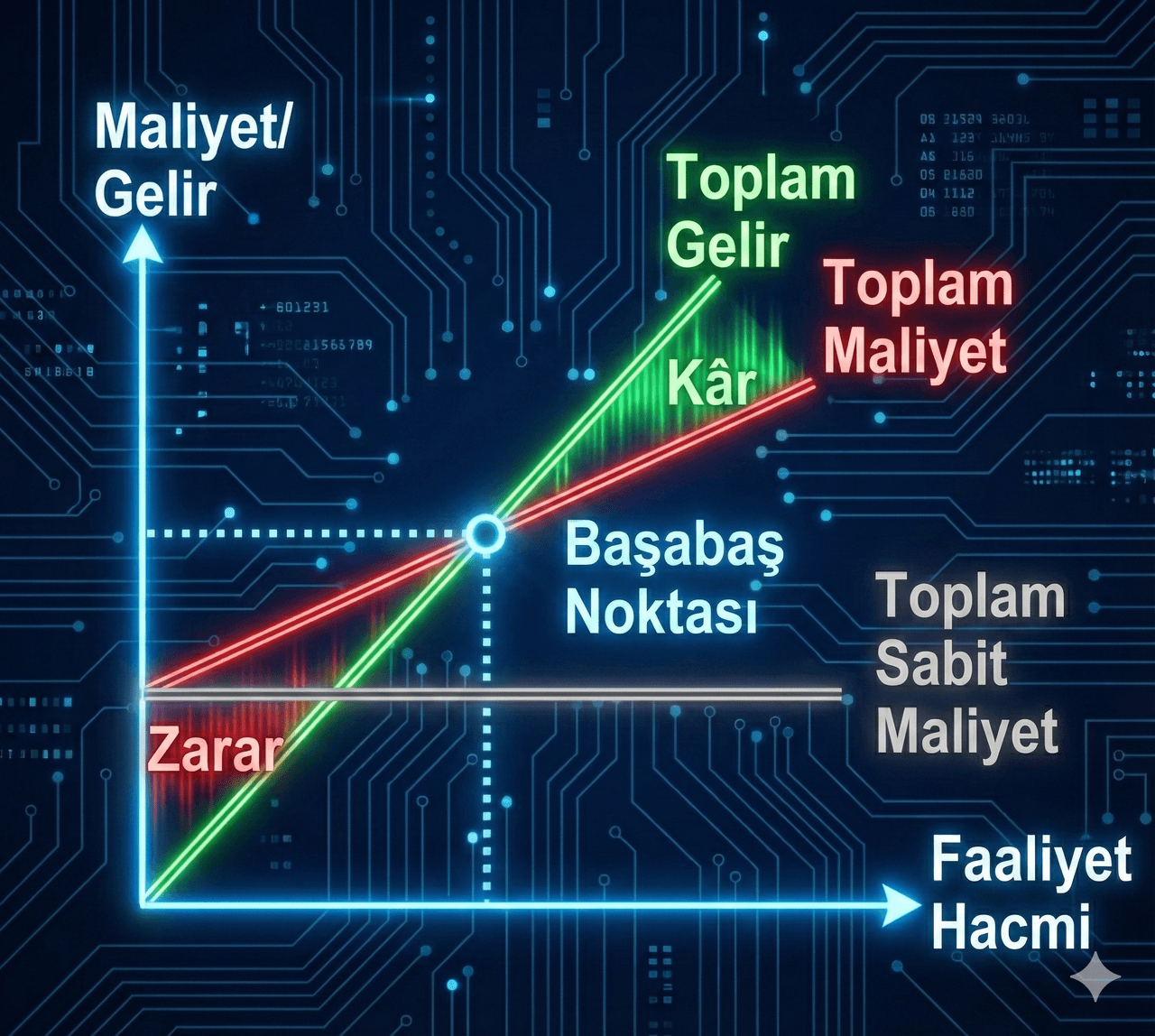
Break-even Point (Generated by Artificial Intelligence)
Break-even point analysis is based on the following concepts:
Break-even point analysis informs decisions such as:
In strategic cost management, when combined with value chain analysis, the break-even point enables the separate measurement of the value added and cost burden of each business function, allowing organizations to identify which functions reduce or enhance profitability and to develop long-term competitive strategies.
This analysis relies on the following assumptions:
In practice, when these assumptions are not fully met, the analysis yields approximate results; however, it remains a powerful and widely used tool for quickly assessing business risk, the speed of profitability, and alternative scenarios.
The break-even point is a classic management accounting method that clearly explains the relationship between cost, behavior, and revenue in simple, visual, and mathematical terms. While useful on its own for operational decisions, it provides significant contributions to strategic cost management when used in conjunction with modern approaches such as value chain analysis.
Holmes, Geoffrey. “Başabaş Noktası ve Kar/Kapasite Analizi.” Translated by Tuğrul Tüfekçioğlu. *Eskişehir İktisadi ve Ticari İlimler Akademisi Dergisi* 8, no. 2 (December 1972): 172–201. Accessed December 1, 2025. https://dergipark.org.tr/tr/pub/eitiad/issue/49507/633294#article_cite.
Tandoğan, Uğur. “Stratejik Maliyet Yönetiminde Başabaş Noktası ve Değer Zinciri Analizi ile İşletme Fonksiyonlarının Performans Ölçümü: Yemek Fabrikası Örneği”. *Afyon Kocatepe Üniversitesi İktisadi ve İdari Bilimler Fakültesi Dergisi* 17, no. 1 (2015): 1–18. Accessed December 1, 2025. https://dergipark.org.tr/tr/pub/akuiibfd/issue/1615/20215#article_cite.

Key Elements
Applications
Assumptions and Limitations