


This article was automatically translated from the original Turkish version.
+2 More
St. Pierre Kilisesi is located on the slopes of Haç (Stauris) Mountain, an extension of Habib-i Neccar Mountain, along the Reyhanlı highway, approximately 2 km northeast of Antakya. Recognized as one of the earliest Christian places of worship, the kilise has served as one of the most important religious centers throughout history.
After the death of Jesus Christ, Saint Peter, regarded as the founder and first priest of the Church of Antakya, arrived in the city between AD 29 and 40 and held its first religious gathering in the cave now known as St. Pierre Kilisesi. It was here, for the first time in history, that the term “Christian” was used to describe this cemaat.
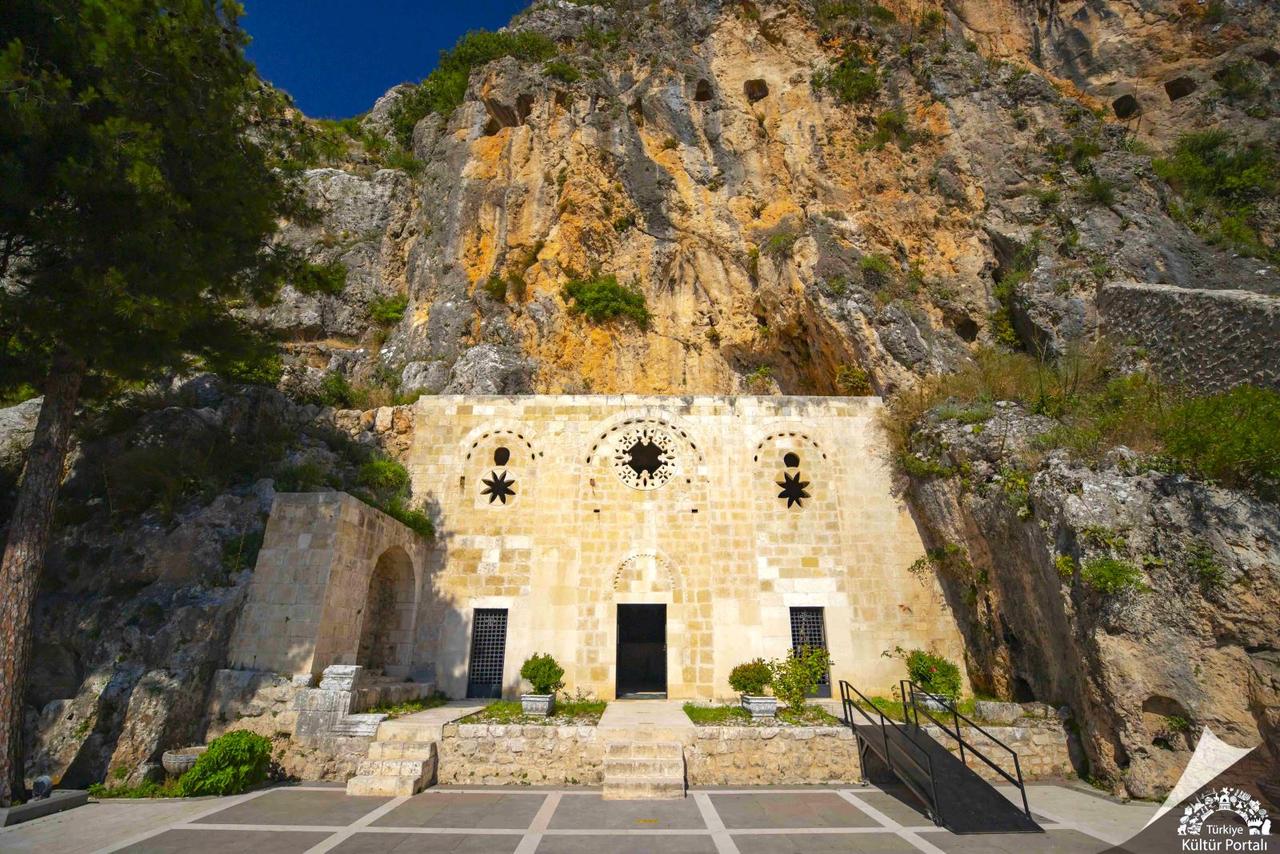
St. Pierre Kilisesi - Türkiye Kültür Portalı
On 3 June 1098, the Crusaders who captured Antakya expanded the front section of the church and connected it to the façade using two arches. The church’s façade was constructed using local materials and in an Eastern architectural style.
Inside the church, remains of mosaics dating to the 4th and 5th centuries AD, fresco traces located to the right of the altar, a tunnel used by the congregation fleeing persecution by pagan soldiers to the left of the altar, and a water cistern can be found.
The church’s façade was restored in 1863. In 1931, a new altar was installed, and in 1932, a white marble statue of Saint Peter was placed atop it. In the same year, a stone pulpit was added behind the altar to commemorate the Feast of the Chair of Saint Peter in Antakya.
In 1997, the Turkish Ministry of Tourism implemented a restoration and environmental improvement project, expanding the church’s front courtyard and adding a second entrance. As a result, the church’s length reached 17 meters.
Today, St. Pierre Kilisesi serves as an “Monumental Museum” as one of the earliest Christian churches. At the same time, it is used for religious ceremonies such as liturgies, weddings, baptisms, and other rites upon request by the Christian community.
Declared a pilgrimage site by Pope Paul VI in 1983, an annual ceremony known as “St. Pierre Day” is held on 29 June, attended by clergy and the faithful.
The church welcomes both Christian and Muslim visitors and is regarded as a major center for faith-based tourism. Due to its historical, religious, and cultural value, it is visited by thousands of tourists each year.
Eykay, İ., Dalgın, T., and Çeken, H. "İnanç Turizmi Potansiyeli Açısından Antakya’nın Değerlendirilmesi." Journal of Life Economics 2, no. 2 (2015): 59-74.
Hatay Valiliği. "Tarihsel Süreç İçinde Hatay." Accessed March 5, 2025.http://www.hatay.gov.tr/tarihsel-surec-icinde-hatay.
Hatay Valiliği. "İnanç Turizmi." Accessed March 5, 2025.http://www.hatay.gov.tr/inanc-turizmi.
Türkiye Kültür Portalı. "St. Pierre Anıt Müzesi - Hatay." Accessed [Date].
İsmail, E. G. E. "Saint Pierre (Kilisesi) Mağarası (Antakya/Hatay)." The Journal of Academic Social Science 16, no. 16 (2024): 165-188.

History and Architectural Structure
Religious and Touristic Significance