


This article was automatically translated from the original Turkish version.
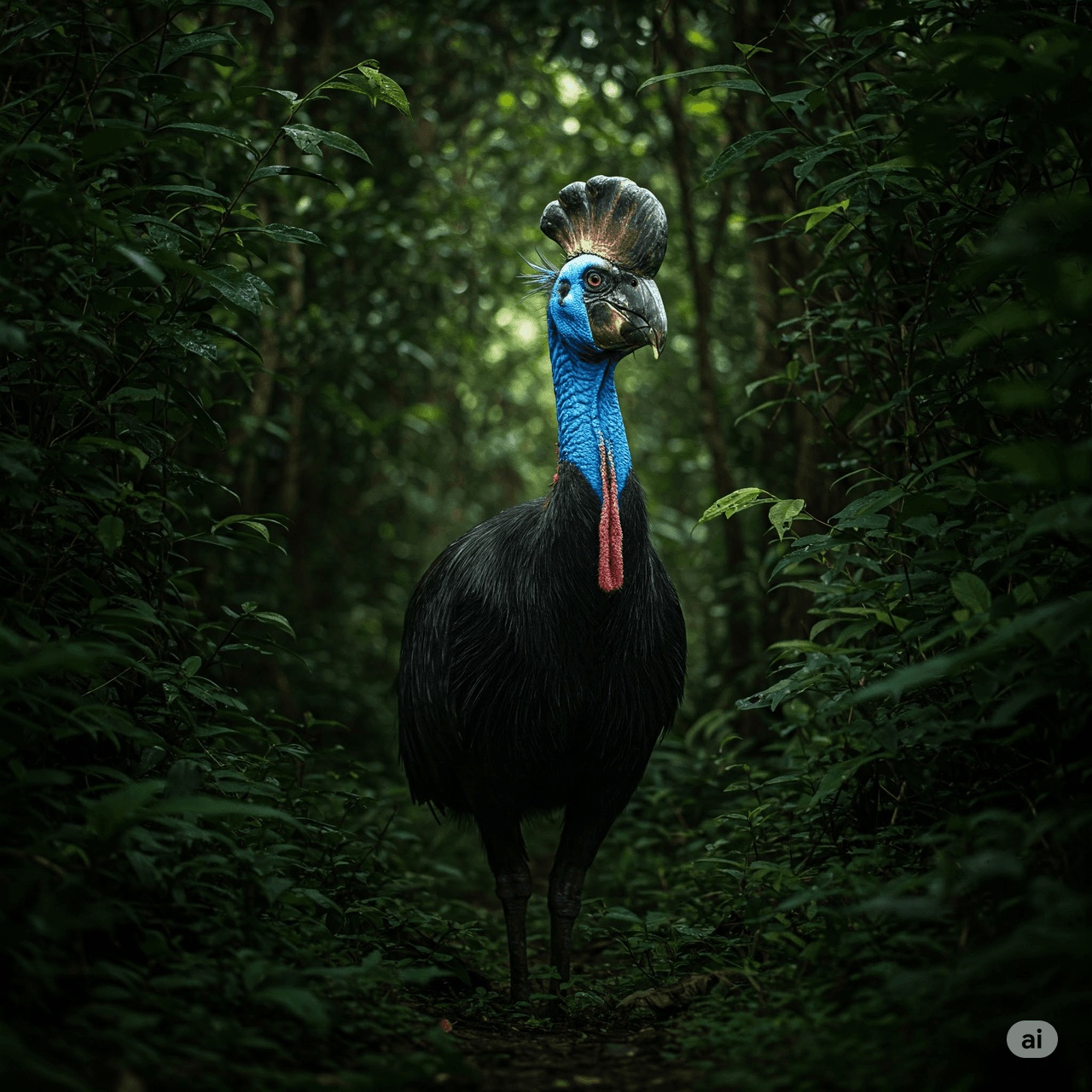
Southern Cassowary (Casuarius casuarius)
Name(s) | Southern Cassowary | ||||||||
|---|---|---|---|---|---|---|---|---|---|
Scientific Name(s) | Casuarius casuarius | ||||||||
Family | Casuariidae | ||||||||
Order | Struthioniformes | ||||||||
Size(s) | 1.5–1.8 m | ||||||||
Weight(s) | Up to 55 kilograms | ||||||||
Color | bare neck and head in blue and red tones Black feathers | ||||||||
Habitat | northeastern Australia New Guinea Tropical rainforests | ||||||||
Diet(s) | vertebrates small invertebrates fungi Fruit-dominated | ||||||||
Reproduction(s) | Females lay eggs males incubate and care for the young | ||||||||
Importance | sustainability of forest ecosystems Key role in seed dispersal | ||||||||
Conservation Status | Vulnerable (IUCN) | ||||||||
The Southern Cassowary (Casuarius casuarius) is a large, flightless bird species belonging to the subclass Ratitae. Its natural habitat encompasses New Guinea, northeastern Australia, and surrounding islands. This species is one of the largest frugivorous birds in tropical rainforests and plays vital roles in its ecosystem, including seed dispersal. It is recognized by its powerful legs, prominent casque on the head, and brightly colored skin structures. The biology, ecology, and conservation status of the Southern Cassowary are among the focal points of scientific research.
The Southern Cassowary is a large bird, measuring between 1.5 and 1.8 meters in height and weighing up to 55 kilograms. Its black plumage contrasts with bare skin on the neck and head, which displays shades of blue and red. The casque-like structure on top of the head is a keratinized projection that grows with age and varies among individuals. This structure may serve to protect the bird from low-hanging branches while moving through dense forest and aid in sound transmission. Each foot has three toes, with the inner toe bearing a long, sharp claw that can be used for defense.
Casuarius casuarius belongs to the family Casuariidae and the genus Casuarius. It is classified within the subclass Ratitae and is most closely related to other flightless birds such as the emu, ostrich, and kiwi. The genus Casuarius includes three species: Casuarius casuarius (Southern Cassowary), Casuarius unappendiculatus (Northern Cassowary), and Casuarius bennetti (Dwarf Cassowary). The Southern Cassowary is the largest of these species.
The Southern Cassowary inhabits tropical rainforests, particularly in southern regions of New Guinea, the Queensland state of northeastern Australia, and nearby islands. These birds prefer dense forested areas, riverbanks, and swampy habitats. Conservation of their habitat is critical for the species’ long-term survival.
The Southern Cassowary is primarily frugivorous and plays a crucial role in seed dispersal within forest ecosystems. It ingests fruits and passes their seeds through its digestive system, spreading them over wide areas, thereby contributing to plant diversity. Its diet may also include fungi, small invertebrates, and vertebrates.
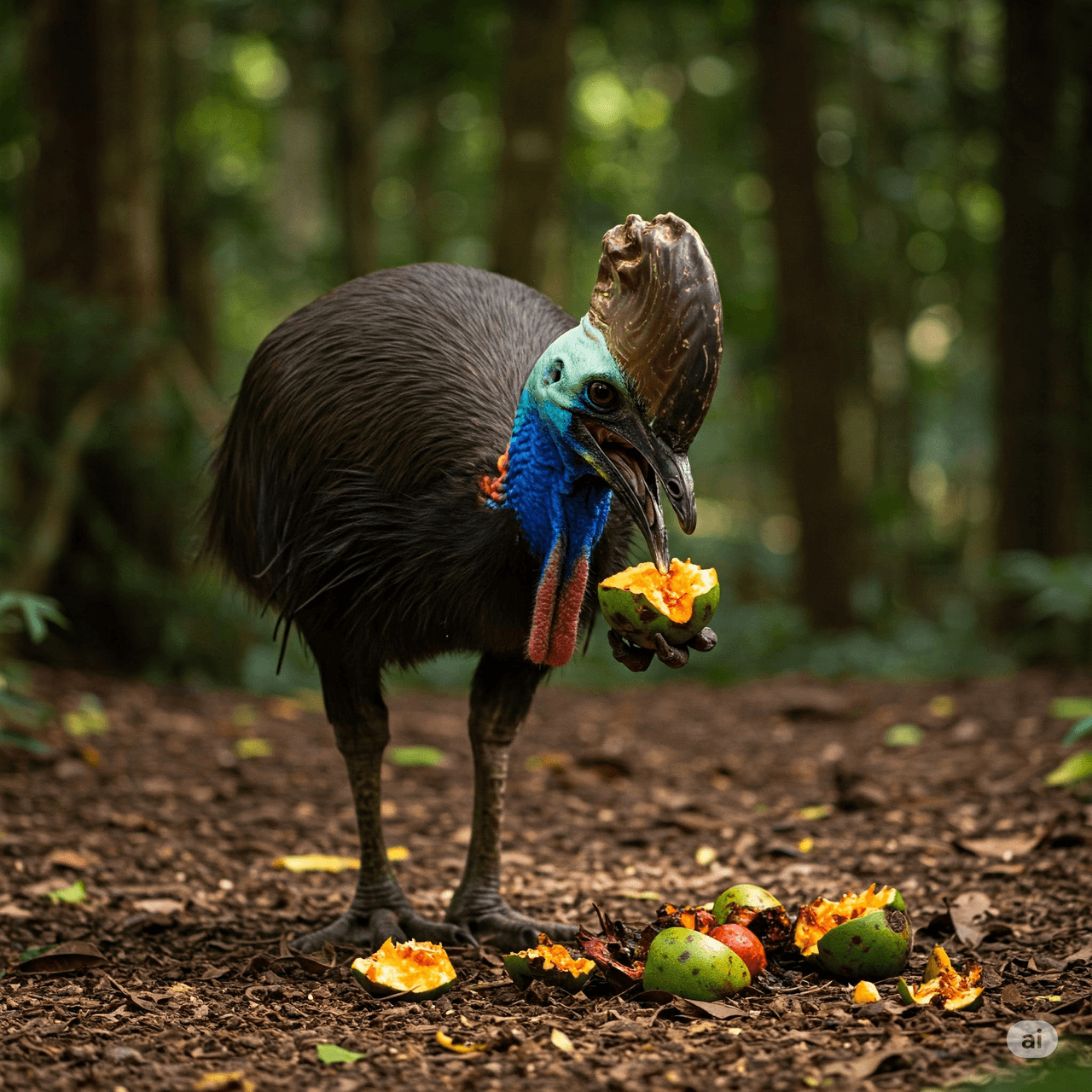
Southern Cassowary Feeding (Generated by Artificial Intelligence)
This species is generally solitary and only interacts during the breeding season. The female lays eggs and then leaves, with the male assuming full responsibility for incubation and chick rearing. The eggs are greenish in color and quite large. Chicks are precocial and begin walking shortly after hatching, remaining under the protection of their father.
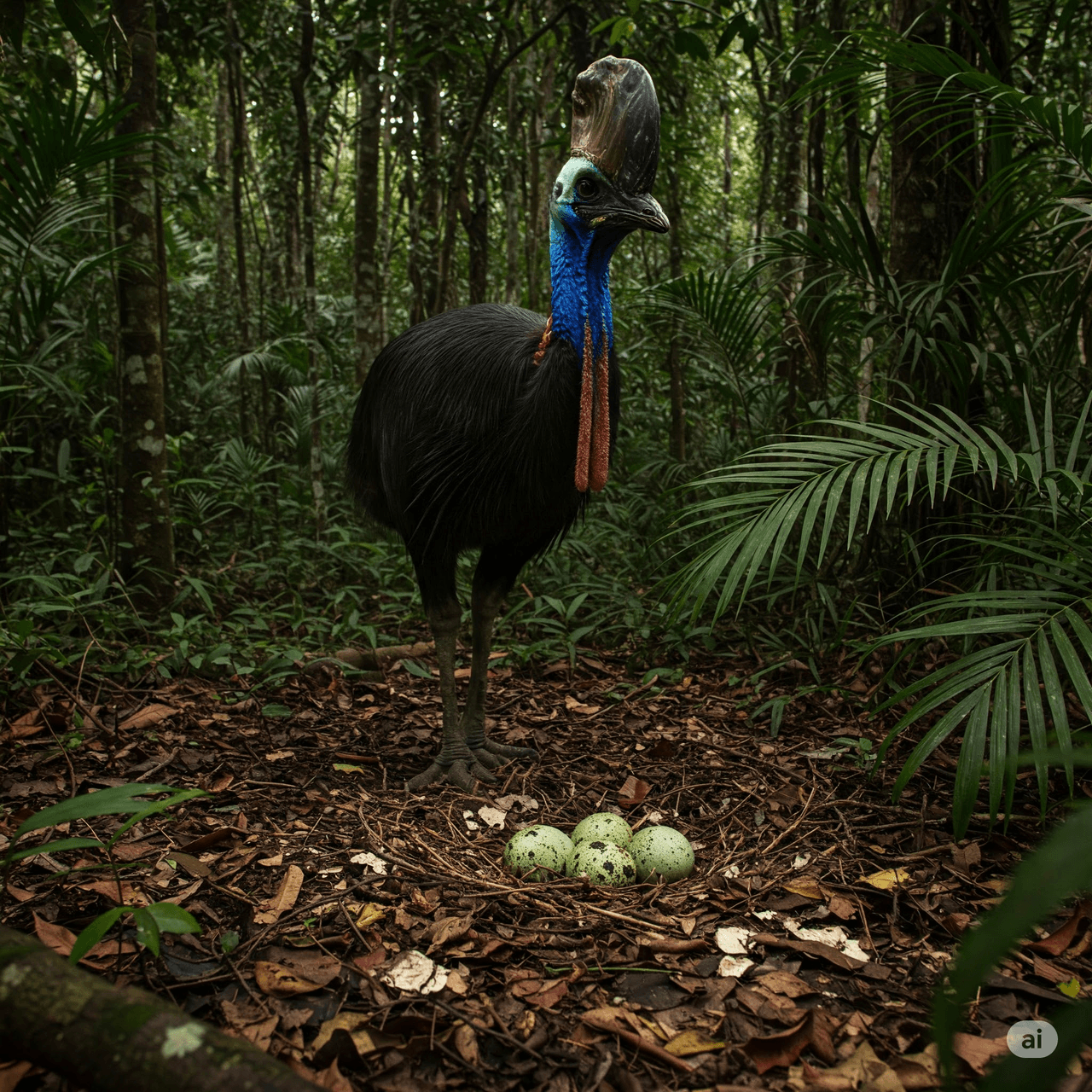
Southern Cassowary Reproduction (Generated by Artificial Intelligence)
The Southern Cassowary is classified as "Vulnerable" by the International Union for Conservation of Nature (IUCN). In Australia, some subpopulations are assessed as "Endangered." This status is linked to threats such as habitat loss, vehicle collisions, dog attacks, and illegal hunting.
Various strategies are being implemented to protect the species. These include habitat conservation and restoration, establishment of wildlife reserves, public awareness campaigns, and research initiatives. Captive breeding programs also play an important role in ensuring the species’ long-term viability.
Campbell, Hamish A., Ross G. Dwyer, Sean Fitzgibbons, Carissa J. Klein, Graham Lauridsen, Adam McKeown, Annebelle Olsson, Scott Sullivan, Matthew E. Watts, and David A. Westcott. "Prioritising the Protection of Habitat Utilised by Southern Cassowaries Casuarius casuarius johnsonii." Endangered Species Research 17 (2012): 53–61. Accessed May 24, 2025. https://www.int-res.com/articles/esr2012/17/n017p053.pdf.
Campbell, M. A., T. Lawton, V. Udyawer, K. S. Bell-Anderson, D. Westcott, and H. A. Campbell. "The Southern Cassowary (Casuarius casuarius johnsonii) Remains an Important Disperser of Native Plants in Fragmented Rainforest Landscapes." Austral Ecology 48, no. 4 (2023): 787–802. Accessed May 24, 2025. https://doi.org/10.1111/aec.13309.
Kofron, C. P. "Attacks to Humans and Domestic Animals by the Southern Cassowary (Casuarius casuarius johnsonii) in Queensland, Australia." Journal of Zoology 249, no. 4 (1999): 375–381. Accessed May 24, 2025. https://doi.org/10.1111/j.1469-7998.1999.tb01206.x.
Moore, L. A. "Population Ecology of the Southern Cassowary *Casuarius casuarius johnsonii*, Mission Beach North Queensland." *Journal of Ornithology* 148, no. 3 (2007): 357–366. Accessed May 24, 2025. https://doi.org/10.1007/s10336-007-0137-1.

Southern Cassowary (Casuarius casuarius)
Name(s) | Southern Cassowary | ||||||||
|---|---|---|---|---|---|---|---|---|---|
Scientific Name(s) | Casuarius casuarius | ||||||||
Family | Casuariidae | ||||||||
Order | Struthioniformes | ||||||||
Size(s) | 1.5–1.8 m | ||||||||
Weight(s) | Up to 55 kilograms | ||||||||
Color | bare neck and head in blue and red tones Black feathers | ||||||||
Habitat | northeastern Australia New Guinea Tropical rainforests | ||||||||
Diet(s) | vertebrates small invertebrates fungi Fruit-dominated | ||||||||
Reproduction(s) | Females lay eggs males incubate and care for the young | ||||||||
Importance | sustainability of forest ecosystems Key role in seed dispersal | ||||||||
Conservation Status | Vulnerable (IUCN) | ||||||||
No Discussion Added Yet
Start discussion for "Southern Cassowary (Casuarius casuarius)" article
Morphological Characteristics and Taxonomic Position
Physical Structure
Taxonomic Classification
Ecology and Habitat
Habitat and Distribution
Diet and Seed Dispersal
Reproduction and Behavior
Conservation Status and Threats
Conservation Status
Conservation Efforts