


This article was automatically translated from the original Turkish version.
+1 More
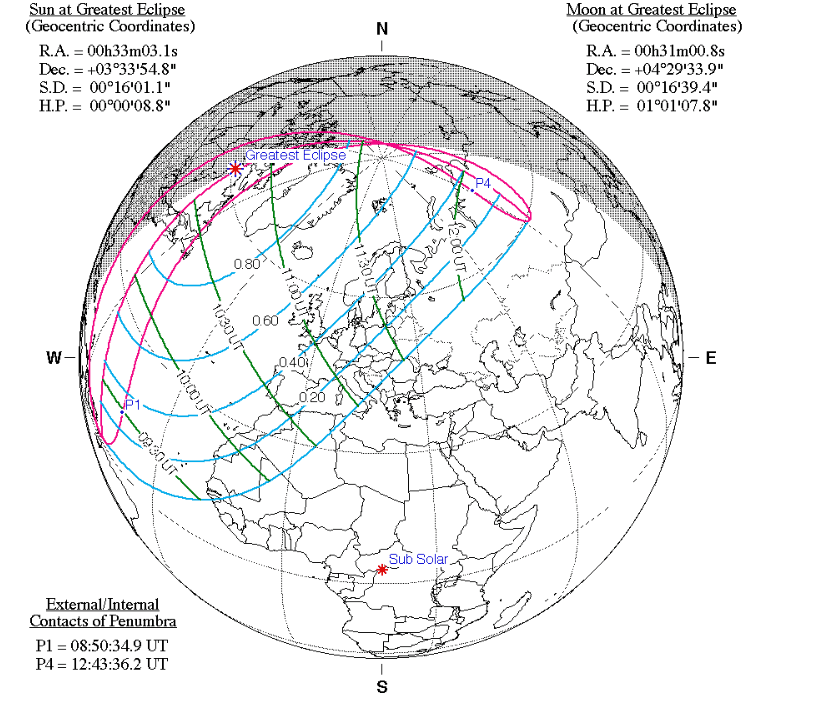
Partial Solar Eclipse Map
History | 2025-03-29 | ||||||||
|---|---|---|---|---|---|---|---|---|---|
Gamma | 1.0405 | ||||||||
Eclipse Magnitude | 0.9361 | ||||||||
Eclipse Type | Partial Solar Eclipse | ||||||||
Güneş eclipse is an astronomical phenomenon that occurs when the Moon passes between the Earth and the Sun, partially or completely blocking sunlight from reaching Earth. This event has been a subject of great interest throughout human history, both scientifically and culturally.
Solar Eclipse Source: Youtube, National Geographic
Solar eclipses are classified into four main categories based on their observational appearance:
Occurs when the Moon completely covers the Sun. During this time, the Moon’s shadow falls on Earth, and observers located within the umbra (total shadow) region see the Sun entirely obscured.
The duration of a total eclipse can last up to 7 minutes and 31 seconds.
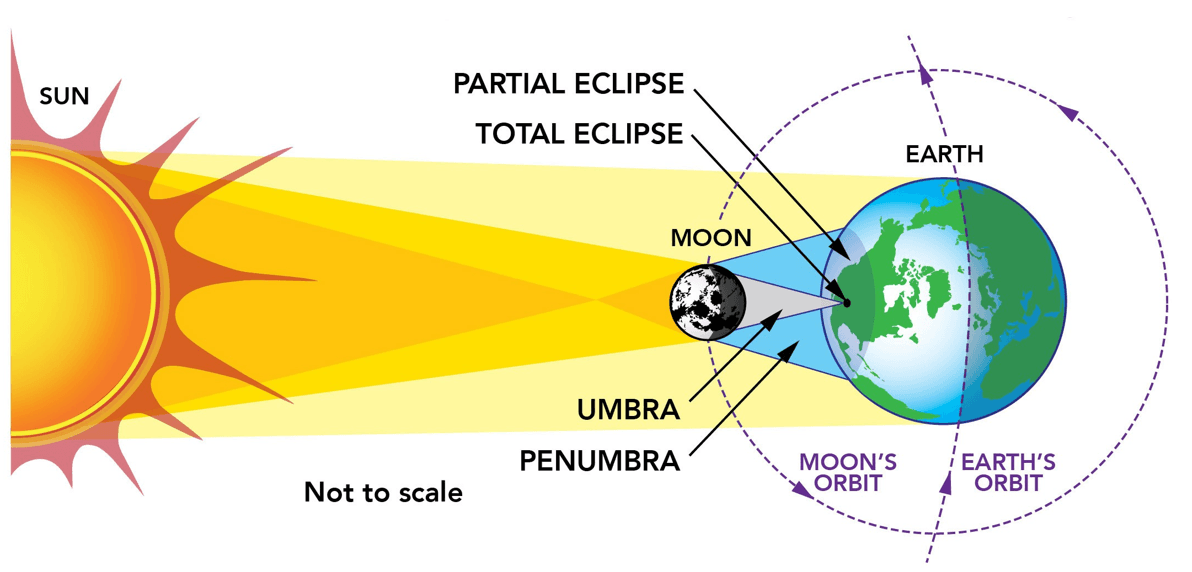
Solar Eclipse, Source: My NASA Data
Occurs when the Moon passes directly in front of the Sun but does not completely cover it. During this eclipse, the center of the Sun is obscured by the Moon, while its edges remain visible, creating a visual effect known as the “ring of fire” or “light ring”.
The Moon’s orbit is elliptical, meaning its distance from Earth is not constant.
This results in an annular eclipse because the Moon’s apparent diameter is smaller than that of the Sun.
The duration of an annular eclipse can last up to 12 minutes and 30 seconds.
A partial solar eclipse occurs when the Moon covers only a portion of the Sun. During this eclipse, the Sun appears partially darkened but never fully obscured. Observers are located within the penumbra (partial shadow) region of the Moon’s shadow.
The total duration of a partial solar eclipse is the time from its first contact to its final contact.
A hybrid solar eclipse occurs when the same eclipse appears as a total solar eclipse in some regions and an annular solar eclipse in others. This is a very rare celestial event (occurring approximately once every 10 years) and is technically referred to as an “annular-total eclipse”.
Due to Earth’s spherical shape, parts of the shadow may fall within the umbra (total) while others fall within the antumbra (annular).
The total duration of a hybrid solar eclipse (from start to finish): hours 2–3, while the total or annular phase lasts between 30 seconds and 5 minutes (depending on the observation location).
A solar eclipse can occur only during the New Moon phase. However, not every New Moon results in an eclipse because the Moon’s orbit is tilted by approximately 5 degrees relative to Earth’s orbit. As a result, the Moon usually passes above or below the Sun. For an eclipse to occur, the Moon must be at one of its nodes, the points where its orbit crosses the plane of Earth’s orbit around the Sun.
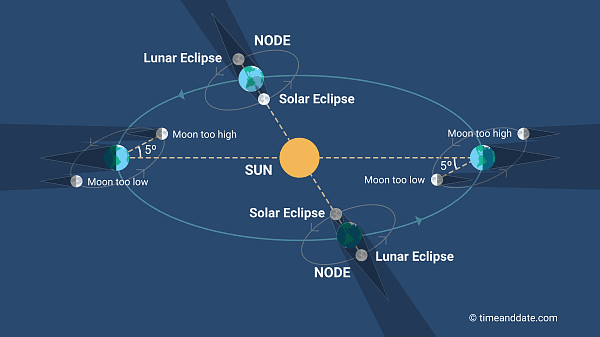
When Does a Solar Eclipse Occur? Source: Time and Date
Solar eclipses occur more frequently than commonly assumed, but they are not visible from every location on Earth.
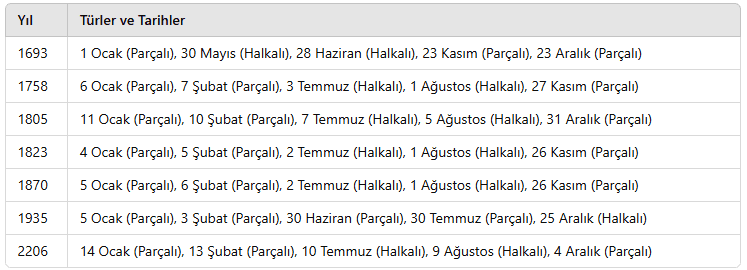
Years in the past and future when five solar eclipses occurred in a single year, generated by artificial intelligence.
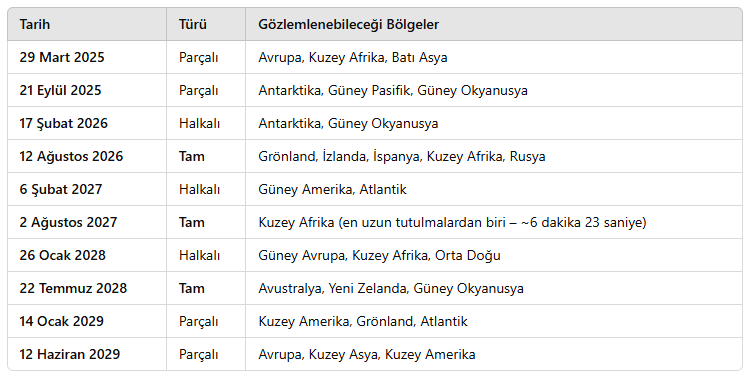
Solar Eclipse Calendar 2025–2029 Source: NASA
Solar eclipses are of great value to astronomers for studying the structure of the Sun. In particular, during total solar eclipses, the Sun’s corona can be observed clearly. Additionally, Einstein’s General Theory of Relativity was supported by observations made during the total solar eclipse of 1919.
Throughout history, solar eclipses have been regarded by many cultures as sacred, frightening, or prophetic events.
Solar eclipses, particularly due to the sudden darkness and changes in the sky, can induce feelings of confusion, fear, or awe in some individuals.
Looking directly at a solar eclipse does not cause physical harm — if observed with proper equipment.
However:
Dyches, Preston. "Eclipses - NASA Science." NASA Science. Accessed April 7, 2025.https://science.nasa.gov/eclipses/.
Espenak, Fred. “Hybrid Solar Eclipses.” NASA Eclipse Page. Accessed April 7, 2025.https://eclipse.gsfc.nasa.gov.
Espenak, Fred. “NASA - Solar Eclipses: 2021 - 2030.” Accessed April 7, 2025.https://eclipse.gsfc.nasa.gov/SEdecade/SEdecade2021.html.
Littmann, Mark, Fred Espenak, and Ken Willcox. Totality: Eclipses of the Sun. Oxford: Oxford University Press, 2008.
My NASA. "Explore Solar Eclipses | My NASA Data." Accessed April 7, 2025.https://mynasadata.larc.nasa.gov/interactive-models/explore-solar-eclipses.
NASA Eclipse Web Site. Accessed April 7, 2025.https://eclipse.gsfc.nasa.gov/.
National Geographic. "Solar Eclipse 101 | National Geographic." YouTube Video, August 17, 2017. Accessed April 7, 2025.https://www.youtube.com/watch?v=cxrLRbkOwKs.
Pasachoff, Jay M. "Eclipses and Their Types." Astronomy Education Review, 2009.
Pasachoff, Jay M. "The Sun and Solar Eclipses." Scientific American, 2009.
Pasachoff, Jay M. “Total Solar Eclipse Offers Rare Chance to Understand the Sun’s Atmosphere.” Scientific American, February 20, 2024.https://www.scientificamerican.com/article/total-solar-eclipse-offers-rare-chance-to-understand-the-sun-rsquo-s-atmosphere/.
Time and Date. "How Often Do Solar Eclipses Happen?," March 5, 2025. Accessed April 7, 2025.https://www.timeanddate.com/eclipse/how-often-solar-eclipse.html?utm_source=chatgpt.com.
Türkiye Uzay Agency (TUA). "Güneş Tutulmaları ve Etkileri." Accessed April 7, 2025.https://tua.gov.tr.

Partial Solar Eclipse Map
History | 2025-03-29 | ||||||||
|---|---|---|---|---|---|---|---|---|---|
Gamma | 1.0405 | ||||||||
Eclipse Magnitude | 0.9361 | ||||||||
Eclipse Type | Partial Solar Eclipse | ||||||||
Types of Solar Eclipses
Total Solar Eclipse
Annular Solar Eclipse
Partial Solar Eclipse
Hybrid (Mixed) Eclipse
Conditions for a Solar Eclipse
How Often Do Solar Eclipses Occur?
How Many Occur Per Year?
Scientific Significance
Impact of Solar Eclipses on Humans
Historical and Cultural Effects
Psychological Effects
Physiological Effects