


This article was automatically translated from the original Turkish version.
+2 More
Solar Apex is an astronomical term that denotes the direction of motion of the Sun system within the Milky Way Galaxy. The Sun and all its associated planets move along a specific orbit within the galaxy. During this motion, the point toward which the Sun is presumed to be moving is referred to as the Solar Apex.
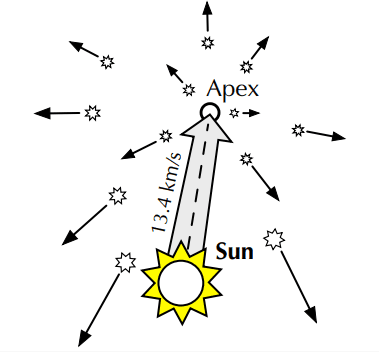
Figure 1 Solar Apex Diagram
While all planets in the Sun system orbit around the Sun, the Sun system itself follows an orbit around the center of the Milky Way Galaxy. The Sun system’s orbital speed around the galactic center is 828,000 km/h (230 km/s), and it completes one full revolution approximately every 225 to 250 million years. This period is known as a galactic year or cosmic year. However, the Sun’s motion does not occur along a straight line. Instead, it moves through the galactic plane with up-and-down oscillations and travels in the direction of the Solar Apex alongside nearby stars.
The Sun’s motion can be measured relative to different reference points:
Relative to nearby stars, its velocity is 19.7 km/s (71,000 km/h or 44,000 miles/h), while relative to the galactic center it is 828,000 km/h (514,000 miles/h). This motion of the Sun system can be regarded as a small current within the overall dynamics of the galaxy.
From Earth, the direction of the Solar Apex lies in the region of the constellations Ophiuchus and Hercules. More specifically, the direction of the Sun’s motion corresponds to a Right Ascension (RA) of 18 hours 28 minutes and a Declination (Dec) of approximately +30°. This position serves as an important reference point for determining the future trajectory of the Sun system.
The Sun’s motion through the galaxy is a fundamental factor influencing many astronomical processes. These include:
The point directly opposite the Solar Apex is called the Solar Antapex. This point lies in the constellation Columba (the Dove). While the Solar Apex marks the direction in which the Sun is moving forward, the Solar Antapex indicates the direction it has left behind. Over millions of years, the Sun will continue to traverse different regions of the galaxy.
"The Solar Apex." *Nature*, vol. 162, p. 920, 1948.https://doi.org/10.1038/162920a0
Astronomical League. "Solar Apex." astroleague.org.
Astronomy & Astrophysics. "Gaia Early Data Release 3: Acceleration of the Solar System from Gaia Astrometry." aanda.org.
NASA Astrophysics Data System (ADS). "New Determination of the Solar Apex." ui.adsabs.harvard.edu.
Oxford Academic. "Solar Apex and Galactic Rotation." academic.oup.com.

The Galactic Motion of the Sun System
The Velocity of the Solar Apex
The Position of the Solar Apex in the Sky
The Importance of the Solar Apex
The Opposite of the Solar Apex: Solar Antapex