


This article was automatically translated from the original Turkish version.
+2 More
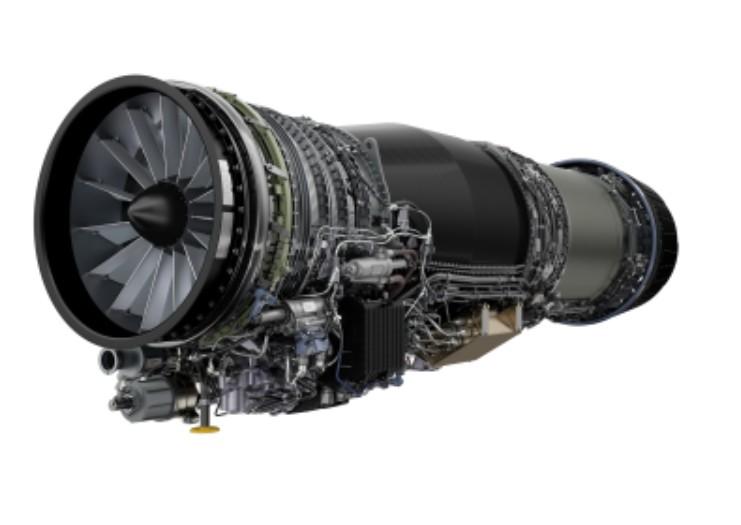
M88 Turbofan Engine
Manufacturer(s) | Safran Aircraft Engines | ||||||||
|---|---|---|---|---|---|---|---|---|---|
First Flight(s) | 27 February 1989 | ||||||||
Entry into Service | 1996 (French Air and Space Force) | ||||||||
Engine Type | Twin-engine, low bypass ratio, afterburning turbofan | ||||||||
Thrust (With Afterburner) | 75 kN (17,000 lbf) | ||||||||
Thrust (Dry) | 50 kN (11,250 lbf) | ||||||||
Bypass Ratio | 0.3 | ||||||||
Overall Pressure Ratio | 24.5 | ||||||||
Turbine Inlet Temperature | 1850 K | ||||||||
Specific Fuel Consumption (AB) | 1.70 kg/daN·h | ||||||||
Weight(s) | ~1 977 lb (897 kg) | ||||||||
Length(s) | 139 inches (approximately 3.53 m) | ||||||||
Control System | Full-authority digital engine control (FADEC) | ||||||||
Application Area(s) | Dassault Rafale multirole fighter aircraft | ||||||||
The SNECMA M88-2 is a low-bypass, twin-spool turbofan engine with an afterburner, designed to power the Dassault Aviation Rafale fighter aircraft. Developed to meet the French Air and Space Force’s requirement for a multirole combat aircraft, the engine is tailored for diverse mission profiles. The M88-2, the first production model of the M88 engine family, made its first flight in 1989 and entered operational service in 1996.
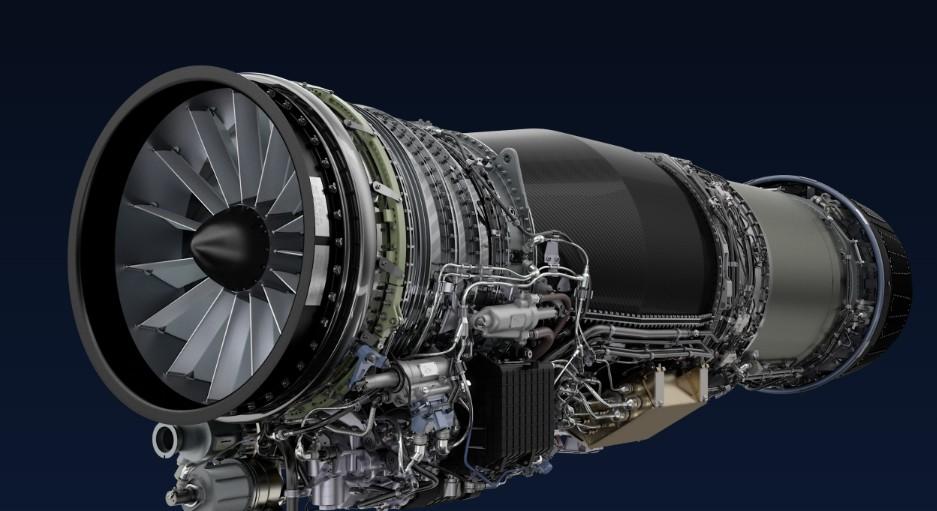
Snecma M88 Turbofan Engine (SAFRAN)
The M88-2 engine is engineered to perform effectively across both high-altitude air superiority and interception missions and low-altitude penetration and ground attack roles. Within this framework, conflicting design requirements have been integrated. A high bypass ratio and high pressure ratio are targeted to achieve low specific fuel consumption at low power settings, while low bypass ratio, high fan pressure ratio, and high turbine inlet temperature are preferred for missions demanding high speed and thrust.
The M88-2 consists of a three-stage variable inlet guide vane low-pressure (LP) compressor, a six-stage high-pressure (HP) compressor, a short and smokeless combustor, single-stage cooled HP and LP turbines, and a compact afterburner system. Maximum afterburning thrust is 75 kN (17,000 lbf), while dry thrust is 50 kN (11,250 lbf). Specific fuel consumption is reported as 1.70 kg/daN·s in afterburner mode and 0.80 kg/daN·s in dry operation. Turbine inlet temperature is 1850 K, overall pressure ratio is 24.5, and bypass ratio is 0.3.
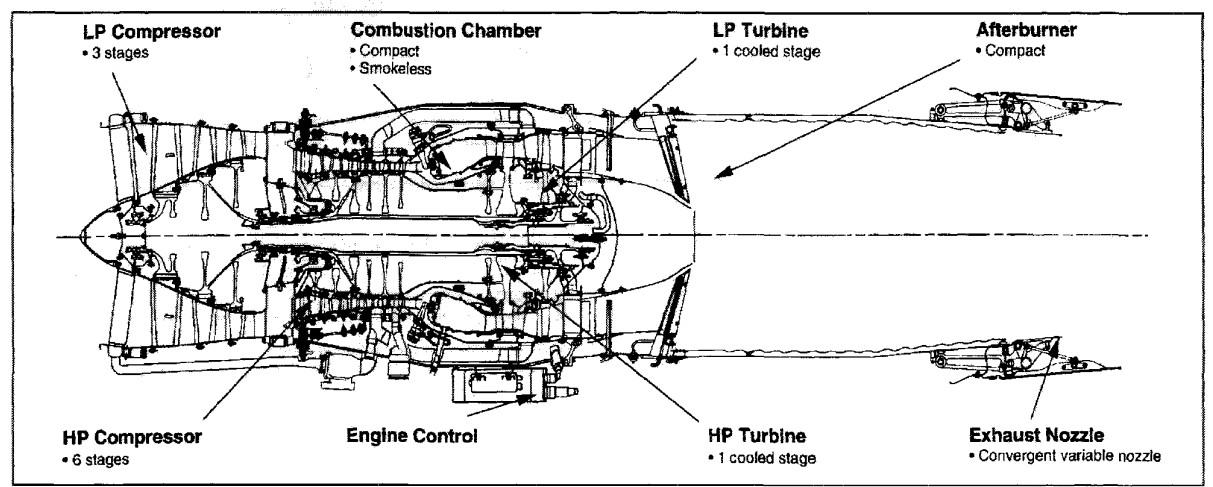
M88 Engine Cross-Section (M88)
The M88-2 engine has been optimized using advanced three-dimensional computational fluid dynamics and structural analysis methods. It incorporates single-crystal AMI turbine blades, powder metallurgy-produced N18 alloy disks, a PMR-15 resin-based composite bypass duct, and C/SiC exhaust flaps—all high-temperature-resistant and lightweight materials.
The M88-2 is equipped with a dual-redundant FADEC (Full Authority Digital Engine Control) system. This system interprets pilot commands to ensure optimal engine control while also performing engine health monitoring and maintenance analysis functions. FADEC calculates engine fatigue based on mission profile and assists in fault detection through event logging.
The development of the M88-2 is grounded in advanced research and technology demonstration programs initiated in the 1970s. Demonstrator programs such as DEXTRE, DRAC, and SIRA enabled the turbine inlet temperature to be raised to 1850 K and the engine configuration to be optimized. Certification was completed using only 22 engines (nine for development and thirteen for flight testing). By 1996, the M88-2 had accumulated 11,700 test hours, achieving operational readiness.
The engine’s structure, composed of 21 modules, provides high operational accessibility. Line and intermediate (O and I-level) maintenance tasks have been simplified, with many components designed for easy replacement. The M88-2 allows maintenance to be performed without requiring a test cell. Removal and installation procedures have been successfully tested under carrier-based naval conditions.
Corde, J. C. “SNECMA M88 Engine Development Status.” *Journal of Engineering for Gas Turbines and Power* 113, no. 1 (1991): 20–24. https://doi.org/10.1115/1.2906233.
Desaulty, Michel, and Catherine Devaux. “The M88.” Paper presented at the 36th AIAA/ASME/SAE/ASEE Joint Propulsion Conference, Huntsville, Alabama, July 17–19, 2000. https://arc.aiaa.org/doi/abs/10.2514/6.2000-3462.
Safran Group. "M88: Proven Performance and Reliability." Accessed May 16, 2025. https://www.safran-group.com/products-services/m88-proven-performance-and-reliability.
Safran Group. "Military Aircraft Engines." Accessed May 16, 2025. https://www.safran-group.com/products-services?category%5B0%5D=345-military-aircraft-engines.
Snecma. *M88-2 Military Aircraft Engines – Product Data Sheet*. Évry-Courcouronnes: Snecma Communications Department, June 2009. PDF. https://omnirole-rafale.com/wp-content/uploads/2019/01/Fiche-technique-M-88.pdf.

M88 Turbofan Engine
Manufacturer(s) | Safran Aircraft Engines | ||||||||
|---|---|---|---|---|---|---|---|---|---|
First Flight(s) | 27 February 1989 | ||||||||
Entry into Service | 1996 (French Air and Space Force) | ||||||||
Engine Type | Twin-engine, low bypass ratio, afterburning turbofan | ||||||||
Thrust (With Afterburner) | 75 kN (17,000 lbf) | ||||||||
Thrust (Dry) | 50 kN (11,250 lbf) | ||||||||
Bypass Ratio | 0.3 | ||||||||
Overall Pressure Ratio | 24.5 | ||||||||
Turbine Inlet Temperature | 1850 K | ||||||||
Specific Fuel Consumption (AB) | 1.70 kg/daN·h | ||||||||
Weight(s) | ~1 977 lb (897 kg) | ||||||||
Length(s) | 139 inches (approximately 3.53 m) | ||||||||
Control System | Full-authority digital engine control (FADEC) | ||||||||
Application Area(s) | Dassault Rafale multirole fighter aircraft | ||||||||
Design Requirements
Technical Architecture and Performance
Technological Features and Materials
Control System
Development Strategy
Maintenance and Modularity