


This article was automatically translated from the original Turkish version.
The Sixth Municipality District was a municipal organization established in 1857 in the Beyoğlu and Galata areas of the Ottoman Empire, based on Western municipal concepts and constituting the first example of the transition to a modern local governance system. This institution, which possessed a partially autonomous structure from the central government, was tasked with providing services in urban planning, sanitation, infrastructure, public order, and health, and was modeled after the French Sixième Arrondissement. The Sixth Municipality District played a pioneering role in the institutionalization of municipal governance in the Ottoman Empire through both its institutional structure and its practices, serving as a model for subsequent municipal organizations.
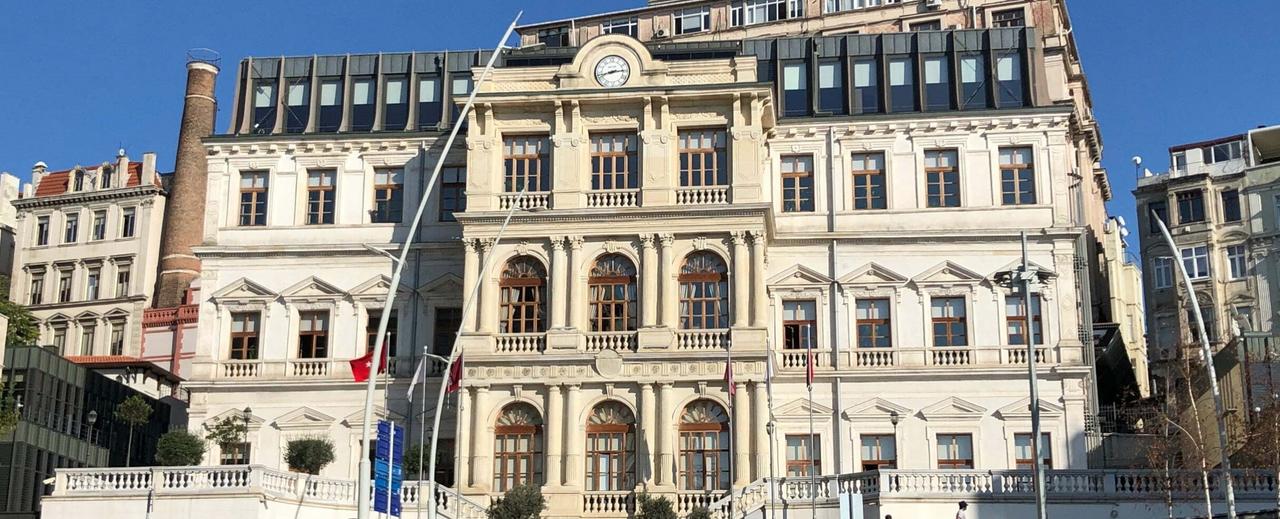
Building of the Sixth Municipality District (Cultural Inventory)
The first and most significant step toward modern municipal governance in the Ottoman Empire was the establishment of the Sixth Municipality District through regulations issued in 1857 and 1858. This institution emerged as a modernization effort responding both to internal urbanization challenges and to direct inspiration from municipal models in Western Europe.
The establishment of the Sixth Municipality District gained momentum following the Crimean War (1853–1856), due to the increasing presence of Western populations in Istanbul and the growing need for modernization in the Beyoğlu-Galata region. Inadequate infrastructure, public order issues, and deficiencies in public services highlighted the necessity for a municipal organization adhering to Western standards.
In this context, the first steps toward municipal service provision in Istanbul were taken with the publication of the “Regulation on Municipality Districts” in 1857. However, the full legal foundation of the Sixth Municipality District was established by the “General Regulation of the Beyoğlu and Galata District” issued in 1858. This regulation detailed the district’s duties and powers, organizational structure, revenue sources, and operational principles. With the publication of this regulation, the Sixth Municipality District officially began operations.
The operational area of the Sixth Municipality District encompassed the Beyoğlu and Galata neighborhoods of Istanbul. This region was the most cosmopolitan and modernized part of Istanbul in the mid-19th century. Particularly due to the dense presence of Levantines, Western merchants, and diplomatic missions, these neighborhoods required the order and service standards found in European cities. Therefore, establishing the first modern municipal organization in this area aimed both to address urgent needs and to serve as a showcase for the Westernization project.
The organization and functioning of the Sixth Municipality District were directly influenced by the French municipal system, especially the model of Paris’s “Sixième Arrondissement.” This model allowed district administrations to deliver specific services independently from central authority. Ottoman administrators were particularly impressed by the success of this model in urban planning, infrastructure, sanitation, and public order. Indeed, the very name “Sixth District” is a concrete manifestation of this French influence.
Some sources suggest that the designation “Sixth District” was based on the area’s distance from Istanbul’s center. However, the general consensus is that it was inspired by Paris’s “Sixième Arrondissement.” The transformation of Pera and Galata into one of Europe’s key centers of trade and diplomacy was the fundamental reason for applying this model there. Implementing a modern administrative structure in this region, which operated under the influence of foreign powers and capitulations, aimed to enhance international prestige and improve service quality.
As an embodiment of modern municipal governance in the Ottoman Empire, the Sixth Municipality District was established with a defined administrative structure and an extensive range of responsibilities. This structure aimed to provide more orderly and Western-standardized services, differing from traditional local governance models.
The district was headed by a president, known as the “Daire Reisi” or “Şehremini,” appointed by the central government and held accountable for the overall functioning of the district. Below the president were directorates and commissions managing various service areas. The employment of professionals such as engineers, doctors, architects, and other specialists reflected the principles of modern municipal governance. In particular, the reliance on engineering expertise for urban planning and infrastructure projects marked a significant departure from the traditional Kadılık system.
A key feature of the district was its financial autonomy. It had the authority to formulate its own budget and collect revenues. This financial independence enabled the district to deliver services more effectively. The administration was not composed solely of appointed officials but also included an “Administrative Council” or “Municipal Council” representing the local population.
The duties and powers of the Sixth Municipality District were detailed in the “General Regulation of the Beyoğlu and Galata District” (1858). Its core service areas included:
The Sixth Municipality District had access to various revenue sources to fulfill its duties, including property taxes, business licensing fees, market dues, and other local levies. It could also receive financial support from the central government in specific circumstances. The district’s budget was managed transparently, with regular reports prepared to ensure fiscal balance. This financial structure formed the foundation for the district’s sustainable service delivery.
The district also possessed certain legal authorities related to its jurisdiction. For instance, it had the power to impose penalties and fines on individuals who violated its regulations. Additionally, a “Peace Court” was established within the district to handle minor civil disputes. This demonstrated that the district possessed not only administrative but also partial judicial authority.
The Sixth Municipality District was not only an institutional innovation but also a symbolic landmark in the Ottoman modernization process due to its physical structure. The building reflected the architectural trends and Westernization influences of its time.
The previous Şehremaneti building had operated on the site of the present-day Istanbul Metropolitan Municipality building. However, the Sixth Municipality District required a separate building to effectively deliver services specific to Beyoğlu and Galata.
The Sixth Municipality District building clearly exhibits Westernization influences characteristic of 19th-century Ottoman architecture. It is believed to have been constructed under the influence of neoclassical and Empire styles. Such buildings diverged from traditional Ottoman civic architecture by embodying the monumental and functional characteristics of European public buildings. The design incorporated contemporary Western architectural principles, with façade arrangements, window openings, and interior layouts adhering to modern standards. The building’s existence and architecture demonstrate that the Sixth Municipality District was not merely an administrative innovation but also an integral part of the physical modernization of the urban environment.
From an art historical perspective, the Sixth Municipality District building holds significant importance as one of the earliest examples of public buildings constructed during the Ottoman Westernization period. It is worthy of study for reflecting changing aesthetic preferences, functional aspirations, and the initial applications of Western-style architecture in Ottoman territories. Unfortunately, detailed floor plans or interior photographs of the building are not directly accessible in existing sources. However, it is known that such administrative buildings typically housed management offices, meeting halls, and service units. Although the specific construction materials are not explicitly stated, it is reasonable to infer that common materials of the era—such as stone, wood, and iron—were used.
Aydın, A. "Türkiye’de İlk Modern Yerel Yönetim Denemesi Olan Altıncı Daire-İ Belediye İle Sixième Arrondissement Karşılaştırması." OPUS International Journal of Society Researches 11, no. 18 (2019): 2708-2727. DOI Link
Kolay, E. "Osmanlı Belediye Binalarının İlk Örneği: Altıncı Daire-i Belediye Binası." Journal of Palmette sy. 3 (2023): 28-52.
Oktay, T. "Tanzimat Dönemi İstanbul’da Bir Belediye Örgütlenmesi Örneği 'Altıncı Dâire-i Belediye'." Öneri Dergisi 4, no. 15 (2001): 157-166. https://doi.org/10.14783/maruoneri.735505.
Önver, Ş. B. "Altıncı Daire-i Belediye ve Günümüz Belediye Hizmetleriyle Karşılaştırılması." Takvim-I Vekayi 7, sy. 1 (2019): 37-72.

No Discussion Added Yet
Start discussion for "Sixth Municipal Department" article
Establishment of the Sixth Municipality District
Area of Operation: Beyoğlu and Galata
Structure and Responsibilities of the Sixth Municipality District
Service Areas and Activities
Financial Structure and Revenue Sources
Legal Authorities
The Sixth Municipality District Building