


This article was automatically translated from the original Turkish version.
+2 More
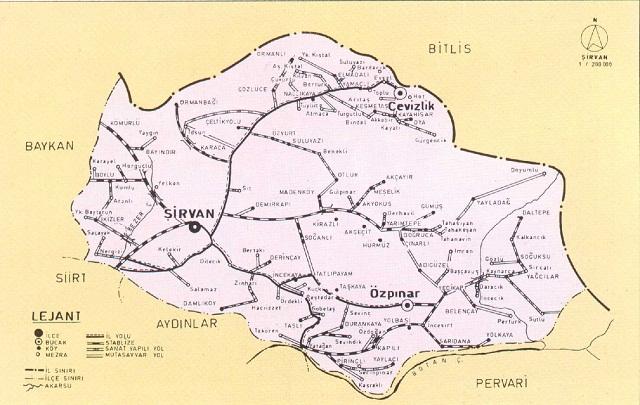
Şirvan (District)
Location | The northern part of Siirt Province Southeastern Anatolia Region | ||||||||
|---|---|---|---|---|---|---|---|---|---|
Former Name(s) | Küfre | ||||||||
Area(s) | 1 034 km² | ||||||||
Number of Villages | 55 | ||||||||
Neighbors | To the east Pervari, to the west Baykan, to the north Bitlis, to the northeast Hizan, to the south Siirt | ||||||||
Şirvan is a town situated on flat terrain in the northern part of Siirt Province within the Southeastern Anatolia Region. It is notable for its attached gardens, rivers, mosque and medreses, caravanserai, bathhouse, bazaar and covered bazaar. Originally known as Küfre, Şirvan was recorded in the 1871 Diyarbekir Salname as one of the four kazas under Siirt Sancağı. The Küfre Beylik maintained dominance in Şirvan and a structure known as “Küfre” from that period has survived to the present day.
Şirvan has a deeply rooted history. In 77 AD it came under the influence of the Roman Empire, and from 395 it became part of the Byzantine Empire. In 572 it fell within the borders of the Sassanian State. In the 700s Şirvan came under Arab control, then in the 1100s it was incorporated into the Artuqid Beylik, and in 1243 it came under Mongol control. In 1514 it was incorporated into Ottoman territory. Before the Republic, Şirvan was one of the oldest settlement units under Ottoman administration within Siirt Sancağı and remained a subdistrict under Bitlis Province until Siirt attained vilayet status in 1871.
Şirvan is located immediately north of Siirt Province and covers an area of 1,034 km². It is bordered by Pervari District to the east, Baykan District to the west, Bitlis Province to the north, Hizan District to the northeast, and Siirt Province to the south. The district has 55 villages and its terrain is generally hilly. The main mountains of Şirvan are Hasteri Dağı to the north, Bardak Dağı, Siser Tepesi and Bacavan Dağı to the northeast, and Kaş Dağı to the south. The region’s climate exhibits land characteristics: winters are cold, summers are hot, and autumn and winter seasons are rainy.
Şirvan’s economy is primarily based on animal husbandry. In addition, row, walnut, pistachio, pomegranate and rice like are also significant agricultural products. Since 1965 the economy has shown continuous development. Rice production on approximately 100 hectares is one of the district’s main sources of livelihood. Animal husbandry and the salt mines in the district center also hold economic importance. The copper mines in Mine Village, with visible reserves of 27 million tons, have not yet been opened for operation. Although animal husbandry has declined over the years, beekeeping has recently emerged as a new income source through hives distributed by the district governorship. Greenhouse farming and trout facilities are also being newly established and represent initiatives aimed at encouraging productivity and offering alternative livelihoods.
Şirvan is located 26 km from the center of Siirt Province. Although there are no villages without roads in the district, the inadequate condition of village roads causes serious transportation difficulties, especially during rainy weather and winter months.
Şirvan continues to exist as one of the important districts of Siirt due to its rich history, geographical location and economic potential.
Siirt Valiliği. "Şirvan." Accessed April 8, 2025. http://www.siirt.gov.tr/sirvan.
Siirt İl Kültür ve Turizm Müdürlüğü. “Siirt İl Kültür ve Turizm Müdürlüğü.” Accessed April 8, 2025. https://siirt.ktb.gov.tr/
Siirt İl Kültür ve Turizm Müdürlüğü. “Şirvan.” Accessed April 8, 2025. https://siirt.ktb.gov.tr/TR-56333/sirvan.html.
Şirvan Kaymakamlığı. "Tarihçe." Accessed April 8, 2025. http://www.sirvan.gov.tr/tarihce.

Şirvan (District)
Location | The northern part of Siirt Province Southeastern Anatolia Region | ||||||||
|---|---|---|---|---|---|---|---|---|---|
Former Name(s) | Küfre | ||||||||
Area(s) | 1 034 km² | ||||||||
Number of Villages | 55 | ||||||||
Neighbors | To the east Pervari, to the west Baykan, to the north Bitlis, to the northeast Hizan, to the south Siirt | ||||||||
Historical Development
Geographical Location
Economic Situation
Transportation