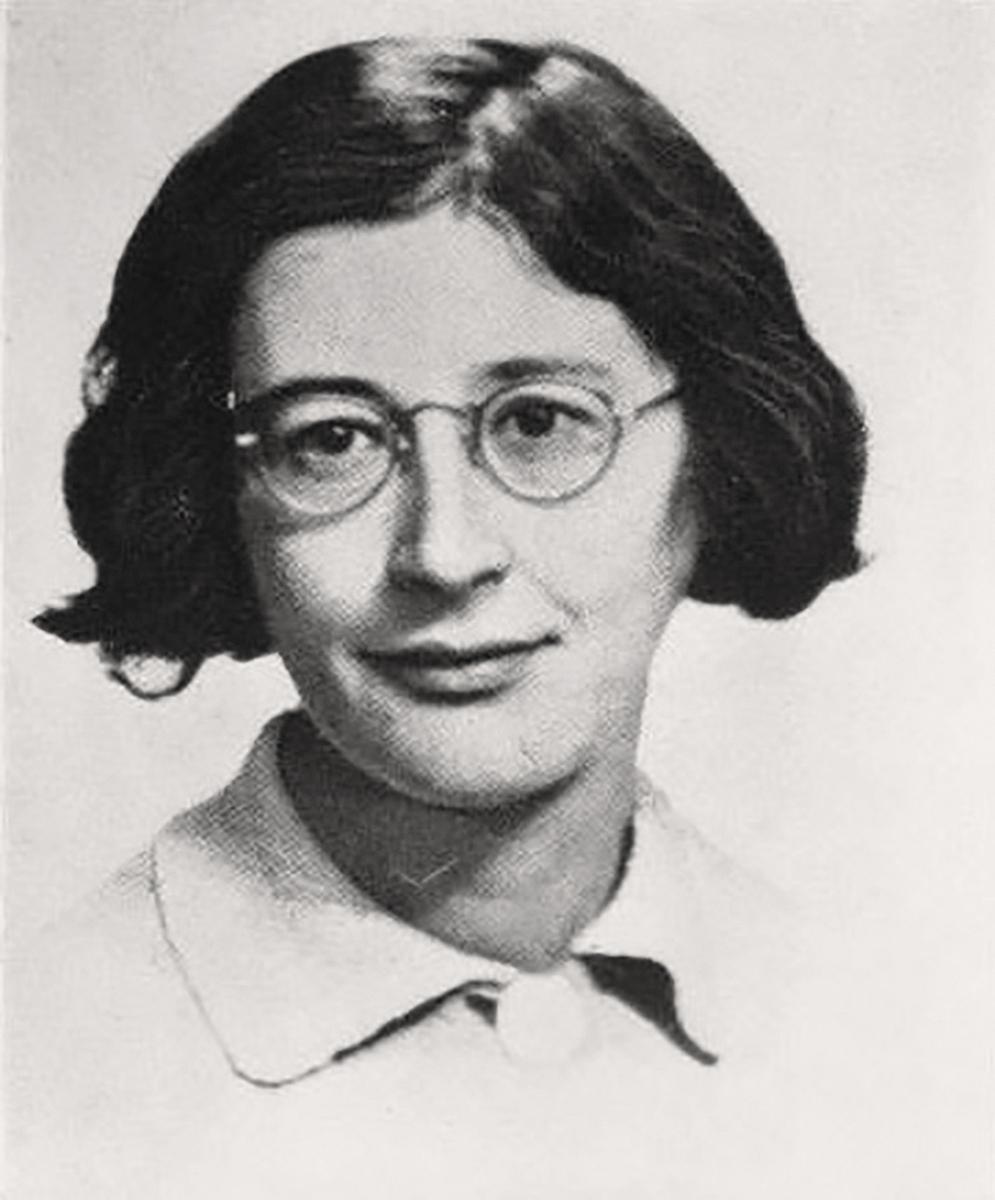

Doğum tarihi | 1909-02-03 | ||||||||
|---|---|---|---|---|---|---|---|---|---|
Ölüm tarihi | 1943-08-24 | ||||||||
Place of Death | Ashford / United Kingdom | ||||||||
Place of Birth | Paris / France | ||||||||
Nationality | French | ||||||||
Genres of Writing | Essay, Letter, Notebook, Draft text | ||||||||
Important Experiences | Factory labor (1934–1935), Observations of the Spanish Civil War (1936), Experiences in Portugal, Italy, and Solesmes (1935–1938), Free France activities - London (1942–1943) | ||||||||
Areas of Work | Work, Social pressure, Power and violence, Suffering and calamity (malheur), Obligation, Rootedness, Ethics, Politics, Religion | ||||||||
Profession(s) | Philosopher Political Writer Teacher | ||||||||
Education | Lycée Henri-IV École Normale Supérieure Agrégation de philosophie | ||||||||
Simone Weil was a French philosopher who, throughout her life, integrated philosophical thought with lived experience on an ethical plane, examining the political and moral problems of the modern world through concepts such as labor experience, social oppression, affliction, power, obligation, and rootedness, synthesizing critical Marxism with heterodox Christian thought.
Simone Weil was born on 3 February 1909 in Paris. She was the younger of two children in a family that enjoyed economic comfort and provided a secular and agnostic environment. Both of her parents came from Jewish families. Weil’s childhood unfolded within a culturally enriched and bourgeois French milieu.
Her father worked as a physician. Her older brother, André Weil, three years her senior, became a renowned mathematician; he was one of the founders of the Bourbaki group and served at the Institute for Advanced Study. Weil later recalled that during her adolescence she felt inadequate in comparison to her brother’s talents, a sense that generated in her profound despair; it was during this period that she came to believe that access to truth was possible only through constant attention and intense effort.【1】
From childhood, Weil displayed a pronounced moral sensitivity. It is recounted that at age five she refused to accept a gift necklace, arguing that luxury was inherently discriminatory, and at age six she declined to consume more sugar than was allocated to French soldiers at the front. It is known that within the family she was called “Simon,” a name preferred by her parents and occasionally used by Weil as a signature in some of her correspondence.
Weil’s relationship with Judaism remained controversial throughout her life. Due to her family’s secular outlook, she never established a connection with Jewish religious practices and did not identify herself as Jewish in religious terms. In a 1940 letter, she stated that she had never entered a synagogue and saw no reason to feel connected to the communities that had lived in Palestine two thousand years ago. At the same time, she described herself as “inherently inspired by Christianity” and associated her education and cultural orientation with Catholic and French traditions.【2】
Simone Weil received her education in various schools and under private tutors during her childhood and early youth. She completed her secondary education in Paris. During this period, she studied at Lycée Henri-IV as a student of Émile Chartier (pen name Alain), one of the leading philosophy teachers of the era. Chartier’s classes centered on ancient Greek philosophy, the history of modern philosophy, and literature. Through this educational process, Weil systematically engaged with the texts of thinkers such as Plato, Marcus Aurelius, Descartes, Spinoza, and Kant.
In 1928, she was admitted to the École Normale Supérieure. At the time, she was among the small number of female students enrolled in the institution. Between 1929 and 1930, she conducted a thesis study focused on knowledge and perception in Descartes.
Throughout her academic training, Weil did not treat philosophy as merely a theoretical discipline. Her education became a period of questioning the relationship between thought and practical activity. As a student, she engaged in union activities, wrote on workers’ movements, and interacted with various political groups. This orientation continued alongside her later teaching duties.
Weil’s philosophical orientation during this period drew from Descartes’ subject-centered thought, Marx’s social and material analyses, and Kant’s conception of moral absolutism. The theoretical framework she acquired during her education formed the foundation of her later social, ethical, and political thought.
Simone Weil began her career as a philosophy teacher in French state secondary schools after passing the agrégation examination in 1931. Her first posting was at a girls’ high school in Le Puy, one of the regional centers of France. Between 1931 and 1934, she taught at various secondary schools. During this time, she devoted significant time outside her professional duties to extracurricular activities.
While teaching, Weil established direct contact with workers’ movements. She gave philosophy lessons to worker groups, participated in union activities, and wrote on workers’ demands. During this same period, she did not remain merely an observer; she occasionally engaged in physically demanding labor to experience working-class life firsthand.
In 1932, she traveled to Germany. The purpose of this journey was to examine on-site the social and economic conditions underlying the rise of National Socialism. She observed the state of trade unions, the prevalence of unemployment, and the political organizing capacity of the working class. This experience deepened her critiques of the effects of modern societies’ bureaucratic structures and organizational hierarchies on the individual.
During this period, Weil drew on Marx’s methodological analyses but maintained a critical distance from the notion of revolution as a historical necessity. She argued that social oppression originated not only from property relations but also from the division of labor, specialization, and forms of bureaucratic management. In her 1934 work “Thoughts on the Causes of Liberty and Social Oppression,” she systematically articulated the foundational concepts of her early political thought.
In 1934, Simone Weil took a leave of absence from her teaching duties to apply for work in factories in Paris. This decision was motivated by her desire to directly experience the conditions of the working class and to observe from within the material foundations of social oppression. For approximately twenty-four weeks, she worked in various factories alongside unskilled female laborers.
In her Factory Journal, written during this period, she described how the production process had crystallized method into machinery, how thought had become concentrated in metal, and how the worker had been reduced to an automaton serving the machine. Under these conditions, she noted, thought receded and conscious activity gradually disappeared.【3】The labor process is defined not only as a physical but also as a mental and moral site of exhaustion. Weil explains this condition using the concept of “slavery,” emphasizing that fatigue and passivity, rather than resistance, emerge under such conditions.
The conditions of factory work are detailed extensively in Weil’s writings. The high speed of production, constant directives from supervisors, and time pressure are identified as central elements of the labor process. Weil notes that under these conditions, thinking becomes increasingly difficult, while fatigue and obedience come to the fore.【4】She associates her experience less with physical pain than with feelings of degradation and devaluation.
Simone Weil’s conception of war, violence, and power was shaped by her factory experience, observations during the Spanish Civil War, and her analyses of classical texts. The central concept in this conception is “power.” In Weil’s writings, power is defined as an effect that strips humans of their humanity and reduces them to objects.
For Weil, power is not limited to armed violence. Factory systems, battlefields, and bureaucratic structures are all arenas in which power operates in different forms. The essential feature of power is its capacity to render the subject passive and incapable of asserting control over their own existence. Thus, power functions both through physical and social conditions.
The executions and civilian deaths she witnessed during the Spanish Civil War were decisive in shaping her views on violence. These experiences served as examples demonstrating that war cannot be morally elevated and that violence, regardless of the side, drags humans into the condition of objects.
This perspective is also evident in her analysis of Homer’s Iliad. Weil argues that in this epic, power equally alienates both victors and vanquished from their humanity. Power temporarily elevates its user to a position of superiority, yet simultaneously renders that person fragile and vulnerable to destruction. Thus, there is no absolute or lasting superiority in war.
Another notable aspect of Weil’s conception of power is its weakening of the capacity for thought. The person subjected to power acts under fear and compulsion; this condition restricts both moral reasoning and free will. The same effect is observed in the person wielding power: it renders them incapable of perceiving the suffering of others.
In Simone Weil’s thought, the concepts of suffering and affliction (malheur) are distinctly separated. Weil asserts that not all suffering constitutes affliction. Affliction refers to a holistic condition encompassing not only physical pain but also spiritual collapse and social degradation.
Affliction arises from an event that shatters a person’s life at its roots. This event simultaneously affects the person’s bodily integrity, spiritual balance, and social standing. According to Weil, affliction goes beyond physical pain; it is a condition that devalues the individual both in the eyes of others and in their own self-perception.【5】In this process, the person is pushed into the position of “nobody.”
Weil defines affliction as equivalent to death. Affliction does not kill the person physically but creates an effect that destroys them while they are still alive. Therefore, affliction is not merely an individual experience but also a social phenomenon. Social degradation and exclusion are distinguishing features of affliction.
According to Weil, affliction eliminates the human “I.”【6】The person can no longer perceive themselves as a subject; will, hope, and expectations for the future weaken. Consequently, the individual subjected to affliction largely loses the capacity to ask for help or to help others. The difficulty afflicted people experience in articulating their condition is understood within this context.
Weil emphasizes that affliction is difficult to comprehend.【7】Those who have not experienced affliction cannot fully grasp it. Thought naturally tends to flee from affliction. This avoidance leads to affliction becoming socially invisible.
Simone Weil’s relationship with Christianity was shaped by three experiences during the 1930s. Weil refers to these as “three significant encounters.” These were not part of a systematic process of religious conversion but were lived, personal experiences.
The first experience occurred in 1935 during a religious procession in a fishing village in Portugal. She later wrote that it was then she became acutely aware of Christianity as “the religion of slaves.”【8】The second occurred in 1937 while praying in a chapel near Assisi in Italy; she recalled falling to her knees. The third took place in 1938 during Holy Week in Solesmes, while listening to Gregorian chants; she wrote of perceiving a connection between suffering and divine love. During the same period, while repeatedly reading George Herbert’s poem “Love,” she felt the presence of Christ.
Despite these experiences, Weil was never baptized and never joined the institutional Church. She approached Christianity through the concepts of suffering, necessity, affliction, and obedience, evaluating this relationship within a framework of social and personal experience.
Simone Weil’s personality and lifestyle were defined by her unique strict principles and conscious self-restraints. In daily life, she avoided physical comfort, limiting her food, housing, and working conditions to match those of the most disadvantaged members of the social groups she cared about. At various times, she restricted her food intake according to the conditions of soldiers, workers, refugees, and prisoners of war.
Weil did not prioritize her physical health. Prolonged sleep deprivation, intense work pace, and inadequate nutrition persisted throughout different phases of her life. It is noted that she frequently accused herself of “inertia” and “insufficiency,” and embraced greater work and self-discipline as a means to overcome this state.【9】
Her clothing style was simple and distinctive. She avoided garments that emphasized femininity; she wore skirts, jackets, flat shoes, and in later years, a beret and trousers. She associated these choices with her health, her valuation of time, and her understanding of social equality.
She maintained distance from physical contact and bodily closeness. It is reported that she avoided hugging and similar behaviors and adopted a cautious attitude toward friendships and romantic relationships. Her self-assessments often contained negative statements regarding the body and the sense of “I.”
Her lifestyle was directly connected to her intellectual production. Weil argued that no distinction should be made between thought and life; she strove to align her philosophical attitudes with everyday practices.【10】This approach was decisive in her work routine, political activities, and personal habits.
Simone Weil’s later thought becomes prominent in the writings she produced during the years of the Second World War. During this period, the concepts of obligation, rootedness, and social order occupy a central place. Weil approaches political thought not in terms of individual rights but in terms of obligations corresponding to human physical and spiritual needs.
For Weil, obligation is a principle that exists whether recognized or not.【11】Obligations are linked not only to human physical needs such as hunger, shelter, and security, but also to spiritual needs such as order, continuity, tradition, and meaning. In this framework, the concept of rights occupies a secondary position and is evaluated conditionally.
The concept of rootedness refers to a genuine and effective bond between an individual and the community in which they live. Weil argues that in modern societies, processes such as war, industrialization, and centralization lead to rootlessness. Rootlessness is understood as a condition that impoverishes the individual both socially and spiritually.
During this period, Weil maintained a critical distance from revolutionary politics. She argued that solutions to social problems must emerge not from abstract projects but from concrete, context-based arrangements. She links politics to the limitation of power and the preservation of human capacity for thought and consent.
In her later writings, the purpose of political order is defined as the minimization of conditions that produce affliction. Within this framework, the regulation of working life, the strengthening of local communities, and the limitation of centralized structures are among the central concerns.
Simone Weil’s writings were produced over a period of approximately fifteen years. The majority of her texts were unpublished during her lifetime and were compiled and published posthumously. Her writings consist of essays, drafts, letters, and personal notebooks. A significant portion of her texts were written in response to specific historical and political contexts.
Weil’s writing style is often fragmented and aphoristic. Her notebooks, in particular, were not intended to construct a systematic philosophical structure but were maintained as records of intellectual inquiry. These notebooks and draft texts were later edited according to editorial choices after her death. As a result, her works are understood not as completed treatises but as documents of a thinking process.
The fragmented nature of her writings and their publication through various editorial arrangements have made it difficult to consolidate her intellectual legacy under a single interpretation. Therefore, Weil’s thought is understood not as a completed doctrine but as a coherent body of ideas spread across multiple domains and open to diverse readings.
Simone Weil died in England in 1943. Her health deteriorated while working for Free France in London. Prolonged inadequate nutrition, excessive work, and sleep deprivation had weakened her physical resilience. During this period, she was diagnosed with tuberculosis.
She was treated in a hospital and later in a rural sanatorium. Despite doctors’ recommendations to improve her nutrition and rest, Weil refused to eat. This stance is recorded as being motivated by her identification with the conditions of those living under occupation in France.
She died on 24 August 1943 at the age of 34. Official records list the cause of death as tuberculosis and malnutrition. Although she was never baptized, she was buried in the pauper’s section of the Catholic cemetery in Ashford, Kent, England.
Chenavier, Robert. “Simone Weil. Philosophe du travail.” *Revue d'éthique et de théologie morale*, no. 244 (2007): 31-40. Accessed January 31, 2026. https://shs.cairn.info/revue-d-ethique-et-de-theologie-morale-2007-2-page-31?tab=texte-integral
Kinsella, Helen M. “Simone Weil: An Introduction.” *Emigré Scholars and the Genesis of American International Relations*. (2014): 176-196. Accessed January 31, 2026. https://www.researchgate.net/publication/331212512_Simone_Weil_An_Introduction
Lynch, Tony. “Simone Weil (1909—1943)”. *Internet Encyclopedia of Philosophy*. Accessed January 31, 2026. https://iep.utm.edu/weil/
Rozelle-Stone, A. Rebecca, and Benjamin P. Davis. “Simone Weil.” *Stanford Encyclopedia of Philosophy*. Accessed January 31, 2026. https://plato.stanford.edu/entries/simone-weil/
Winther, Truls Olav, and Geir Uvsløkk. “Simone Weil.” *Store norske leksikon*. Accessed January 31, 2026. https://snl.no/Simone_Weil
[1]
Helen M. Kinsella, “Simone Weil: An Introduction,” Émigré Scholars and the Genesis of American International Relations (Felix Rösch, ed.) (2014): p 182, https://www.researchgate.net/publication/331212512_Simone_Weil_An_Introduction
[2]
A.e., p 185
[3]
A.e., p 186-187
[4]
A.e., 186-187
[5]
A.e., p 189
[6]
Tony Lynch, “Simone Weil (1909—1943),” Internet Encyclopedia of Philosophy, Accessed: 3 February 2026, https://iep.utm.edu/weil/
[7]
Tony Lynch, “Simone Weil (1909—1943),” Internet Encyclopedia of Philosophy, Accessed: 3 February 2026, https://iep.utm.edu/weil/
[8]
A. Rebecca Rozelle-Stone and Benjamin P. Davis, “Simone Weil,” Stanford Encyclopedia of Philosophy, Accessed: 3 February 2026, https://plato.stanford.edu/entries/simone-weil/
[9]
Helen M. Kinsella, “Simone Weil: An Introduction,” Émigré Scholars and the Genesis of American International Relations (Felix Rösch, ed.) (2014): p 178, https://www.researchgate.net/publication/331212512_Simone_Weil_An_Introduction
[10]
Tony Lynch, “Simone Weil (1909—1943),” Internet Encyclopedia of Philosophy, Accessed: 3 February 2026, https://iep.utm.edu/weil/
[11]
Tony Lynch, “Simone Weil (1909—1943),” Internet Encyclopedia of Philosophy, Accessed: 3 February 2026, https://iep.utm.edu/weil/

Doğum tarihi | 1909-02-03 | ||||||||
|---|---|---|---|---|---|---|---|---|---|
Ölüm tarihi | 1943-08-24 | ||||||||
Place of Death | Ashford / United Kingdom | ||||||||
Place of Birth | Paris / France | ||||||||
Nationality | French | ||||||||
Genres of Writing | Essay, Letter, Notebook, Draft text | ||||||||
Important Experiences | Factory labor (1934–1935), Observations of the Spanish Civil War (1936), Experiences in Portugal, Italy, and Solesmes (1935–1938), Free France activities - London (1942–1943) | ||||||||
Areas of Work | Work, Social pressure, Power and violence, Suffering and calamity (malheur), Obligation, Rootedness, Ethics, Politics, Religion | ||||||||
Profession(s) | Philosopher Political Writer Teacher | ||||||||
Education | Lycée Henri-IV École Normale Supérieure Agrégation de philosophie | ||||||||
Birth and Family
Education and Academic Life
Teaching Activities and Early Political Work
Factory Experience and Philosophy of Labor
War, Violence, and Conception of Power
Affliction (Malheur)
Religious Experiences and Relationship with Christianity
Personality and Lifestyle
Later Period: Obligation, Rootedness, and Politics
Works and Nature of Her Writings
Major Works
Death