


This article was automatically translated from the original Turkish version.
+1 More
(Generated by Artificial Intelligence.)
Silifke's Yogurt (Türkü)
Subject(s) | Love / Passion | ||||||||
|---|---|---|---|---|---|---|---|---|---|
Type(s) | Turkish Folk Song | ||||||||
Region(s) | Mersin – Silifke | ||||||||
Collector – Notator | Muzaffer Sarısözen | ||||||||
Source Person | Cavit Erden | ||||||||
Repertuar No | 1657 | ||||||||
Silifke’s Yogurt is a folk song deeply integrated into the local culture of the Silifke district of Mersin Province. The folk song addresses the role of animal husbandry and particularly yogurt production in daily life and social relations in the Silifke region. Originating in oral culture, the piece was later collected and incorporated into the repertoire of Turkish folk music.
Silifke’s Yogurt folk song is registered under repertoire number 1657. Its region of origin is identified as the Silifke district of Mersin. The source informant is Cavit Erden. The collection and notation were carried out by Muzaffer Sarısözen. The piece is performed by a regional ensemble.
The song is composed in the Segâh modal system. Its meter is 2/4 and its final and resolution tone is si. The lowest note is sol and the highest is la, giving it a nine-note range. Although thematically classified within the context of love and longing, it also reflects elements of local life.
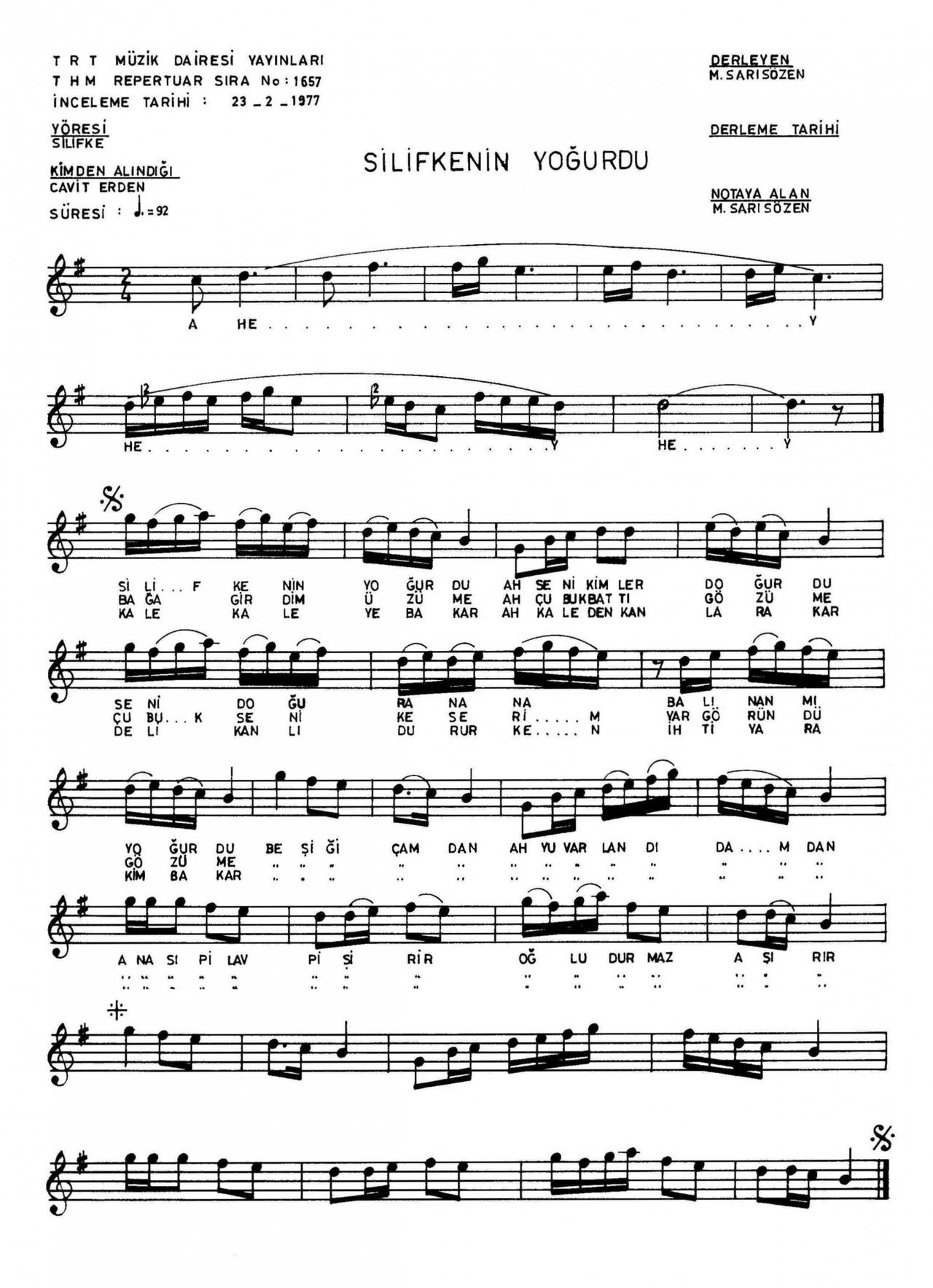
First page of the notation for Silifke’s Yogurt folk song (Segâh mode, 2/4 meter) (Repertükül)
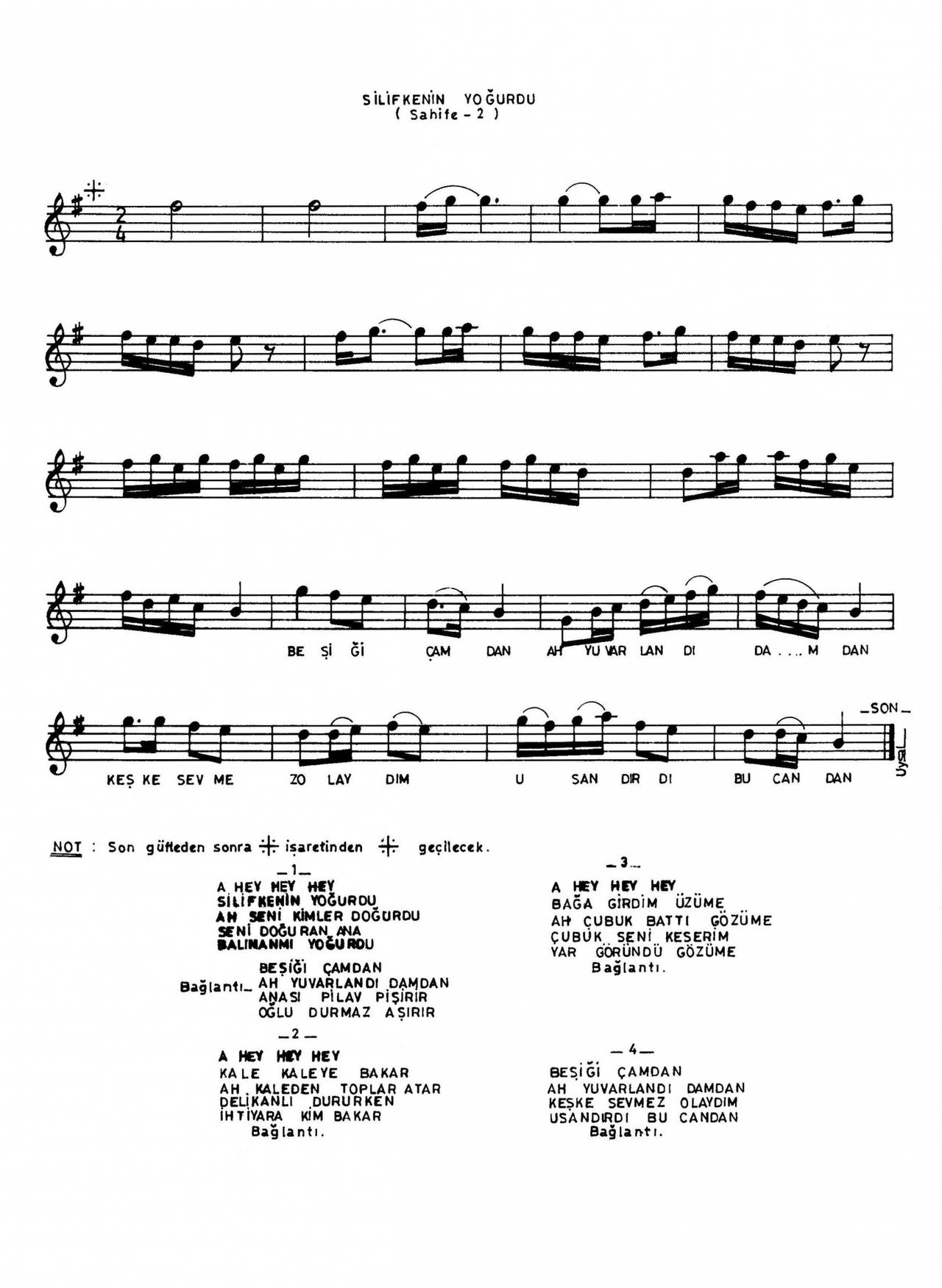
Second page of the notation for Silifke’s Yogurt folk song (Repertükül)
In the song, yogurt is presented as an element tied to the lifestyle of the Turkmen and Yörük communities living in Silifke and its surroundings. Yogurt production and sale were important sources of livelihood for these groups in past centuries. This economic role provided the foundation for yogurt to appear not only in daily life but also in oral narratives and music.
The lyrics of the song focus on Yörük girls who make and sell yogurt in Silifke, reflecting how local economic activities are mirrored in social life and emotional expression. Poets expressed these observations in the form of folk songs, and the piece was passed down from generation to generation.
Silifke’s Yogurt folk song is performed together with a folk dance of the same name. This dance is described as an old Turkmen dance. Women and men perform it in alternating roles. The dance movements symbolize the process of yogurt production.
The dance includes steps such as forward-backward stepping, crouching, 360-degree turns, and quadruple stomps. These movements serve as a symbolic representation of the livestock-based production process and the significance of yogurt in Turkmen life.
(a hey hey hey)
Silifke’s yogurt, who gave birth to you? Was your mother the one who made it?
Its cradle was made of pine, Ah it rolled down from the roof. The mother cooks pilaf, the son never stops working.
(a hey hey hey)
The castle looks at another castle, Ah stones are thrown from the rampart. When the young man stands still, who watches the old man?
(a hey hey hey)
I entered the orchard for grapes, Ah the stick struck my eye. I will cut you with this stick, for your face has appeared before my eyes.
(a hey hey hey)
Its cradle was made of pine, Ah it rolled down from the roof. I wish I had never loved you, you have wearied this soul.
Silifke’s Yogurt (Folk Song and Folk Dance) (TRT Avaz)
Silifke’s Yogurt folk song is one of the oral cultural expressions reflecting the place of animal husbandry and yogurt production in the social life of the Silifke region. The fact that yogurt served as a livelihood for Turkmen communities endowed it with cultural value, a value preserved and transmitted to the present through the folk song and dance.
In this regard, the song is regarded as part of Silifke’s cultural memory and among the works that express local life practices through musical narrative.
Atasoy, Ahmet, Aydın Demiral, Cevat Ercik, Demet Gül, Deniz Demirkan, Lale Yılmaz, Luna Çavuşoğlu, Mehmet Kaan Ünlübulduk, and Ömer Biçer. *Silifke İlçesi (Mersin) Turizm Destinasyonu.* Google Books. Accessed January 9, 2026. https://books.google.com.tr/books?hl=tr&id=n5hMEQAAQBAJ
Bali, Aslı. *Halk Oyunları Üzerine Halkbilimsel Bir Araştırma: Mersin İli Silifke İlçesi Örneği.* Kültür Ajans Tanıtım ve Organizasyon. Accessed January 9, 2026. https://dergipark.org.tr/en/download/article-file/283391
Kabak, Turgay. “Geleneksel Silifke Mutfak Kültürünün Sürdürülebilir Gastronomi ve Kültürel Mirasın Aktarımı Açısından Değerlendirilmesi.” *Türk Folklor Araştırmaları Dergisi*, no. 368 (2024): 76–85. https://dergipark.org.tr/tr/download/article-file/4232626
RepertuKul. "Silifke’nin Yoğurdu (Repertuar No: 1657)." Accessed January 9, 2026. https://www.repertukul.com/SILIFKE-NIN-YOGURDU-1657
RepertuKul. "Silifke’nin Yoğurdu Türküsüne Ait Nota Görseli (1. sayfa)." Accessed January 9, 2026. https://www.repertukul.com/K_gresimleri/60e147fcc2d3b824b089e4e64907fefc.jpg
RepertuKul. “Silifke’nin Yoğurdu Türküsüne Ait Nota Görseli (2. sayfa).” Accessed January 9, 2026. https://www.repertukul.com/K_gresimleri/7574082cc15c0405ac98e628bae3cac1.jpg
Silifke Belediyesi. "Silifke Yöresi Halk Türküleri." Accessed January 9, 2026. https://www.silifke.bel.tr/turkulerimiz
TRT Avaz. “Silifke’nin Yoğurdu Oyunu - Mersin.” YouTube, April 3, 2017. Accessed January 9, 2026. https://youtu.be/4A8L9lDxqf8

(Generated by Artificial Intelligence.)
Silifke's Yogurt (Türkü)
Subject(s) | Love / Passion | ||||||||
|---|---|---|---|---|---|---|---|---|---|
Type(s) | Turkish Folk Song | ||||||||
Region(s) | Mersin – Silifke | ||||||||
Collector – Notator | Muzaffer Sarısözen | ||||||||
Source Person | Cavit Erden | ||||||||
Repertuar No | 1657 | ||||||||
No Discussion Added Yet
Start discussion for "Silifke's Yogurt (Türkü)" article
Repertoire and Musical Characteristics
Themes Addressed in the Folk Song
Relationship to the Folk Dance
Lyrics of the Folk Song
Cultural Context