


This article was automatically translated from the original Turkish version.
+2 More
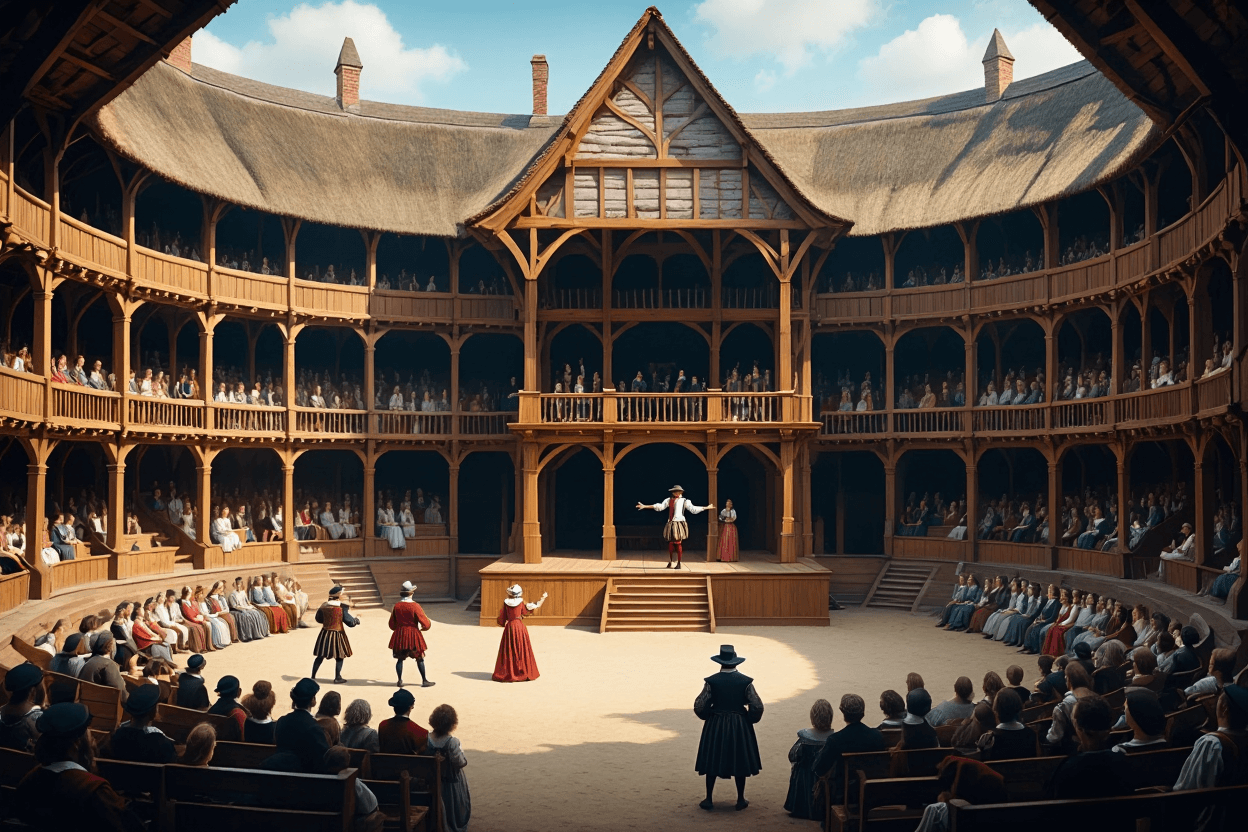
Shakespeare Theatre (generated with artificial intelligence)
Period | Late Renaissance (Elizabethan and Jacobean Period) | ||||||||
|---|---|---|---|---|---|---|---|---|---|
Time Period | Approximately 1589–1616 | ||||||||
Important Theaters | The Theatre, The Curtain, The Globe, Blackfriars | ||||||||
Important Community | Lord Chamberlain's Men (later known as King's Men) | ||||||||
Dramatic Features | Breaking of the three unities, blending of genres, poetic language, psychologically complex characters | ||||||||
Shakespeare Theatre refers to the cultural and artistic environment in which the works of William Shakespeare were written and performed. This period spans the late 16th century and early 17th century and is commonly known as Elizabethan Theatre. It corresponds to one of the most important phases of the English Renaissance and represents a time of significant development in both the content and staging of theatrical art. Shakespeare was not merely a playwright but also an actor and a partner in the Lord Chamberlain’s Men theatre company (later the King’s Men after 1603), placing him at the heart of this tradition. His works are directly connected to the contemporary theatrical sensibilities, staging techniques, and audience habits of the time. Plays performed in open-air theatres reflected the cultural structure of the era through the participation of audiences from diverse social classes.
Notable features of Shakespeare’s plays include the loosening of classical dramatic rules, detailed psychological exploration of characters, and the use of intense poetic language. These elements contributed not only to the success of his works in his own time but also to their adaptation on stages across different cultures in subsequent centuries and their broad influence. Shakespeare Theatre represents a crucial stage in the development of both English stage arts and the global theatrical tradition through these characteristics.
The Elizabethan era, which decisively shaped William Shakespeare’s artistic development, is described as the “golden age” of English theatre. The theatrical outlook of this period synthesized the legacy of medieval drama with the humanist intellectual currents introduced by the Renaissance. Religious and moral dramatic forms prevalent throughout the Middle Ages—such as guild plays, mystery plays, morality plays, and miracle plays—transformed during the 16th century and continued to exist. In addition, under the influence of the Renaissance, new forms such as pastoral plays, humanist dramas, and popular theatre entered the theatrical repertoire. This diversification was supported by growing interest in classical antiquity, classical literature, and philosophy, providing an important intellectual foundation for the stage arts of the era. The influence of this humanist education and mastery of classical theories is clearly evident in Shakespeare’s works. The path to the Elizabethan stage was opened by a group of writers educated at Oxford and Cambridge Universities. Known as the “University Wits,” this group—including Christopher Marlowe, Robert Greene, and Thomas Nashe—brought a new narrative style and dramatic structure to English theatre. Although Shakespeare lacked formal academic training, he achieved a broader reach than this group through his mastery of stage language and dramatic power. Nevertheless, some members of the University Wits occasionally dismissed Shakespeare’s works and style, mocking his language and theatrical understanding.【1】
The political and social structure of the Elizabethan era also played a decisive role in the development of theatre. The relative balance established between the aristocracy and the rising bourgeoisie fostered a sense of national unity between court and common people. The expansion of early capitalist production relations and international trade increased economic prosperity, leading to greater diversity in cultural activities. In this context, theatre became a shared meeting point for both court circles and the general public, functioning as a major cultural institution that brought together different social classes within the same space.【2】
The most important centre for Shakespeare’s company, the Lord Chamberlain’s Men (later the King’s Men), both in terms of performance and ownership, was the Globe Theatre. Built in 1599, this structure embodied the most distinctive features of Elizabethan theatre architecture. Constructed primarily of wood and typically circular or octagonal in shape, the Globe had a capacity of between 1,000 and 3,000 spectators.
The most striking feature of the Globe was the “yard,” the open area in front of the stage. Spectators standing here watched performances without shelter from sun or rain, occupying the closest possible position to the stage. This section, offering the cheapest tickets, was accessible to the lower classes of society. Audience members could interact directly with the actors through applause, booing, or even throwing food onto the stage. The three-tiered galleries surrounding the yard were covered and seated, catering to higher social classes in exchange for more expensive tickets. The most expensive seats were reserved for the lords’ boxes, which offered the best view of the stage. Performances typically began at two in the afternoon to make use of natural daylight.
The history of the Globe Theatre was marked by brief interruptions. In 1613, during a performance of Shakespeare’s Henry VIII, a cannon fired on stage ignited a fire that completely destroyed the building; however, it was rebuilt within a year. In 1642, under the Puritan regime’s anti-theatre policies, the theatre was closed and demolished in 1644.
Interest in the Globe revived toward the end of the 20th century. In 1997, a reconstruction based on historical records was built near the site of the original structure. Today, this building serves not only as a theatre staging Shakespeare’s works but also as an important cultural centre for visitors seeking to experience the conditions of Elizabethan theatre.
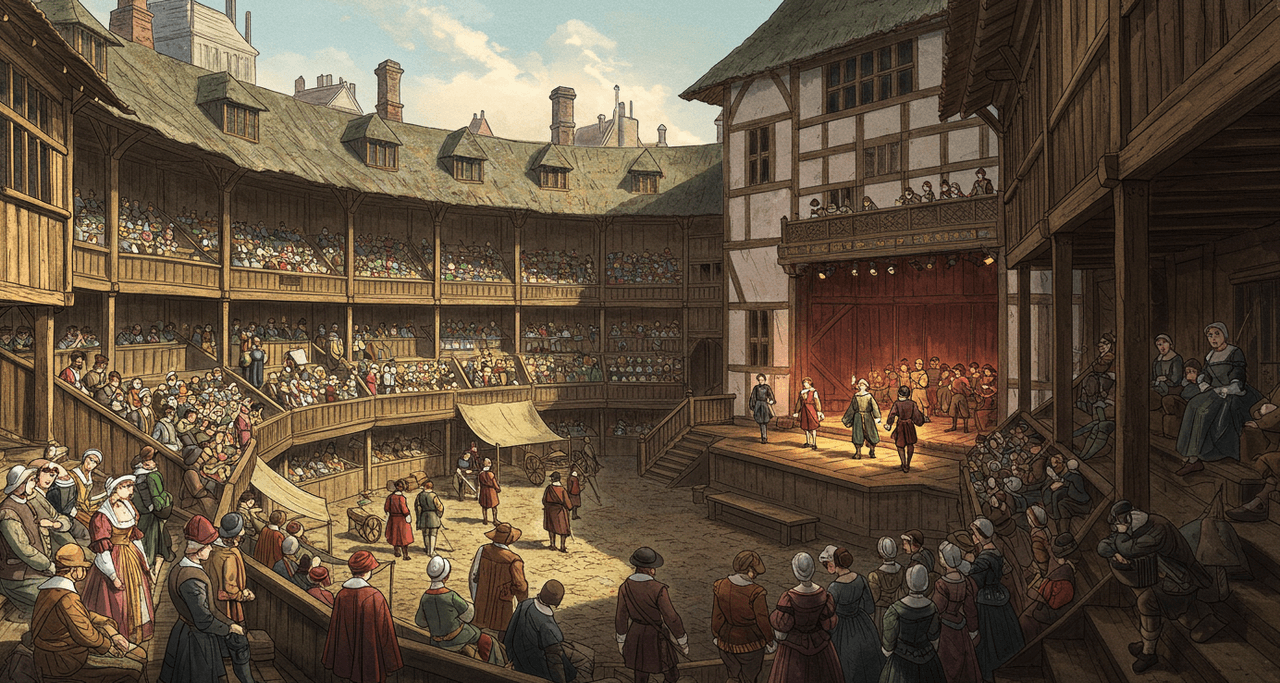
Shakespeare Theatre (generated by artificial intelligence)
In Elizabethan theatre, women were not permitted to perform on stage. Until the Stuart Restoration of 1660, female roles were portrayed exclusively by male actors. In this context, Shakespeare’s female characters such as Juliet, Lady Macbeth, Viola, or Cleopatra were played by adolescent boys known as “boy-actresses.” Their voices had not yet changed, and their physical appearance was considered suitable for female roles, enabling them to deliver convincing performances. Audiences accepted this practice as an integral part of the theatrical tradition of the time, and the illusion on stage was largely preserved.
The portrayal of female roles by male actors also influenced the dramatic structure of Shakespeare’s plays. Disguise, particularly female characters adopting male attire, became one of the central motifs in Shakespearean dramaturgy. Characters such as Portia in The Merchant of Venice, Viola in Twelfth Night, and Rosalind in As You Like It assume male identities at critical moments in the plot, altering the course of the story. Such staging conventions allowed the male actor portraying a female character to approach his own natural state when assuming the character’s male disguise, making the performance more natural.【3】
In terms of staging, the use of scenery in Elizabethan theatres was extremely limited. The stage typically consisted of a bare platform, and changes in location were indicated through the actors’ lines or simple props brought onto the stage—for example, a table, a chair, or an actor holding a letter. This required the audience to actively engage their imagination and directed their attention toward the poetic power of the text, the acting performances, and the dramatic dialogue.
Music and dance were important elements of Elizabethan theatrical practice. Live music was used during scene transitions, to heighten dramatic intensity, or in comic scenes, with songs and various instruments enhancing the atmosphere of the play. This practice was regarded as an inseparable part of the theatrical culture of the time. Modern Shakespearean productions continue this approach, with orchestras or small musical ensembles accompanying performances to convey the original aesthetic qualities of Elizabethan theatre to contemporary audiences.
William Shakespeare’s theatrical works are too diverse to be reduced to a single dramatic category. His plays were first collectively published in 1623 in the First Folio and classified under three main headings: Comedies, History Plays, and Tragedies. However, this classification failed to fully reflect the diversity of Shakespeare’s entire body of work. For this reason, modern critics have preferred to categorize some of his plays under subcategories such as “problem plays” and “late romances.” Works such as Measure for Measure and All’s Well That Ends Well exemplify the difficulty of clearly distinguishing genre boundaries.【4】
One of Shakespeare’s most important innovations in drama was his loosening of the classical dramatic rules outlined in Aristotle’s Poetics. The “three unities” (of time, place, and action) were frequently disregarded in his plays. Shakespeare’s dramas are not confined to events occurring within a single day or location; instead, they often span long time periods and include scenes set in different geographical locations. In addition to the main plot, his plays incorporate subplots, secondary character relationships, and social reflections. Macbeth is a typical example of this approach; the events unfold not within a single time frame but over an extended period and across multiple locations.【5】
Shakespeare’s works exhibit great thematic variety. The primary sources for his plays include English history, Roman and Greek antiquity, mythology, and folk tales. However, Shakespeare did not simply reproduce these sources; he transformed them through his own dramatic vision. For instance, although Macbeth draws inspiration from Scottish history, it has become a universal tragedy exploring themes of ambition, power, guilt, and conscience rather than a historical biography. The defining characteristics of Shakespeare’s dramatic style are as follows:
These features are among the main reasons why Shakespeare’s works continue to be staged today, not only in his own time but also in contemporary theatre.
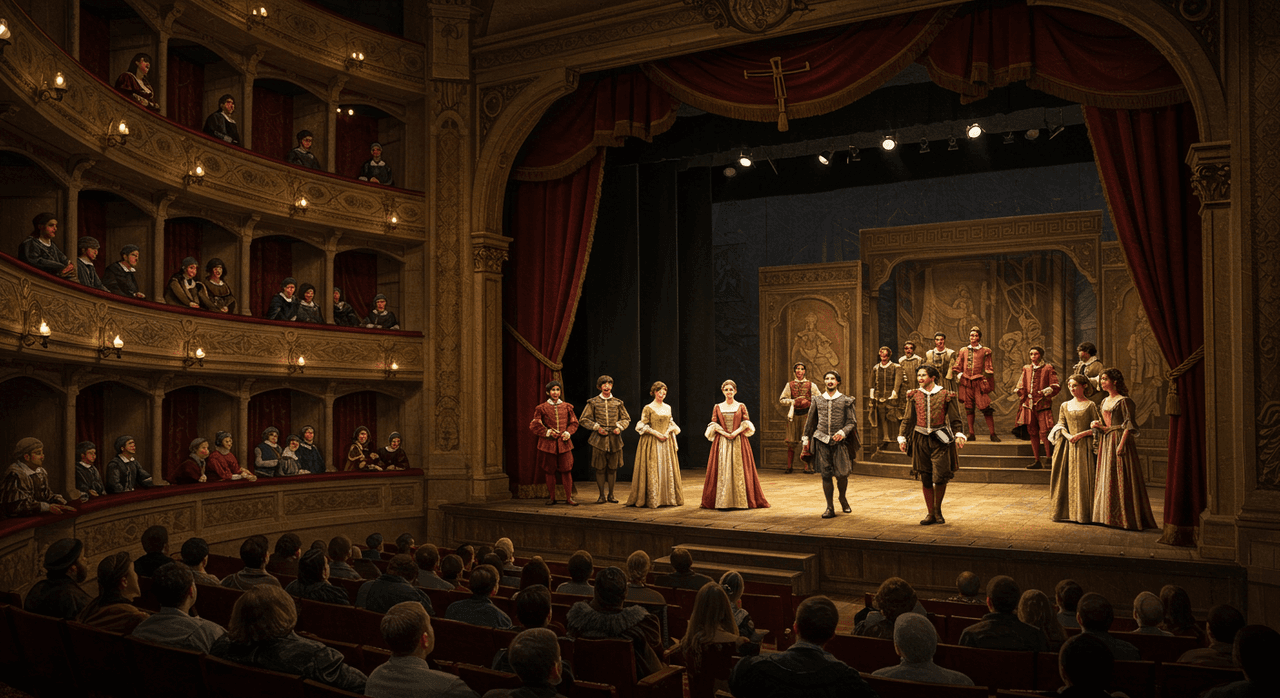
Shakespeare Theatre (generated by artificial intelligence)
William Shakespeare is one of the most prolific and influential writers in world literature, having left behind 38 plays, 154 sonnets, and several long poems. His works are generally divided into three main categories: Tragedies, comedies, and history plays. Among Shakespeare’s tragedies, Hamlet, Othello, King Lear, and Macbeth stand out. These works explore the darkest aspects of human nature through themes such as personal flaws, ambition for power, jealousy, mental instability, and moral decay. In his comedies, a different dramatic approach is evident. Plays such as A Midsummer Night’s Dream, Twelfth Night, and The Comedy of Errors are built around love, mistaken identity, confusion, and the humorous questioning of social norms. History plays such as Richard III, Henry IV, and Henry V dramatize the power struggles and the formation of national identity during critical periods of English history.
The formal richness of Shakespeare’s works makes it difficult to draw clear boundaries between genres. Despite the classification in the First Folio, some plays are classified by modern critics as “problem plays” or “late romances.” For example, Measure for Measure is seen as transitional between genres, while The Tempest and Pericles are interpreted within this framework due to their mythological and fantastical elements.【6】
Shakespeare was recognized during his lifetime as a respected playwright, and his works reached broad audiences in both public theatres and court performances. However, his global reputation rose significantly in the 18th and especially the 19th century. Romantic writers and thinkers regarded his works not merely as dramatic texts but as fundamental sources for understanding the human soul. As Ben Jonson noted in the preface to the First Folio, Shakespeare “was not of an age, but for all time.”【7】
Shakespeare’s plays have been translated into numerous languages and are performed more frequently than those of any other playwright in history. His works have also influenced literature, music, opera, ballet, cinema, and popular culture. Operas adapted from Romeo and Juliet, cinematic interpretations of Hamlet, or contemporary stagings of The Tempest demonstrate how Shakespeare’s legacy has been reimagined across different art forms. Additionally, modern productions such as Shakespeare in Love offer contemporary interpretations of the playwright’s life and works, contributing to the ongoing vitality of his legacy.
Shakespeare’s influence is also assessed through its impact on language and literature. The many idioms and expressions he introduced into English remain in use today, and the psychological depth of his characters and the universality of his themes allow his plays to be reinterpreted across different eras. In this context, Shakespeare’s legacy is viewed not merely as a literary achievement but as a permanent reference point within the collective memory of world culture.
Froehlich, Heather. “Dramatic Structure and Social Status in Shakespeare’s Plays.” *Journal of Cultural Analytics* 5 (2020).https://doi.org/10.22148/001c.12556.
Gray, P. “Shakespeare and Morality.” *Shakespeare* 19, no. 4 (2023): 433–45.https://doi.org/10.1080/17450918.2023.2291070.
IJCRT. "Shakespeare’s Plays: An Analytical Study." International Journal of Creative Research Thoughts (IJCRT). Accessed September 2, 2025.https://www.ijcrt.org/papers/IJCRT2402830.pdf.
Mazanoğlu, E. S. Çağlayan. “Revisiting Shakespeare’s *Measure for Measure*: A Problem Play in Terms of the Issue of Justice.” *Ankara Üniversitesi Dil ve Tarih-Coğrafya Fakültesi Dergisi* 58, no. 1 (2018): 804–21. Accessed September 16, 2025.https://dergipark.org.tr/en/pub/dtcfdergisi/issue/66800/1044747
Multi-Subject Journal. "Shakespeare’s Moral Themes." Multi-Subject Journal 7, no. 7 (2024): 430–36. Accessed September 2, 2025.https://www.multisubjectjournal.com/article/733/7-7-23-430.pdf
Narayanrao, H. L. “A Study on University Wits and William Shakespeare.” *Journal of Education and Practice.* Accessed September 16, 2025.https://iiste.org/Journals/index.php/JEP/article/view/199.
Plecháč, Petr. “Relative Contributions of Shakespeare and Fletcher in *Henry VIII*: An Analysis Based on Most Frequent Words and Most Frequent Rhythmic Patterns.” *Digital Scholarship in the Humanities* 36, no. 2 (June 2020): 430–38.https://doi.org/10.1093/llc/fqaa032.
Sanyal, Sanghita. “Gendered Guise: Shakespeare’s Use of Transvestism and Gender Appropriation in His Plays.” *Litinfinite Journal* 3, no. 1 (July 2, 2021): 58–68. Accessed September 16, 2025.https://doi.org/10.47365/litinfinite.3.1.2021.58-68
Sivrioğlu, Ş. “Function of Fate/Space/Time in the Political Discourse of *Macbeth*.” *Düşünce ve Toplum Sosyal Bilimler Dergisi* 4, no. 2 (2022): 177–88. Accessed September 16, 2025.https://doi.org/10.55796/dusuncevetoplum.1211293
Swisher, Charles, and Lior Shamir. “A Data Science and Machine Learning Approach to Continuous Analysis of Shakespeare’s Plays.” *Journal of Data Mining & Digital Humanities* (July 2023).http://dx.doi.org/10.46298/jdmdh.10829.
University of Leeds Library. "The Significance of the First Folio: Shakespeare as Literary Figure." Accessed September 16, 2025.https://library.leeds.ac.uk/special-collections/collection/580
Watson, Jackie. “Satirical Expectations: Shakespeare’s Inns of Court Audiences.” *Actes des congrès de la Société française Shakespeare* 33 (2015). Date Published: October 10, 2015. Accessed September 18, 2025.http://journals.openedition.org/shakespeare/3352https://doi.org/10.4000/shakespeare.3352
[1]
Narayanrao, H. L. “A Study on University Wits and William Shakespeare.” Journal of Education and Practice. Erişim Tarihi: 16 Eylül 2025. https://iiste.org/Journals/index.php/JEP/article/view/199.
[2]
Watson, Jackie. “Satirical Expectations: Shakespeare’s Inns of Court Audiences.” Actes des congrès de la Société française Shakespeare 33 (2015). Yayınlanma Tarihi: 10 Ekim 2015. Erişim Tarihi: 18 Eylül 2025. http://journals.openedition.org/shakespeare/3352. https://doi.org/10.4000/shakespeare.3352.
[3]
Sanyal, Sanghita. “Gendered Guise: Shakespeare’s Use of Transvestism and Gender Appropriation in His Plays.” Litinfinite Journal 3, no. 1 (2 Temmuz 2021): 58–68. Erişim Tarihi: 16 Eylül 2025. https://doi.org/10.47365/litinfinite.3.1.2021.58-68.
[4]
Mazanoğlu, E. S. Çağlayan. “Revisiting Shakespeare’s Measure for Measure: A Problem Play in Terms of the Issue of Justice.” Ankara Üniversitesi Dil ve Tarih-Coğrafya Fakültesi Dergisi 58, no. 1 (2018): 804–21. Erişim Tarihi: 16 Eylül 2025. https://dergipark.org.tr/en/pub/dtcfdergisi/issue/66800/1044747.
[5]
Sivrioğlu, Ş. “Function of Fate/Space/Time in the Political Discourse of Macbeth.” Düşünce ve Toplum Sosyal Bilimler Dergisi 4, no. 2 (2022): 177–88. Erişim Tarihi: 16 Eylül 2025. https://doi.org/10.55796/dusuncevetoplum.1211293.
[6]
Mazanoğlu, E. S. Çağlayan. “Revisiting Shakespeare’s Measure for Measure: A Problem Play in Terms of the Issue of Justice.” Ankara Üniversitesi Dil ve Tarih-Coğrafya Fakültesi Dergisi 58, no. 1 (2018): 804–21. Erişim Tarihi: 16 Eylül 2025. https://dergipark.org.tr/en/pub/dtcfdergisi/issue/66800/1044747.
[7]
University of Leeds Library. “The Significance of the First Folio: Shakespeare as Literary Figure.” Erişim Tarihi: 16 Eylül 2025. https://library.leeds.ac.uk/special-collections/collection/580.

Shakespeare Theatre (generated with artificial intelligence)
Period | Late Renaissance (Elizabethan and Jacobean Period) | ||||||||
|---|---|---|---|---|---|---|---|---|---|
Time Period | Approximately 1589–1616 | ||||||||
Important Theaters | The Theatre, The Curtain, The Globe, Blackfriars | ||||||||
Important Community | Lord Chamberlain's Men (later known as King's Men) | ||||||||
Dramatic Features | Breaking of the three unities, blending of genres, poetic language, psychologically complex characters | ||||||||
No Discussion Added Yet
Start discussion for "Shakespeare Theatre" article
Elizabethan Theatre Atmosphere
Shakespeare Theatre
Acting and Staging Conventions
Dramatic Features of Shakespeare’s Plays
Shakespeare’s Works and Legacy
Shakespeare Theatre and Its Influence