


This article was automatically translated from the original Turkish version.
+2 More
Fatih Sultan Mehmet’s reign saw the Şâhi cannons play a significant role in the military power of the Ottoman Empire. These were large-caliber, typically bronze-cast bombard-type artillery pieces used in 15th-century siege warfare. They are particularly known for their role in breaching the walls of Istanbul during its conquest and demonstrate the Ottoman mastery of artillery technology of the era.
The reign of Fatih Sultan Mehmet (1451–1481) marked the institutionalization of Ottoman artillery and the peak of cannon-casting technology. During this period, the Ottomans cast their first large cannons. In preparation for the conquest of Istanbul, Fatih Sultan Mehmet summoned many of the era’s foremost cannon founders to Edirne to produce cannons of various calibers. Among these masters, the most renowned was the Hungarian Urban (Orban). Alongside Urban, artisans such as Ali, Müslihiddin, and Saruca were commissioned to cast the largest cannons of Fatih’s reign. It is recorded that Fatih Sultan Mehmet himself possessed detailed knowledge of artillery techniques and proposed a new type of cannon—similar to modern howitzers capable of high-angle fire—to target ships on the Haliç. The establishment of Tophane-i Âmire during this period institutionalized Ottoman artillery.
The Ottomans typically conducted cannon casting in foundries with square layouts, roofs covered with “pedavra boards,” and numerous large chimneys for smoke exhaust. The casting process took place in a large pit dug into the ground. The outer shape of the cannon was formed by a large mold made of clay mixed with durable fibers such as flax and hemp. The internal bore (maça) was created using a second mold made of the same materials. Molten metal alloy was poured into the space between the two molds to form the cannon body. It is noted that the Ottomans had a sophisticated understanding and mastery of mold-making technology. During casting, unique rituals were performed, such as throwing gold liras into the molten alloy; it was believed this strengthened the barrel’s structural integrity.
One of the major casting centers during Fatih’s reign was the Demirköy/Kırklareli Facility, established to supply the army and navy with cannons, humbara, and shot. Copper minerals such as chalcopyrite and bornite were found in this region. The Tophane-i Âmire, depicted in the miniatures of Matrakçı Nasuh, was also an important foundry building commissioned by Fatih.
During the reign of Fatih Sultan Mehmet, cannons were generally made of bronze (tunç). Bronze consisted of approximately 90 percent copper and 10 percent tin. The Ottomans preferred bronze over iron despite its higher cost because it allowed for the production of thicker-walled barrels capable of withstanding higher combustion pressures. Analyses of Fatih-era cannons indicate that the ideal bronze alloy was applied by the Ottomans a century before it was adopted by European states. Occasionally, zinc (tutya), lead, arsenic, antimony, and bismuth were intentionally or unintentionally added to the bronze alloy.
For cannonballs, stone, marble, lead, iron, and copper alloys were widely used. It is specified that granite cannonballs were used specifically for Urban’s cannon.
The term “Şâhi” was used for the large two-piece muhasara cannons commissioned by Fatih Sultan Mehmet from the Hungarian master Urban and others. Although varying accounts exist regarding their dimensions, these cannons are said to have reached lengths of 8 meters, internal diameters of 80 cm, and weights of 18 tons; they could fire projectiles weighing 544–680 kg up to 2 km and their explosions were reportedly audible from 24 km away. The shortest Şâhi barrel length is recorded as 91.5 cm, with a carriage weighing 8 tons.
The cannon cast by the Hungarian Urban for Fatih Sultan Mehmet was the largest-caliber weapon used in the conquest of Istanbul.
Approximately ten years after the conquest, in 1464, the Dardanel Cannon (known in England as the “Turkish Bombard”) was produced by Münir Ali Usta and shares similar production techniques and structural features with the Urban Cannon.
The two-piece design—casting the barrel and powder chamber separately and assembling them with threaded joints—was a significant technological innovation developed to facilitate the transport of these massive weapons.
During and after Fatih’s reign, the Ottomans also employed various other types of artillery, known by names such as Balyemez, Darbzen (cannon used to batter castle walls), and Humbara (a type of hand grenade).
These large cannons were muzzle-loaded; gunpowder and projectiles were inserted through the barrel, and ignition was performed through a small vent known as the “falya deliği.” Kritovulos noted that Urban’s cannon’s powder chamber was completely filled and compacted with gunpowder.
The rate of fire for large cannons was low. Dukas recorded that during the conquest, Urban’s cannon could fire three to seven times per day, and between shots it was cooled with olive oil to prevent cracking. It is noted that the practice of cooling heated firearms with oil was first implemented by the Ottomans during this period.
The transportation of Urban’s massive cannon required a major logistical operation. Historical records indicate that the cannon departed from Edirne in late January 1452 and arrived before Istanbul two months later. According to some historians, it was pulled by 30 wagons and 140 oxen (other sources mention 50–60 pairs of oxen), and 200 soldiers (troops) were assigned to prevent it from overturning. This highlights the logistical constraints of large artillery. The two-piece design aimed to alleviate some of these transport difficulties.
Urban’s cannon was one of the key factors that altered the course of the conquest, both through the physical damage it inflicted on the walls and the psychological impact of its massive explosions. It is noted that Fatih Sultan Mehmet specifically positioned Urban’s cannon at the point on the Topkapı walls where the fortifications were thinnest. Historical accounts state that repeated bombardments on the same target area, or alternatively, shots arranged in a triangular formation as advised by the envoy of John Hunyadi, led to the collapse of the city walls.
The reign of Fatih Sultan Mehmet witnessed significant innovations in Ottoman artillery:
In Ahmet Kaan Toksoy’s study, Urban’s cannon and its contemporaries were compared:
It is noted that six cannons produced in various calibers during the reign of Fatih Sultan Mehmet have survived to the present day.
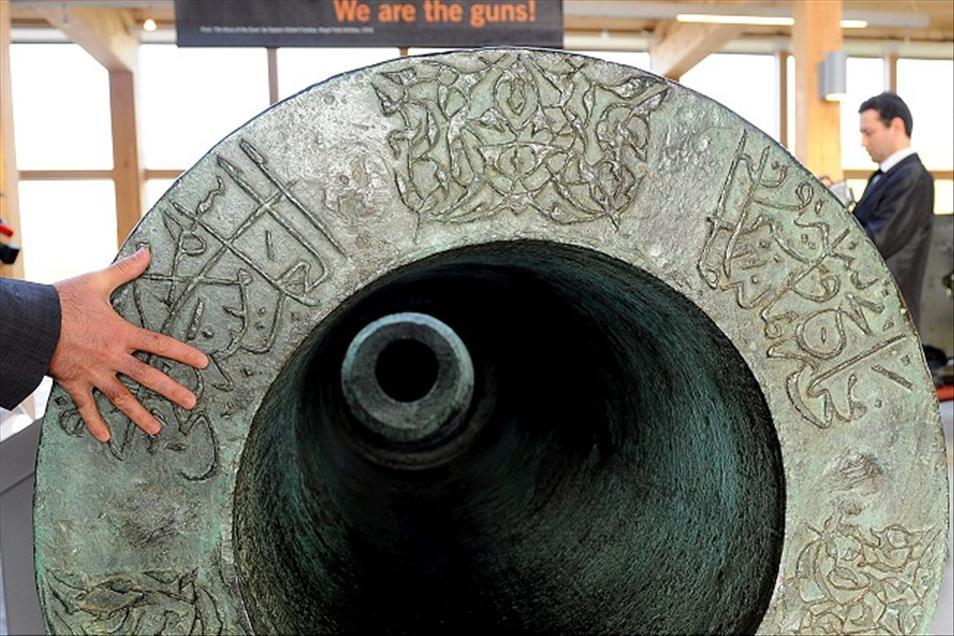
Dardanel Topu (Anadolu Ajansı)
At the ALUTEAM CAD/CAM and Additive Manufacturing Laboratory of Fatih Sultan Mehmet University, 1/25 and 1/50 scale models of the two-piece, threaded Şâhi cannon (made by Münir Ali) from the Fort Nelson Museum have been produced using laser technology with polystyrene powder.
Kaman, Mehmet. “Fatih’in Şahisi Göz Dolduruyor.” Fotoğraf. *Anadolu Ajansı*, December 19, 2011. Accessed May 16, 2025.https://www.aa.com.tr/tr/pg/foto-galeri/fatihin-sahisi-goz-dolduruyor/0/149468
Toksoy, Ahmet Kaan. “Urban Topu’nun Balistik Özelliklerinin 15. Yüzyıldaki Çağdaşlarıyla Karşılaştırılması.” *Harp Tarihi Dergisi*, no. 6 (January 2023): 1–28. Accessed May 16, 2025.https://dergipark.org.tr/tr/download/article-file/2773753.
Yılmaz, Fevzi. “Fatih Sultan Mehmet Dönemi Topları ve Değişen Üretim Paradigması.” *FSM İlmî Araştırmalar İnsan ve Toplum Bilimleri Dergisi*, no. 4 (December 2014): 219–36. Accessed May 16, 2025.https://dergipark.org.tr/tr/download/article-file/73089

Historical Context and Development
Production and Materials
Casting Process and Foundries
Materials Used
Technical Features and Variants
Urban Cannon
Dardanel Cannon (Münir Ali Usta)
Design Features
Other Cannon Types
Operational Characteristics
Firing and Usage
Rate of Fire and Cooling
Logistics
Role and Impact in the Siege
Innovations and Comparisons
Ottoman Innovations
Comparison with Contemporary European Cannons
Surviving Examples