

This article was automatically translated from the original Turkish version.
+1 More
Registration Number | 1388 | ||||||||
|---|---|---|---|---|---|---|---|---|---|
Registration Date | 19.06.2023 | ||||||||
Application Number | C2022/000239 | ||||||||
Application Date | 01.08.2022 | ||||||||
Name of the Geographical Indication | Seymen Kavunu | ||||||||
Product / Product Group(s) | Melon / Processed and Unprocessed Fruits and Vegetables and Mushrooms | ||||||||
Type of Geographical Indication | Place of Origin | ||||||||
Applicant/Registrant(s) | 2- Çorlu Municipality 1- Çorlu Chamber of Commerce and Industry | ||||||||
Address of the Registrant | 1- Zafer Şehitler Cad No:6, 59860 Çorlu TEKİRDAĞ, 2- Salih Omurtak Cd. No:139, 59850 Çorlu TEKİRDAĞ | ||||||||
Geographical Boundary | Seymen Neighborhood Tekirdağ Province Çorlu District | ||||||||
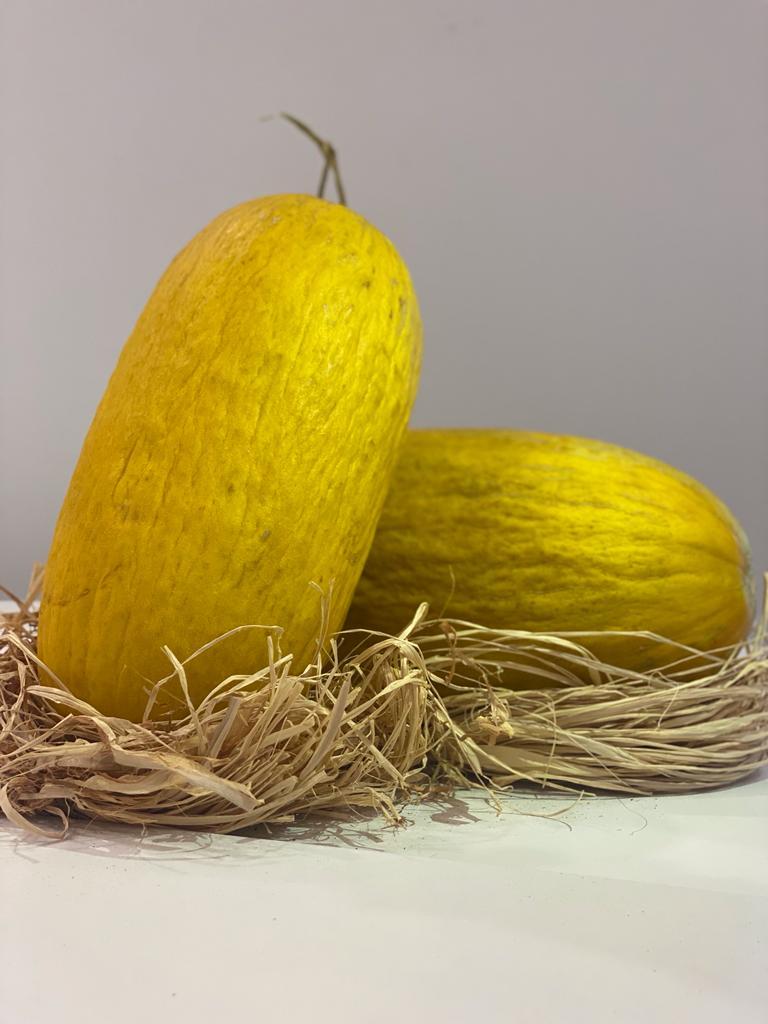
Seymen melon is a local melon variety belonging to the species Cucumis melo L., derived from the Golden Dew variety and cultivated in Seymen Village, Çorlu District, Tekirdağ. Recognized by its elliptical shape, bright yellow thin rind, pale green flesh, and high sugar content, this melon has evolved into a distinctive type known as “Sarı Kanarya”. The fruits, averaging 2.5 kg in weight, are harvested in August and September after a maturation period of 100 to 120 days.
Seymen melon is a large-fruited variety with an elliptical shape, a yellow rind featuring slight indentations and protrusions. The rind is thin (0.12–0.14 cm), and the flesh is pale green. Average fruit weight ranges from 2,350 to 2,500 grams, with a length of 31–33 cm and a diameter of 14–16 cm. Flesh thickness measures 3.8–5 cm, the seed cavity weighs 140–320 g, has a diameter of 5.4–7.5 cm, and a length of 18–25 cm. The soluble dry matter content is 10.33–11.34%, indicating high sugar levels. The juice pH ranges from 6.12 to 6.38.
The melon has a mild aroma and a bright yellow rind. Leaves are large, round or heart-shaped, with serrated and hairy margins. The plant initially has a herbaceous, hairy stem and produces vines that grow up to 3–3.5 meters in length. Flowers are bright yellow and unisexual, typically located in the leaf axils. Seeds are yellow and can retain viability for 5–8 years under suitable conditions. Each gram contains 20–50 seeds.
Seymen melon has been cultivated regionally since 1937 as a traditional crop. Through selective breeding by growers, seeds from individuals with less wrinkled and more elliptical rinds have been favored, leading to the development of the regional “Sarı Kanarya” type. This characteristic emerged from the adaptation of the Golden Dew variety to the local environment.
Rotation is a key human practice in melon production. Melons are grown on the same land once every four to five years, with wheat or sunflower cultivated in between. This system supports the development of both flavor and water content in the fruit.
Soil preparation begins in March and is carried out with plowing to a depth of 40–50 cm. Mounds are formed at the end of April or beginning of May, with row spacing of 120–150 cm and plant spacing within rows of 80–100 cm. Seeds are sown manually or mechanically at a depth of 5–6 cm. After germination, crop management includes fertilization and weeding. Soils rich in organic matter are preferred. Compost fertilizer (15:15:15 NPK) is applied, and a second nitrogen application is carried out during the fruit thinning stage.
Irrigation is adjusted according to the plant’s water needs and soil conditions. Excessive irrigation is avoided. Drip irrigation is generally preferred, but rain-fed production is also possible in years with favorable rainfall distribution.
Seymen melon reaches maturity and is ready for harvest within an average of 100–120 days. The harvest period varies between August and October, with ripeness determined by changes in fruit color, weight, and stem condition. Physical damage during harvesting must be prevented, and appropriate storage conditions must be ensured.
Seymen melon is stored in cool, dry, odor-free environments with no direct contact with soil—for example, placed on straw. Under natural conditions, its shelf life can extend until February. For longer-term storage, a cold chain at 4–8 °C is recommended.
Seymen Village features a flat terrain within the Ergene Basin. The area consists of sediments deposited from the Yıldız Mountains and is influenced by the Marmara climate. Summers are hot and occasionally windy, while winters are dry and cold. Annual rainfall is considered normal. The unique soil structure of the region and the influence of lodos winds have contributed to the development of the Seymen melon’s distinctive characteristics.
The monitoring of Seymen melon production, packaging, logo use, and origin designation is carried out by a committee composed of representatives from the Çorlu Chamber of Commerce and Industry, Çorlu Chamber of Artisans and Tradespeople, Çorlu Chamber of Commerce, and Çorlu District Directorate of Agriculture and Forestry, coordinated by the Çorlu Chamber of Commerce and Industry. Inspections are conducted at least once annually, and additional inspections may be carried out upon complaint. Inspection results are reported annually to the Turkish Patent and Trademark Office.
Turk Patent and Trademark Office. "Seymen Kavunu." Accessed July 20, 2025. https://ci.turkpatent.gov.tr/cografi-isaretler/detay/7252.
Turkish Patent and Trademark Office. "Seymen Kavunu Tescil Belgesi (PDF)." Accessed July 20, 2025. https://ci.turkpatent.gov.tr/Files/GeographicalSigns/5e057a97-eb62-4f19-aca5-63d10cd4c3cf.pdf.

Registration Number | 1388 | ||||||||
|---|---|---|---|---|---|---|---|---|---|
Registration Date | 19.06.2023 | ||||||||
Application Number | C2022/000239 | ||||||||
Application Date | 01.08.2022 | ||||||||
Name of the Geographical Indication | Seymen Kavunu | ||||||||
Product / Product Group(s) | Melon / Processed and Unprocessed Fruits and Vegetables and Mushrooms | ||||||||
Type of Geographical Indication | Place of Origin | ||||||||
Applicant/Registrant(s) | 2- Çorlu Municipality 1- Çorlu Chamber of Commerce and Industry | ||||||||
Address of the Registrant | 1- Zafer Şehitler Cad No:6, 59860 Çorlu TEKİRDAĞ, 2- Salih Omurtak Cd. No:139, 59850 Çorlu TEKİRDAĞ | ||||||||
Geographical Boundary | Seymen Neighborhood Tekirdağ Province Çorlu District | ||||||||
Morphological Characteristics
Agricultural Production and Cultivation Methods
Harvesting and Storage
Geographical Conditions and Ecological Factors
Monitoring and Registration Process