This article was automatically translated from the original Turkish version.
Type of Geographical İndication | Mahreç Sign | ||||||||
|---|---|---|---|---|---|---|---|---|---|
Application Date | 08.09.2022 | ||||||||
Registration Number | 1700 | ||||||||
Registration Date | 13.02.2025 | ||||||||
Product / Product Group(s) | Processed and unprocessed fruits vegetables and mushrooms | ||||||||
Province(s) | Konya | ||||||||
Applicant/Registrant(s) | Seydişehir Municipality | ||||||||
Seydişehir watermelon is a local watermelon variety cultivated in the Seydişehir district of Konya Province and registered with a geographical indication. This product, registered on 13 February 2025, is protected under Law No. 6769 on Industrial Property. Production is restricted exclusively within the boundaries of Seydişehir district.
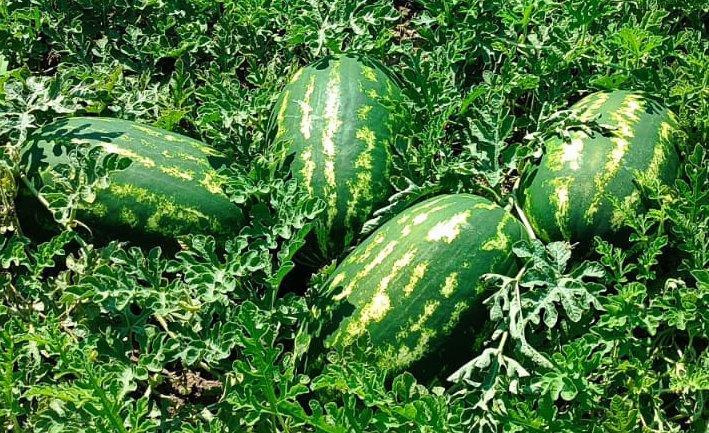
The Seydişehir watermelon is typically grown from seeds and seedlings of the Obüs, Odipus and Jüpiter varieties. The fruit has an elliptical shape with one end nearly flat and the other end conical and pointed. Its rind is striped in dark and light green tones. The average fruit weight ranges from 10 to 16 kg but can reach up to 35 kg. The rind thickness measures between 15 and 25 mm. The flesh is bright red sweet firm and low in fiber. The fructose content is 3–3.5 g/100 g glucose content is 2.08–2.1 g/100 g and sucrose content is 4.53–4.6 g/100 g. Acidity ranges from 0.01 to 0.07 g/100 g while the pH value falls between 5.58 and 6. Brix levels measure between 9% and 10.4%. The rind accounts for 40–43% of the total weight and the seeds for 2–2.3%. The vitamin C content is 16–21 mg per 100 g.
The Seydişehir watermelon is primarily produced using seedlings grown within the district. The planting period varies between late April and late June depending on altitude and climatic conditions. There are three distinct harvest periods:
Seedlings are planted in deep well-aerated sandy-loamy soils with high water retention capacity. The soil pH must be between 6 and 7. Tunnel sites are prepared parallel to the prevailing wind direction with fixed row and bed spacing. Mulching and drip irrigation systems are installed prior to planting. Irrigation is carried out every two days with durations ranging from 1 to 5 hours depending on the fruit development stage.
Ideal soils for Seydişehir watermelon are light sandy-loamy in structure. Soils around Suğla are clay-loam and clay-textured. The parent material is alluvial consisting of fertile soils transported by floods. Organic fertilizer at a rate of 5 tons per hectare is applied in autumn. During flowering fertilization is carried out using 15:15:15 compound fertilizer along with potassium and nitrogen-sulfur fertilizers.
Pest control is conducted in accordance with methods prescribed by the Ministry of Agriculture and Forestry. Fields are regularly monitored and when pests are detected quarantine destruction or chemical treatment is applied. Weeds are removed by hoeing.
Harvest timing is determined by indicators such as brightening of the rind shedding of stem hairs increased sugar content and drying of the peduncle and calyx. A hollow sound when the fruit is tapped also indicates ripeness. The ideal harvest weight is 11–13 kg. Under normal conditions the fruit can be stored for 10 days. At +4 °C and 60–70% humidity it can be stored for 3–4 months. When packaged it can be preserved for up to 30 days.
The Seydişehir watermelon has a long-standing tradition in the region’s culture and economy. All production stages occur within the boundaries of Seydişehir district. Monitoring is conducted at least once annually by experts from relevant institutions under the coordination of Seydişehir Municipality. Monitoring criteria include seedling suitability product characteristics production methods and proper use of the geographical indication mark.
Turk Patent and Trademark Office. "Seydişehir Karpuzu." Turk Patent and Trademark Office. Accessed August 16, 2025. https://ci.turkpatent.gov.tr/Files/GeographicalSigns/295b79cc-28b3-4798-b185-ad3c9a33ecf6.pdf
Turk Patent and Trademark Office. "Seydişehir Karpuzu." Turk Patent and Trademark Office. Accessed August 16, 2025. https://ci.turkpatent.gov.tr/cografi-isaretler/detay/7463

Type of Geographical İndication | Mahreç Sign | ||||||||
|---|---|---|---|---|---|---|---|---|---|
Application Date | 08.09.2022 | ||||||||
Registration Number | 1700 | ||||||||
Registration Date | 13.02.2025 | ||||||||
Product / Product Group(s) | Processed and unprocessed fruits vegetables and mushrooms | ||||||||
Province(s) | Konya | ||||||||
Applicant/Registrant(s) | Seydişehir Municipality | ||||||||
No Discussion Added Yet
Start discussion for "Seydişehir Watermelon" article
Physical Characteristics
Production Process
Soil and Nutritional Requirements
Pest Control
Harvesting and Storage
Geographical Indication and Monitoring