
This article was automatically translated from the original Turkish version.
+1 More
Yeddi Levin is a ritual offering of seven types of dried fruits and nuts that symbolize the abundance of the table, the sevenfold nature of the universe, and the completion of creation in the Nevruz traditions of Azerbaijan and Eastern Anatolia.
Nevruz Bayramı’s celebration evening follows the four Wednesdays named after the elements “water,” “fire,” “wind,” and “earth.” At the center of the table, this special mixture is placed. This tradition, aimed at balancing the physical and spiritual effects of seasonal transition, is one of the elements in the shared cultural heritage of the Turkic world that celebrates nature’s awakening.
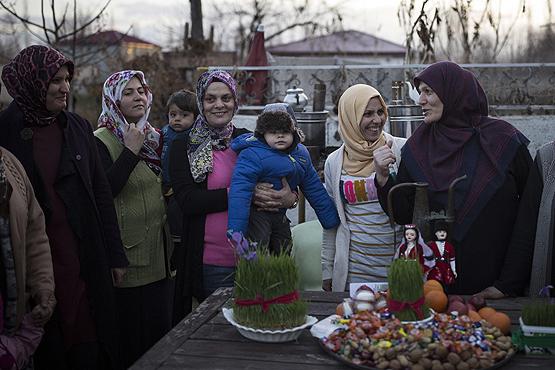
Yeddi Levin (Anadolu Ajansı)
In Turkic cosmology and ancient Middle Eastern traditions, the number seven is not a random numerical preference but a fundamental archetype representing universal order, ontological unity, and the sacred cycle.【1】 The Yeddi Levin tradition concretizes this numerical symbolism through culinary culture, bringing to the table the seven heavens, the seven days of the week, and the stages of creation in symbolic form. This ritual is described as an “threshold” practice symbolizing the end of winter’s chaotic process and the emergence of cosmic order brought by spring.【2】 The gathering of seven distinct types on the table facilitates the transfer of macrocosmic balance into the microcosm of family and community life, thereby inviting the prosperity of the new year through collective consciousness guided by this numerical sacredness.
Yeddi Levin tray consists of seven essential components, each representing a different aspect of nature and the continuity of life; the night’s name also derives from this tradition. Additionally, on Nevruz day, kete, pağaç, berte, and various regional dishes are prepared in nearly every household. On the berte, a cake-like bread, at least seven types of dried fruits and nuts such as quince, raisins, dried grapes, walnut kernels, roasted chickpeas, hazelnuts, and pistachios are placed. This practice is also linked to the Yeddi Levin tradition.【3】 Each component symbolizes the microcosmic counterpart of the macrocosmic order. For instance, hard-shelled nuts such as walnuts and hazelnuts represent nature’s protective shell during its winter dormancy and the latent life potential within; dried fruits carry the energy of the sun and the generosity of the earth to the table. In the cosmic dimension, these seven foods reflect the ancient belief that sustenance flows from seven distinct channels. Moreover, scholarly sources emphasize that these foods were chosen to revitalize the body weakened after winter, highlighting how the tradition fuses medical rationality with a cosmic worldview.
Yeddi Levin, within the Nevruz tradition, is more than a mere act of food consumption; it serves as a symbolic bridge sustaining social solidarity and the culture of sharing.
During holiday visits, the tray placed at the head of the table by the host and offered to guests establishes a collective “shared taste” imbued with a sanctity analogous to the cultural concept of “salt and bread right.” In particular, the joyful distribution of this mixture among children and youth creates a pedagogical environment through which ancient cultural codes and ritual knowledge are transmitted experientially to the next generation.
From a socio-cultural perspective, the gathering around the concept of Yeddi Levin is widely regarded as one of its most fundamental social functions: the resolution of conflicts, reconciliation of estranged individuals, and the reconstruction of social harmony. 【4】 In this context, just as each nut comes together on the same plate, different social strata are intended to unite around the same table.
Anadolu Ajansı. "Matemin ve Sevincin Bayramı Nevruz." Anadolu Ajansı. Accessed April 15, 2026. https://www.aa.com.tr/tr/turkiye/matemin-ve-sevincin-bayrami-nevruz/775340
Azerbaijan National Commission for UNESCO. “Novruz.” unesco.az. Accessed April 15, 2026. https://www.unesco.az/en/articles/intangible_cultural_heritage/novruz-bayrami
Uca, Alaattin. “Türk Toplumunda Nevruz I.” *Atatürk Üniversitesi Türkiyat Araştırmaları Enstitüsü Dergisi* 32, (2007): 137–170. Accessed April 15, 2026. https://dergipark.org.tr/tr/download/article-file/33012
Yıldırım, Seyid. "Azerbaycan Türklerinde Nevruz Bayramı ve Sosyo-Kültürel Yapısı." *Journal of Turkish Studies* 11, no. 14 (2016): 223–229. Accessed April 15, 2026. https://dergipark.org.tr/tr/download/article-file/32945?
[1]
Seyid Yıldırım, "Azerbaycan Türklerinde Nevruz Bayramı ve Sosyo-Kültürel Yapısı", Journal of Turkish Studies, Vol. 11, No. 3 (2016): 225, https://dergipark.org.tr/tr/download/article-file/32945
[2]
Seyid Yıldırım, "Azerbaycan Türklerinde Nevruz Bayramı ve Sosyo-Kültürel Yapısı", 223-233.
[3]
Alaattin Uca, “Türk Toplumunda Nevruz I,” Atatürk Üniversitesi Türkiyat Araştırmaları Enstitüsü Dergisi 32 (2007): 151, https://dergipark.org.tr/tr/download/article-file/33012
[4]
Seyid Yıldırım, "Azerbaycan Türklerinde Nevruz Bayramı ve Sosyo-Kültürel Yapısı", 227-234.

Symbolism and the Significance of the Number Seven
Yeddi Levin Composition and Cosmic Meanings
Social Function