This article was automatically translated from the original Turkish version.
+1 More
Sea Daffodil (Pancratium maritimum L.)
Family | Amaryllidaceae (Narcissaceae) | ||||||||
|---|---|---|---|---|---|---|---|---|---|
Habitat | Coastal dunes up to 60 meters above sea level | ||||||||
Structure(s) | Perennial bulbous | ||||||||
Reproduction Method | Seed, bulb | ||||||||
Flowering Period | August - September | ||||||||
Distribution in Türkiye | Mediterranean, Aegean, and Marmara coasts, Black Sea coasts | ||||||||
Fruit/Seed | Three-chambered capsule, black seeds inside the fruit | ||||||||
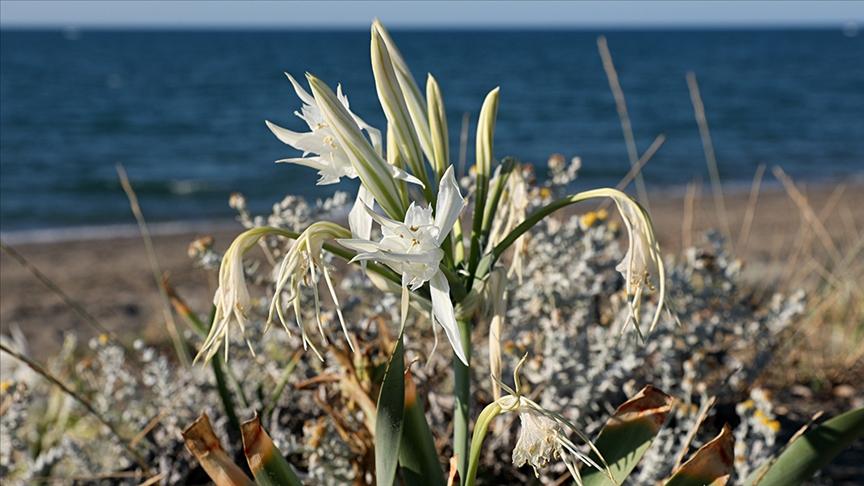
Sea Daffodil (Pancratium maritimum L.), a species of the genus Pancratium in the Amaryllidaceae family (Narcissaceae), is the only species recorded as naturally occurring in Türkiye among the 21 known species worldwide.【1】
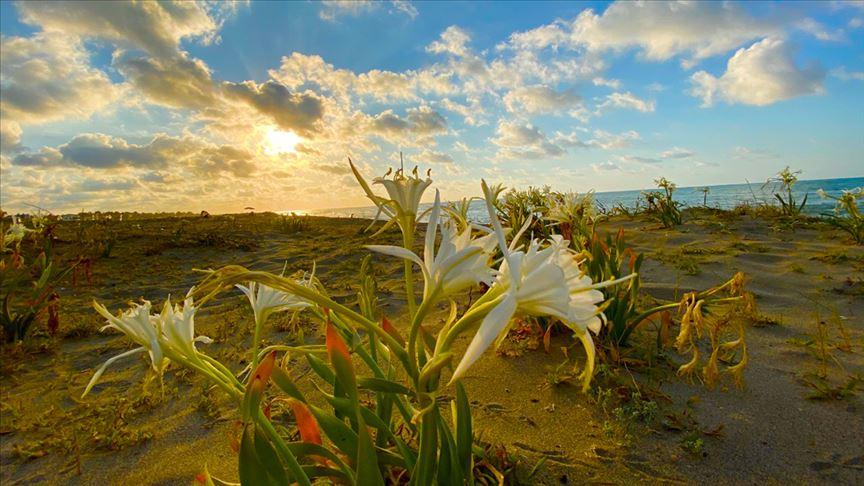
Distribution of the Sea Daffodil along the Seashore (AA)
Sea daffodil naturally occurs in sandy areas along the coasts of the Mediterranean Sea, the Atlantic Ocean, the Black Sea, and the Caspian Sea. France, Spain, Italy, Greece, Israel, Lebanon, and Cyprus are among the countries where this species is native. In Bartın, it is found along the coasts of Kırklareli, Istanbul, Bolu, Sinop, Samsun, Giresun, Trabzon, Antalya, Adana, Muğla (Sarıgerme), and Çanakkale.【2】
It grows in sandy areas parallel to the sea, up to an average distance of 60 meters from the shoreline, and cannot adapt to climatic zones outside the coastal ecosystem. It exhibits high resistance to extreme climatic conditions, sea breezes, consistently high humidity, intense solar radiation, extreme drought, and salinity (abiotic stress factors).
While flowering occurs between June and October globally, in Türkiye it typically blooms between August and September. It is an outcrossing plant whose pollination is primarily carried out by butterflies of the order Lepidoptera and family Sphingidae, under wind speeds not exceeding 2–2.5 m/s. Reproduction occurs both generatively (by seed) and vegetatively (by bulb). Laboratory studies have been conducted to enhance germination and bulb formation using plant growth regulators such as gibberellic acid (GA3) and 24-epibrassinolide (EBR), due to the low natural germination rate of seeds and the prolonged time required for bulb development.
It is a perennial, bulbous plant with a diploid chromosome number of 2n=22. The bulbs are spherical-oval in shape, brown in color, 14–16 cm in circumference, and tunicated. The plant reaches a height of approximately 40–45 cm and has strap-shaped, bluish-green leaves that taper toward the apex. The flowers are white and fragrant, arranged in an umbel consisting of 3 to 15 blooms. Each flower is borne on a green, cylindrical, leafless scape, with a trumpet-shaped corolla measuring 2–6 cm in length and 3–5 cm in width. The seeds are black structures enclosed in three-lobed, dry, light brown capsules that develop upon maturation.
The plant possesses medicinal and aromatic properties due to its alkaloid content.【3】 Amaryllidaceae alkaloids such as lycorine, galantamine, tazettine, narciclasine, pancratistatin, and ungeremin have been identified in the leaves, roots, flowers, fruits, and bulbs. These chemical compounds exhibit cytotoxic, antitumor, antimalarial, analgesic, antibacterial, and antifungal activities. Pharmacological studies have evaluated compounds derived from the sea daffodil for potential use in treating colon cancer, prostate cancer, Alzheimer’s disease, and AIDS. It has also been noted that the plant has applications in the textile industry.
Sea daffodil populations are threatened by anthropogenic pressures including the conversion of coastal areas into beaches for tourism, construction along shorelines, intensive urbanization, uprooting of plants for ornamental use, and harvesting of bulbs.【4】
In Türkiye, the species is listed among those prohibited from being collected from nature for export. Conservation measures include closing beaches to vehicle traffic and fencing off natural habitats. The Ministry of Environment and Urbanization is implementing the Sea Daffodil Species Monitoring Project. Under the Environmental Law, uprooting the plant or damaging its habitat carries severe penalties, with fines set at 387,141 Turkish Lira.【5】 To ensure the species’ continuity and the rehabilitation of sandy habitats, in vitro (tissue culture) micropropagation techniques are being developed, and efforts are being made to raise ecological awareness among local communities and tourists through ecotourism initiatives.
Warning: The content presented here is intended solely for general encyclopedic information. The information provided should not be used for diagnosis, treatment, or medical advice. Always consult a physician or qualified healthcare professional before making decisions regarding health matters. The author and KÜRE Encyclopedia assume no responsibility for any consequences arising from the use of this information for diagnostic or therapeutic purposes.
Aydınyer, Simge, Ömer Onuralp Özcan, Pınar Tuncer, Elifsu Yurt, and Selin İpek Çakırer. “Yok Ettiğimiz Bir Tür Daha: Kum Zambakları.” Doğa Koruma Merkezi, article PDF. Accessed February 22, 2026. https://dkm.org.tr/sites/other/dkm/uploads/yayinlar/makaleler/makale-17.pdf
Gümüş, Cevdet. “Kum Zambağı (Pancratium maritimum L.) Bitkisinde Yapılan Araştırmalar Üzerine Bir İnceleme.” Derim 32, no. 1 (2015): 89–105. Accessed February 22, 2026. https://dergipark.org.tr/tr/download/article-file/53041
Kelkit, Mehmet, and Arda Akçal. “The Effects of Some Plant Growth Regulators on Seed Germination of Sea Daffodil (Pancratium maritimum L.).” ÇOMÜ LJAR 1, no. 2 (2020): 130–135. Accessed February 22, 2026. https://dergipark.org.tr/en/download/article-file/1434594
School Outside Learning Environments. "Sarıgerme Kum Dune Flower Habitat." *Eğitim Bilişim Ağı (EBA).* Accessed February 22, 2026. https://okuldisiogrenme.eba.gov.tr/place-detail/sarigerme-kum-zambagii-yetisme-alani-2589
Türkiye Cumhuriyeti Communication Presidency. “Kum Zambağı Sayısı Arttı.” *Yerel Basın Duyurusu*, September 25, 2024. Accessed February 22, 2026. https://www.iletisim.gov.tr/turkce/yerel_basin/detay/kum-zambagi-sayisi-artti
[1]
Hülya Şereflişan, “The Effect of Different Shell Colors on Helix lucorum (Gastropoda: Helicidae) in Estivation Period,” Journal of Advances in VetBio Science and Techniques 6, no. 1 (2021): 1–8, accessed 22 February 2026, https://dergipark.org.tr/en/download/article-file/1434594
[2]
Ministry of National Education, “Sarıgerme Sea Daffodil Growth Area,” EBA Out-of-School Learning Environments, accessed 22 February 2026, https://okuldisiogrenme.eba.gov.tr/place-detail/sarigerme-kum-zambagii-yetisme-alani-2589
[3]
Hülya Şereflişan, “The Effect of Different Shell Colors on Helix lucorum (Gastropoda: Helicidae) in Estivation Period,” Journal of Advances in VetBio Science and Techniques 6, no. 1 (30 April 2021): 1–8, accessed 22 February 2026, https://dergipark.org.tr/en/download/article-file/1434594
[4]
Hülya Şereflişan, “The Effect of Different Shell Colors on Helix lucorum (Gastropoda: Helicidae) in Estivation Period,” Journal of Advances in VetBio Science and Techniques 6, no. 1 (30 April 2021): 1–8, accessed 22 February 2026, https://dergipark.org.tr/en/download/article-file/1434594
[5]
Presidency of the Republic of Türkiye, “Sea Daffodil Numbers Have Increased,” accessed 22 February 2026, https://www.iletisim.gov.tr/turkce/yerel_basin/detay/kum-zambagi-sayisi-artti
Sea Daffodil (Pancratium maritimum L.)
Family | Amaryllidaceae (Narcissaceae) | ||||||||
|---|---|---|---|---|---|---|---|---|---|
Habitat | Coastal dunes up to 60 meters above sea level | ||||||||
Structure(s) | Perennial bulbous | ||||||||
Reproduction Method | Seed, bulb | ||||||||
Flowering Period | August - September | ||||||||
Distribution in Türkiye | Mediterranean, Aegean, and Marmara coasts, Black Sea coasts | ||||||||
Fruit/Seed | Three-chambered capsule, black seeds inside the fruit | ||||||||
No Discussion Added Yet
Start discussion for "Sea Daffodil (Pancratium maritimum L.)" article
Habitat and Distribution Areas
Reproduction and Pollination Biology
Chemical Composition and Medicinal Potential
Threats and Conservation Status