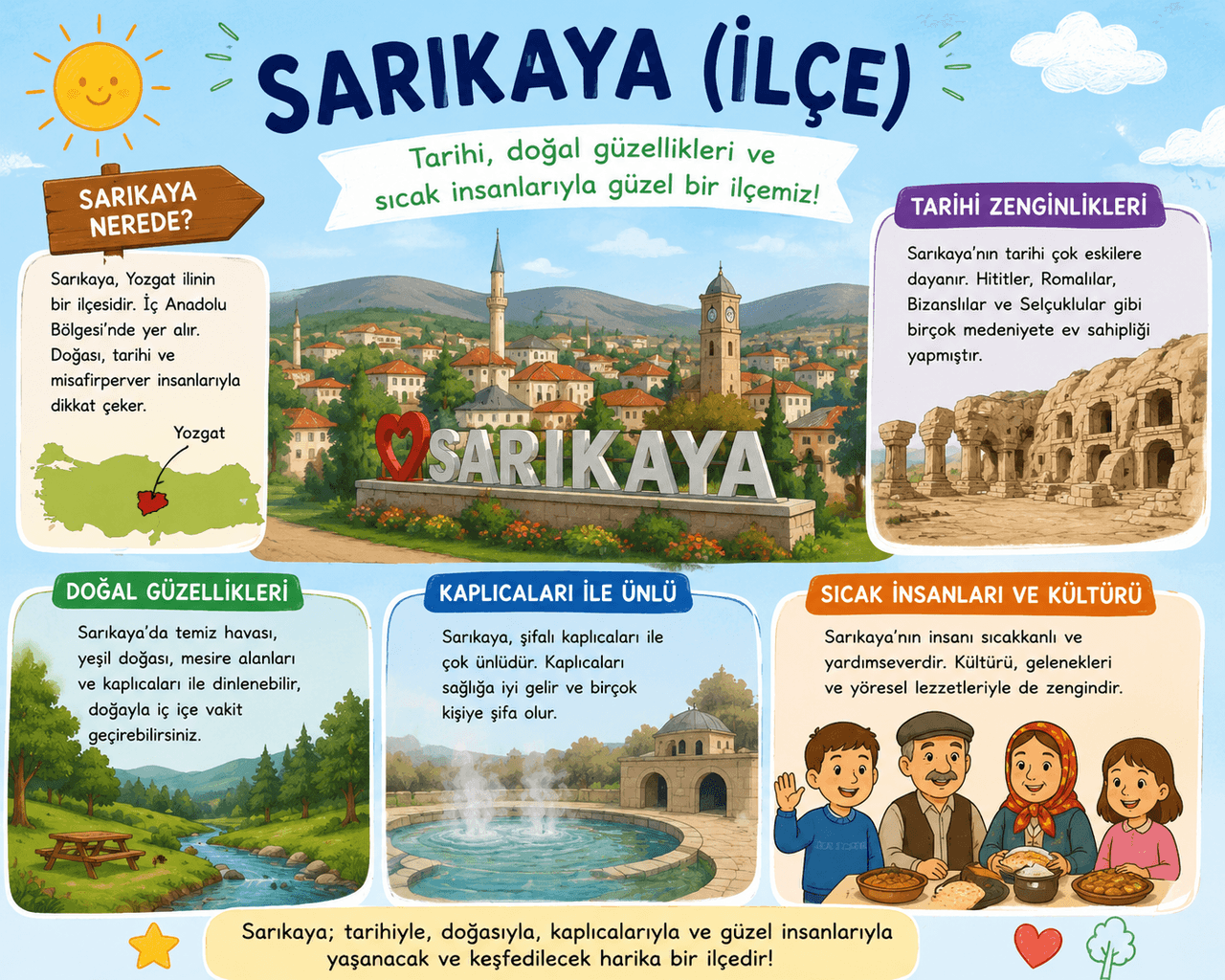
Sarıkaya (District)
Sarıkaya is a charming district of our province Yozgat. It is not merely a place where people live, but also a vast open-air museum filled with stories spanning thousands of years. Have you ever seen a place where warm waters gush forth from beneath the earth and are believed to heal those who bathe in them? Sarıkaya is precisely such a place.
Where is Sarıkaya?
Sarıkaya lies directly on the road between Yozgat and Kayseri, within the Central Anatolia Region. It is built on a plateau at a considerable elevation above sea level, characterized by rolling plains. Surrounding the district are high peaks such as Yazır Mountain and Tilki Mountains. Winters here are cold and snowy, while summers are hot and dry. The Kanak Creek, which flows through the center of the district, brings life to the local soil. The willow and poplar trees lining the riverbanks give the district a lush green appearance.
Why Is It So Important?
What has made Sarıkaya famous worldwide is its ancient Roman-era bathhouse. Long ago, when the Romans lived here, they discovered that the hot springs beneath the ground had healing properties and constructed a magnificent structure of massive stones called the Basilica Therma.
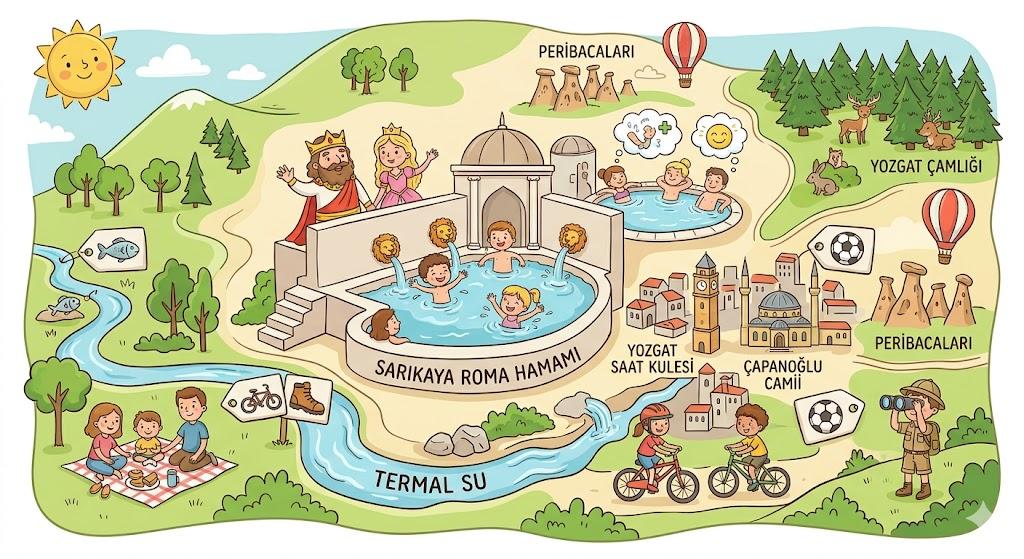
Sarıkaya. (Generated by artificial intelligence.)
According to legend, this bathhouse was built for the sick daughter of a Roman emperor. The princess recovered her health after bathing in these warm waters, and for centuries afterward, the bathhouse served as a healing center. Even today, it is possible to see the remains of this ancient structure.
How Do People Live Here?
Most residents of the district earn their livelihood through agriculture and animal husbandry. Wheat, barley, lentils, and sugar beet are the main crops grown in the fields. In the pastures, sheep and cattle graze, while bees produce delicious honey. During the summer season, Sarıkaya becomes very crowded. Not only do locals from other cities return to their homes, but also tourists from many parts of the world come to benefit from the healing thermal waters.