

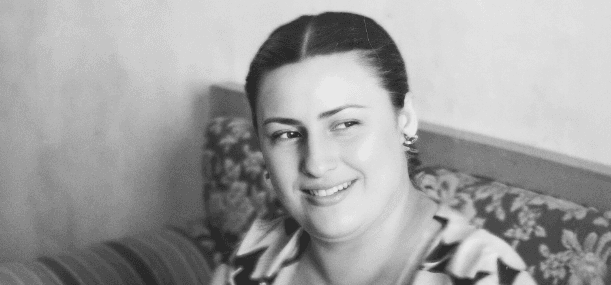

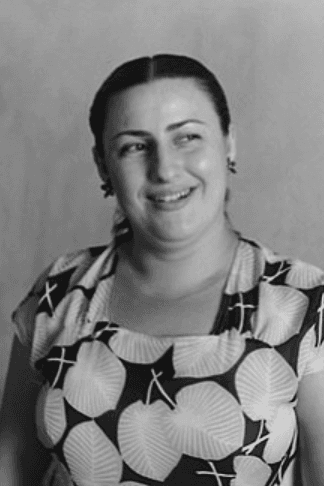
Doğum tarihi | 1922-05-31 | ||||||||
|---|---|---|---|---|---|---|---|---|---|
Place of Birth | Baku, Azerbaijan | ||||||||
Ölüm tarihi | 2005-05-12 | ||||||||
Profession(s) | Azerbaijani Folk and Opera Singer Soloist | ||||||||
Sara Gedimova (Sara Qədimova), after spending her childhood in the village of Güləbli in the Karabakh region of Türkiye, developed an early connection with music and assumed various responsibilities at a young age due to family circumstances. The developments in her education and personal life became key factors shaping her later musical orientation and professional formation.
Although Sara Gedimova was born in Baku, she spent her childhood in the village of Güləbli in the Karabakh region. There, she interacted with prominent figures of Azerbaijani music, thus becoming acquainted with music at an early age. After losing her family at the age of 16, she became responsible for caring for her younger siblings. At 22, she married Qədir İslamzadə, the director of a medical technical school, who was 24 years her senior.
After completing her primary education in Güləbli, Sara Gedimova moved to Baku to continue her musical studies. There, she enrolled at the Azerbaijan State Conservatoire (today known as the Uzeyir Hajibeyli Azerbaijan State Musical Academy). This institution was the principal higher education establishment in Soviet-era Azerbaijan, offering training in both Western classical music and local traditional music.
Throughout her time at the conservatoire, Gedimova received systematic training in areas such as solfège, vocal technique, harmony, repertoire knowledge and mugham theory. During this period, she acquired both theoretical knowledge and practical stage experience through various applied courses. She gained the opportunity to study the technical, formal and historical dimensions of the mugham tradition and reinforced traditional performance techniques through institutional education.
In the later years of her conservatoire education, she undertook individual studies with renowned mugham teachers of the time and participated in various student concerts within the academic environment, further developing her stage practice. These activities provided her with professional experience and accumulated expertise during her transition into an artistic career.
Her education enabled Gedimova to establish a structural relationship between the folk music repertoire and classical music discipline. Her performance practice gradually adopted a standardized musical approach shaped by conservatoire training.
Sara Gedimova began her professional music career as a soloist with the Azerbaijan State Philharmonic Orchestra. This institution was among the principal state-supported organizations in the Soviet Union dedicated to music and performing arts, organizing regular concerts and curated repertoires to promote cultural production and public representation. Gedimova’s long-standing association with this institution demonstrates that her artistic activities were sustained within an institutional framework.
The artist’s repertoire primarily consisted of traditional Azerbaijani mugham genres. Classical mugham pieces such as “Karabakh shikastasi,” “Segah,” and “Bayati-Shiraz” formed the foundation of her stage performances. These works demanded both technical proficiency and stylistic sensitivity to traditional musical forms. Gedimova’s consistent performance of these pieces situates her firmly within the mugham performance practices of her era. Moreover, this repertoire can be seen as reflecting the musical dimension of the Soviet-era construction of a “national” identity linked to folk music.
In addition to her domestic artistic activities, it is known that Gedimova gave concerts in various republics of the Soviet Union and occasionally abroad. These performances should not be viewed merely as individual artistic endeavors but as extensions of the Soviet Union’s cultural foreign policy and domestic propaganda. According to the practices of the time, selected artists performed in different regions to reinforce the ideological concept of “brotherhood among Soviet peoples” through cultural production. Within this context, it can be assumed that Gedimova’s repertoire and concert programs were shaped within a specific ideological framework.
In the later stages of her artistic career, Gedimova participated in various initiatives aimed at transmitting her experience in mugham performance to younger generations. Her participation in music events held across different regions of Azerbaijan and her active presence within the living tradition of mugham performance positioned her not only as a performer but also as a carrier of the tradition. However, this role was less about direct teaching and more closely tied to the performance-based structure of traditional knowledge transmission.
Sara Gedimova - Küsüb Getdi (Sara Qədimova)
During the Soviet era, Sara Gedimova received two significant institutional honors within the official system of titles and awards granted to artists. The first was the title of “Honored Artist of Azerbaijan” (Əməkdar Artist), awarded to her in 1954. This title was a mid-level state recognition in the Soviet system, acknowledging an artist’s professional competence and long-term artistic contribution. It was typically conferred upon artists active in performing arts, music and theater who had achieved a certain level of public visibility.
The second and higher honor was the title of “People’s Artist” (Xalq Artisti), awarded to Gedimova in 1965. This was one of the highest artistic distinctions granted throughout the Soviet Union or within individual Soviet republics, signifying both artistic achievement and representative value in the eyes of the state. The People’s Artist title was not merely a recognition of artistic skill but also reflected the artist’s ideological acceptability and role in cultural representation. Thus, this award functioned as a mechanism that documented not only individual success but also the artist’s alignment with public and cultural policies.
Gedimova’s performances reflect a balanced approach between classical mugham structures and folk music forms. Her stage interpretations are oriented toward faithful transmission of musical forms at a technical level. The individual stylistic features she brought to her interpretations were shaped within the musical norms of her era. In this context, Gedimova’s performances serve as primary sources for the interpretation and transmission of the traditional musical heritage.
Information regarding Sara Gedimova’s private life is limited. It is known that she never married and devoted the majority of her life to her artistic activities. The artist passed away in 2005, and her archival materials are now regarded as source materials by various music institutions in Azerbaijan.
"Azerbaijan Baku Music Academy." *Azerbaijan Universities.* Accessed May 25, 2025. https://www.azerbaycanuniversiteleri.net/azerbaycan-baku-muzik-akademisi/
"Sara Qədimova - Konsertdən Görüntülər." YouTube video, 12:34. Yüklendi 10 Mart 2023. Erişim tarihi Mayıs 25, 2025. https://www.youtube.com/watch?v=kzDkle-cABc
"Sara Qədimova haqqında məqalə." *Milli.az.* Accessed May 25, 2025. https://news.milli.az/culture/849873.html
"Sara Qədimova." Last.fm. Accessed May 25, 2025. https://www.last.fm/music/Sara+Q%C9%99dimova/+wiki
"Who Is Who: Sara Qədimova." *Turkic World.* Accessed May 25, 2025. https://turkic.world/az/articles/who_is_who/86744
The popular artist who married the director 24 years her senior, whom she met while escaping on a cargo truck from Yerevan. *Kulis.az.* Accessed May 25, 2025. https://kulis.az/xeber/media/irevandan-yuk-masininda-qacan-ozunden-24-yas-boyuk-direktorla-evlenen-colorrediran-sahinin-sevimlisi-olan-xalq-artisticolor-30592

Doğum tarihi | 1922-05-31 | ||||||||
|---|---|---|---|---|---|---|---|---|---|
Place of Birth | Baku, Azerbaijan | ||||||||
Ölüm tarihi | 2005-05-12 | ||||||||
Profession(s) | Azerbaijani Folk and Opera Singer Soloist | ||||||||
Life and Education
Educational Journey
Artistic Career
Awards and Institutional Recognition
Artistic Approach and Interpretive Philosophy
Personal Life and Later Years