This article was automatically translated from the original Turkish version.
Architecture(s) | Hardware-Based Multilayer Security (From Chipset to Software) | ||||||||
|---|---|---|---|---|---|---|---|---|---|
Type(s) | Mobile Security Platform Enterprise Mobility Management (EMM) | ||||||||
Developer(s) | Samsung Electronics | ||||||||
Platform | Samsung Galaxy Devices (Android and Tizen) | ||||||||
Service Area | Mobile Device Security, Data Encryption, Device Management | ||||||||
Samsung Knox is a hardware-assisted security platform developed by Samsung Electronics to secure mobile devices, protect data, and meet enterprise management requirements. The platform features an integrated architecture that begins with security mechanisms embedded into the hardware during manufacturing and extends through the operating system and application layers. Its primary objectives are to maintain device integrity, encrypt data, and provide IT administrators with the ability to configure and monitor device fleets. Knox was designed to meet defense-grade security standards.
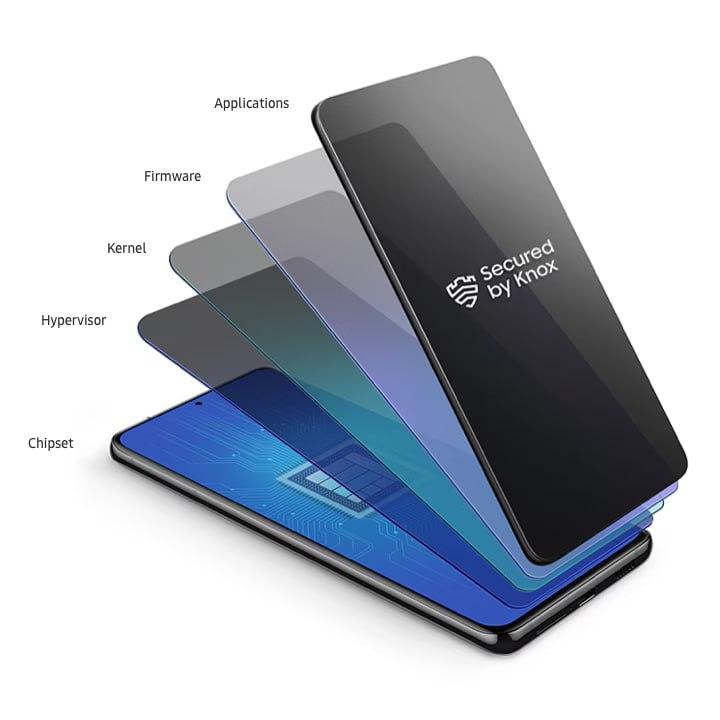
Layers constituting the Samsung Knox architecture (Samsung)
The security of the Knox platform begins with a "Root of Trust" integrated into the hardware during manufacturing. This architecture includes verification processes that check whether software has been altered during each device boot and throughout operation.
The system utilizes the TrustZone technology found in ARM processor architectures. TrustZone divides the processor into two isolated areas: the Normal World and the Secure World. While the Android operating system operates in the Normal World, encryption keys and critical security operations are protected within the Secure World. During the boot process (Secure Boot), the Primary Bootloader (ROM) and Secondary Bootloader verify the digital signature of the operating system kernel to prevent unauthorized code from executing.
If unauthorized modifications such as rooting or installation of a custom ROM are detected during boot or operation, a one-time programmable hardware fuse (e-fuse) is permanently triggered. This mechanism, known as the Knox Warranty Bit, permanently records that the device’s security has been compromised and blocks access to secure areas such as Knox containers.
While the operating system is running, the TrustZone-based Integrity Measurement Architecture (TIMA) periodically checks the integrity of the kernel. Real-time Kernel Protection (RKP) monitors attempts to attack kernel code or data structures and prevents unauthorized modifications.
The Samsung Knox platform has been examined in various academic studies by security researchers. These studies have analyzed Knox’s secure container structure and its use of the Trusted Execution Environment (TEE).
A study published by the Association for Computing Machinery (ACM) reverse-engineered Knox’s Secure Container structure and identified and reported certain design weaknesses. The study confirmed that Knox extensively leverages TrustZone technology to protect enterprise data.
Another academic study analyzed Knox’s use of the Trusted Execution Environment (TEE). The research demonstrated that despite TEE implementation, other software vulnerabilities within the system could still be exploited by attackers, potentially undermining core security design principles.
Analyses published in IEEE (Institute of Electrical and Electronics Engineers) publications have detailed potential attack scenarios targeting the Knox platform and provided in-depth explanations of how its secure boot processes function.
The platform offers cloud-based tools such as Knox Suite, Knox Manage, Knox Configure, and Knox Guard to enable enterprises to manage mobile devices. These tools grant IT administrators the ability to remotely lock, wipe, update devices, and enforce application policies.
Samsung Knox holds numerous global certifications to validate its security capabilities, including the U.S. government’s FIPS 140-2 and Defense Information Systems Agency (DISA) approvals, the Common Criteria certification, and high security ratings from Gartner.
Atamli-Reineh, Ahmad, Ravishankar Borgaonkar, Ranjbar A. Balisane, Giuseppe Petracca, and Andrew Martin. “Analysis of Trusted Execution Environment usage in Samsung KNOX.” Proceedings of the 1st Workshop on System Software for Trusted Execution (SysTEX ’16) (2016): 1–6. https://dl.acm.org/doi/epdf/10.1145/3007788.3007795
Canonov, Uri, and Avishai Wool. "Secure Containers in Android: The Samsung KNOX Case Study." *Proceedings of the 2016 ACM SIGSAC Conference on Computer and Communications Security* (2016): 1011–1022. Accessed January 26, 2026. https://dl.acm.org/doi/epdf/10.1145/2994459.2994470
Dorjmyagmar, Munkhzorig, M. Kim, and H. Kim. “Security analysis of Samsung Knox.” 19th International Conference on Advanced Communication Technology (ICACT) (2017): 550–553. https://ieeexplore.ieee.org/document/7890150/authors
Samsung Knox. "About Knox." Accessed January 26, 2026. https://www.samsungknox.com/en/about-knox
Samsung Knox. "Secured by Knox." Accessed January 26, 2026. https://www.samsungknox.com/en/secured-by-knox
Samsung. "Samsung Knox: Secure Your Business." Accessed January 26, 2026. https://www.samsung.com/us/business/solutions/samsung-knox/

Architecture(s) | Hardware-Based Multilayer Security (From Chipset to Software) | ||||||||
|---|---|---|---|---|---|---|---|---|---|
Type(s) | Mobile Security Platform Enterprise Mobility Management (EMM) | ||||||||
Developer(s) | Samsung Electronics | ||||||||
Platform | Samsung Galaxy Devices (Android and Tizen) | ||||||||
Service Area | Mobile Device Security, Data Encryption, Device Management | ||||||||
Architecture and Technical Structure
Secure Boot and TrustZone
Knox Warranty Bit
Real-time Kernel Protection (RKP) and TIMA
Academic Analyses and Security Evaluations
Enterprise Solutions and Certifications