This article was automatically translated from the original Turkish version.
+1 More
Construction Date(s) | Gregorian 1895 (Hijri 1313) | ||||||||
|---|---|---|---|---|---|---|---|---|---|
Location | Balıkesir | ||||||||
Technique | Kalemişi | ||||||||
Characteristic | Wall paintings inside the interior (landscape and still life figures) | ||||||||
Patron | Kaymakam Hasan Tahsin Bey (With Support) | ||||||||
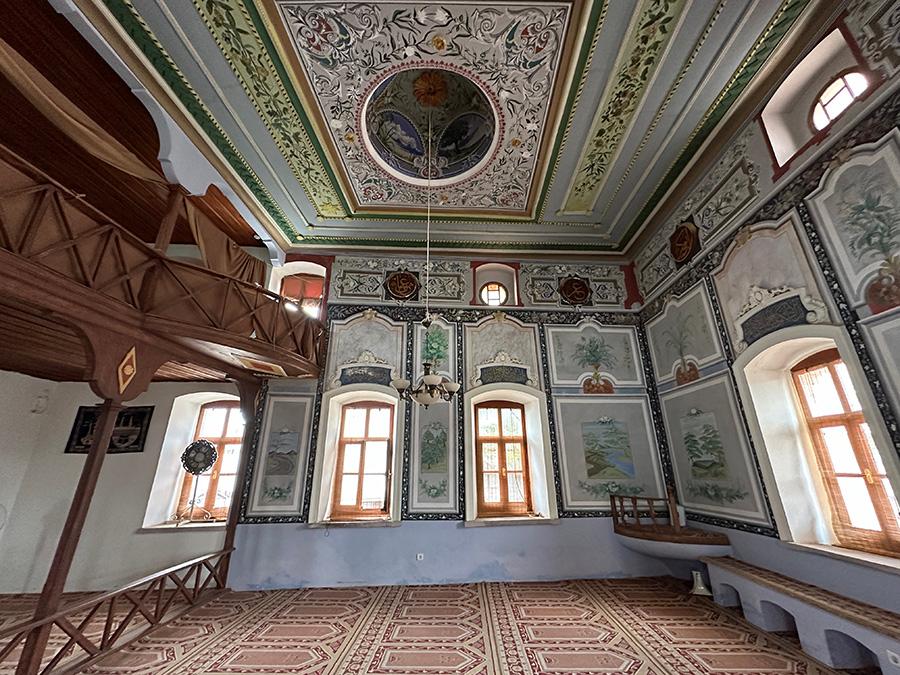
A historical structure located in the Burhaniye district of Balıkesir, recognized as one of the most significant examples of 19th-century Ottoman pictorial art in Anatolia. The building draws attention not for its architectural structure but for its rich wall paintings, which are important for reflecting the technical and stylistic characteristics of the Westernization period in Turkish art within a rural settlement.
Mosque is situated in Şahinler village, approximately six kilometers south of the Burhaniye district of Balıkesir province. According to the inscription above the courtyard entrance gate, the building was constructed in 1895 (Hijri 1313) through the initiative of Hasan Tahsin Bey, the then Kaymakam of Burhaniye. The settlement history of the village, formerly known as “Karga,” extends back to the Late Roman period, as evidenced by archaeological findings in the region. Local accounts mention that village eggs were used in the mortar during construction.
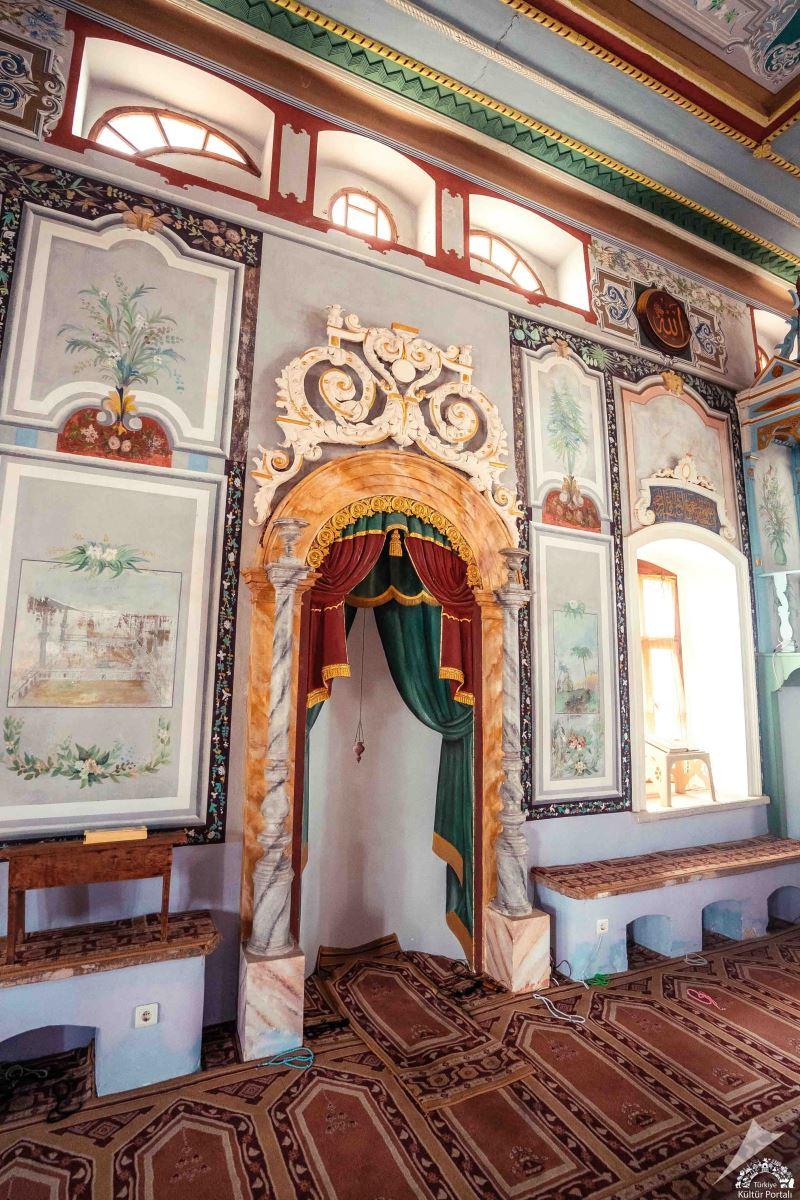
Şahinler Köyü Camii (Kültür Portal)
The structure consists of a transverse rectangular prayer hall (harim), a five-bay northern congregational space, and an independent minaret located in the northwestern corner. The exterior façade is very simple and plastered, making it difficult to determine the exact construction material. The roof is a gabled structure covered with traditional Turkish tiles. Inside, a flat wooden ceiling has been installed, with three “false dome” forms created along the east-west axis on the ceiling surface.
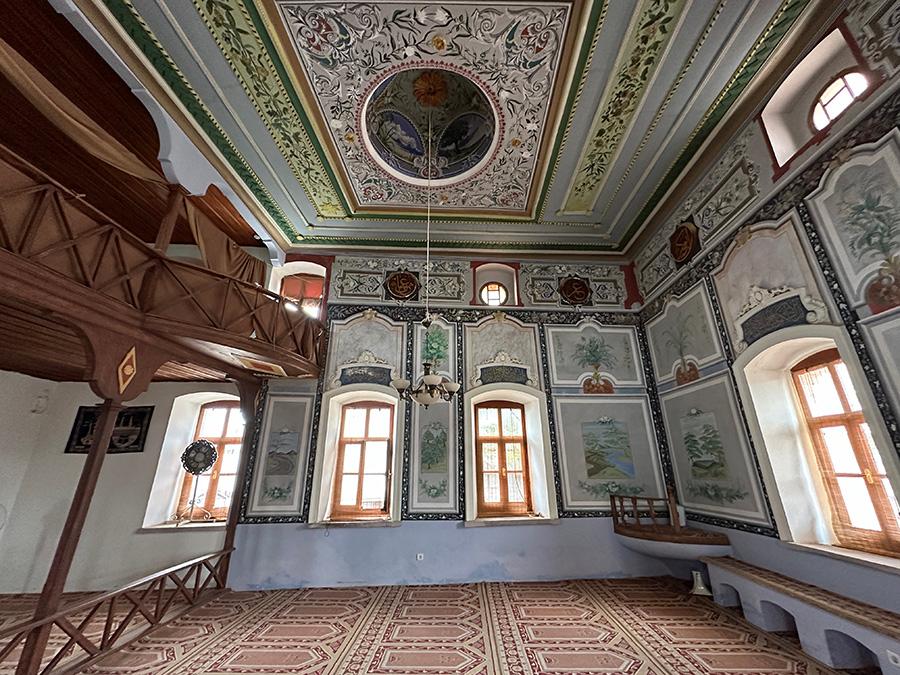
Şahinler Köyü Camii(Diyanet Haber)
Şahinler Köyü Camii is notable for its dense decorative paintings executed in the pencil technique on dry plaster using earth pigments. These decorations reflect the stylistic features of the Westernization period, resulting from the Ottoman Empire’s cultural interactions with the West since the 18th century. While the paintings retain influences from traditional miniature art, they also incorporate Western artistic concepts such as perspective, light and shadow, and depth. Although the identity of the artist is unknown, the stylistic qualities suggest the work of a professional hand familiar with these techniques.
The painting program in the mosque is organized according to a specific structure and grouped into three main categories. The imaginary landscape depictions, concentrated on the lower levels of the prayer hall walls and the false domes, typically portray tranquil and serene natural scenes that cannot be identified with any specific location. These compositions feature riverbanks, lush green meadows, flowering spring branches, and tree species native to the region such as oak, willow, plane, and poplar. The second group of specific spatial depictions includes an imaginary panorama of Istanbul represented by its symbolic monuments, a depiction of Medina with its arcaded courtyard and minarets, a cemetery adorned with poplar trees near the village, and the Rezelli flour mill with smoke rising from its chimney. The third group consists of still lifes, primarily composed of white roses and floral bouquets rising from vases or acanthus leaves, rendered with chiaroscuro effects to create volume in a Baroque style. Additionally, medallions inscribed with the names of Allah, Muhammad, and the Four Caliphs, located in cartouches on the upper sections of the prayer hall walls, are framed by plant motifs such as tulips and clover, completing the overall composition.
Although parts of the wall paintings in Şahinler Köyü Camii have survived intact to the present day, paint erosion and flaking are observable on certain panels, particularly at lower levels. Some depictions have been distorted over time due to moisture or interventions by unqualified individuals, and professional restoration is required.
Diyanet Haber. "Köydeki sanat harikası." August 22, 2024. Accessed January 10, 2026. https://www.diyanethaber.com.tr/koydeki-sanat-harikasi.
Türkiye Kültür Portalı. "Şahinler Köyü Camii - Balıkesir." Accessed January 10, 2026. https://www.kulturportali.gov.tr/turkiye/balikesir/gezilecekyer/sahinler-koyu-camii
Yıldırım, Savaş. "Burhaniye Şahinler Köyü Camii Duvar Resimleri." *Selçuk Üniversitesi Sosyal Bilimler Enstitüsü Dergisi*, no. 29 (2013): 279-293. https://dergipark.org.tr/en/download/article-file/1724824
Construction Date(s) | Gregorian 1895 (Hijri 1313) | ||||||||
|---|---|---|---|---|---|---|---|---|---|
Location | Balıkesir | ||||||||
Technique | Kalemişi | ||||||||
Characteristic | Wall paintings inside the interior (landscape and still life figures) | ||||||||
Patron | Kaymakam Hasan Tahsin Bey (With Support) | ||||||||
No Discussion Added Yet
Start discussion for "Şahinler Village Mosque" article
Location and Historical Background
Architectural Features
Wall Paintings and Technical Characteristics
Themes and Composition of the Paintings
Conservation Status