badge icon

This article was automatically translated from the original Turkish version.

Article

RS-232 (Recommended Standard 232) is a standard that enables communication between terminal equipment (DTE) and data circuit-terminating equipment (DCE). First defined in 1962, this standard was widely used for data transfer between computers, modems, and various communication devices.

Technical Characteristics of the RS-232 Standard

RS-232 includes a set of electrical and mechanical requirements defining serial data transmission. The standard employs a single-ended interface and is designed for short-distance communication at low speeds.
  • Electrical Characteristics: RS-232 uses bipolar signaling. A logical 1 is defined as a voltage between -3V and -15V, while a logical 0 is defined as a voltage between +3V and +15V.
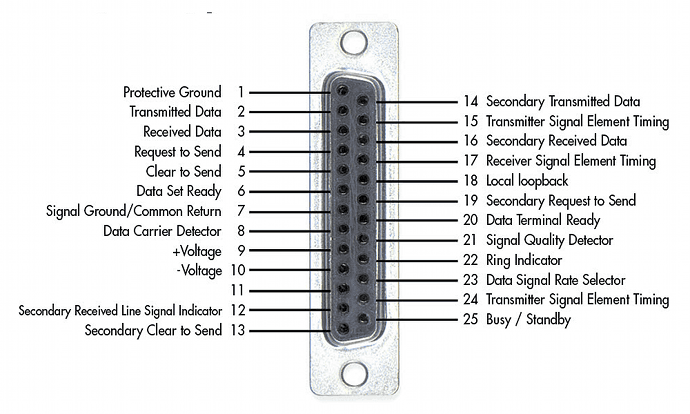
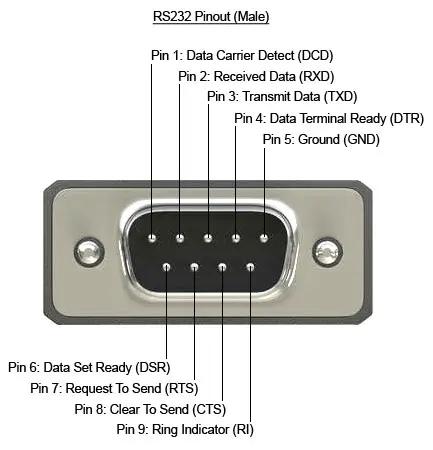
  • Connection Pins: The standard typically uses 25-pin or 9-pin D-sub connectors (DB-25 and DB-9).
  • Connector and Pin Usage: In commonly used DB-9 and DB-25 connectors for RS-232 connections, specific pins are assigned for particular functions. For example:
  • DB-9 Connector:

DB9 Connector

  • DB-25 Connector:

DB25 Connector

  • Transmission Modes: RS-232 is most commonly used for asynchronous communication.
  • Connection Types: A direct connection is established between DTE (computer) and DCE (modem). However, modem cables are required for communication between two DTE devices.
  • Data Rate and Distance: RS-232 provides reliable communication at speeds up to 20 Kbps and distances of approximately 15 meters. However, cable length can be increased at lower speeds.

Advantages and Limitations

One of the greatest advantages of RS-232 is its simplicity and wide compatibility. However, the following limitations must also be considered:

  • Noise Sensitivity: Due to its single-ended nature, RS-232 is sensitive to electromagnetic interference.
  • Low Data Rate: It is inadequate for meeting today’s high-speed data transfer requirements.
  • Short Distance: As cable length increases, signal degradation and data loss may occur.
  • Multidevice Support: RS-232 is designed for point-to-point communication and does not support connections to multiple devices.
  • Legacy Technology: Compared to modern communication protocols such as USB and Ethernet, it is an outdated system.

Modern Applications and Alternatives

With advancing technology, RS-232 has been gradually replaced by newer standards such as USB, RS-485, and Ethernet, which offer higher data rates and longer transmission distances. Nevertheless, RS-232 is still widely used in the following areas:

  • Industrial Automation: RS-232 is used for communication with PLCs and other control systems.
  • Medical Devices: Many older medical instruments continue to use RS-232 interfaces.
  • Test and Measurement Systems: RS-232 communication is preferred in laboratory equipment such as oscilloscopes and multimeters.
  • Aerospace and Defense: Some systems still employ RS-232.
  • Automation Systems: It is used in factory automation and production lines for low-cost and reliable data transfer.
  • Embedded Systems: It is widely used in microcontrollers and embedded systems for serial communication.

RS-232 has been used in industry for decades as a low-cost and reliable communication protocol. Although it struggles to meet modern data transmission demands, it is still preferred in certain applications.

In industrial and scientific devices, RS-232 support continues to ensure backward compatibility with legacy systems. However, in systems requiring high-speed or long-distance communication, more advanced alternatives are preferred, and its general usage is steadily declining.

Bibliographies


RS-232 Overview. Texas Instruments, 1997. Accessed February 24, 2025. https://www.ti.com/lit/an/slla083a/slla083a.pdf.

RS-232 Reference Guide. Omega. Accessed February 24, 2025. https://www.omega.co.uk/techref/pdf/RS-232.pdf.

RS232 Manual. Contrec, June 2017. Accessed February 24, 2025. https://www.contrec.co.uk/wp-content/uploads/2017/06/RS232-manual.pdf.

Author Information

Avatar
AuthorÖmer Said AydınDecember 23, 2025 at 10:20 AM

Tags

Discussions

No Discussion Added Yet

Start discussion for "RS232" article

View Discussions

Contents

  • Technical Characteristics of the RS-232 Standard

  • Advantages and Limitations

  • Modern Applications and Alternatives

Ask to Küre