


This article was automatically translated from the original Turkish version.

Educational Process
(Generated with Artificial Intelligence)
Robert Mills Gagné Theory
Nine-Stage Teaching Process | Ensure Learning Retention and Transfer Assess Performance Provide Feedback Elicit Performance Guide Learning Present New Content Recall Prior Knowledge Inform Objectives Gain Attention | ||||||||
|---|---|---|---|---|---|---|---|---|---|
Basic Components | Planning of Learning Processes Systematic Instructional Design Instructional Events (Nine-Stage Instructional Model) Classification of Learning Types | ||||||||
Approach Type | Systematic Instructional Design Cognitive Learning Approach | ||||||||
Upper Discipline | Learning Theories Instructional Design | ||||||||
Field | Educational Sciences | ||||||||
Robert Mills Gagné (1916–2002) is an American researcher known for synthesizing behaviorist and cognitive approaches in the field of educational psychology. In his foundational work, "The Conditions of Learning", he argued that different types of learning exist and that these types vary according to environmental conditions.
According to Gagné, learning is both a mental process and a product that can be observed through measurable behaviors. This process results from the interaction between internal conditions, such as the learner’s prior knowledge and cognitive skills, and external conditions, including instructional methods and environmental arrangements. Instruction involves organizing and controlling external events to support internal learning processes toward specific learning objectives.
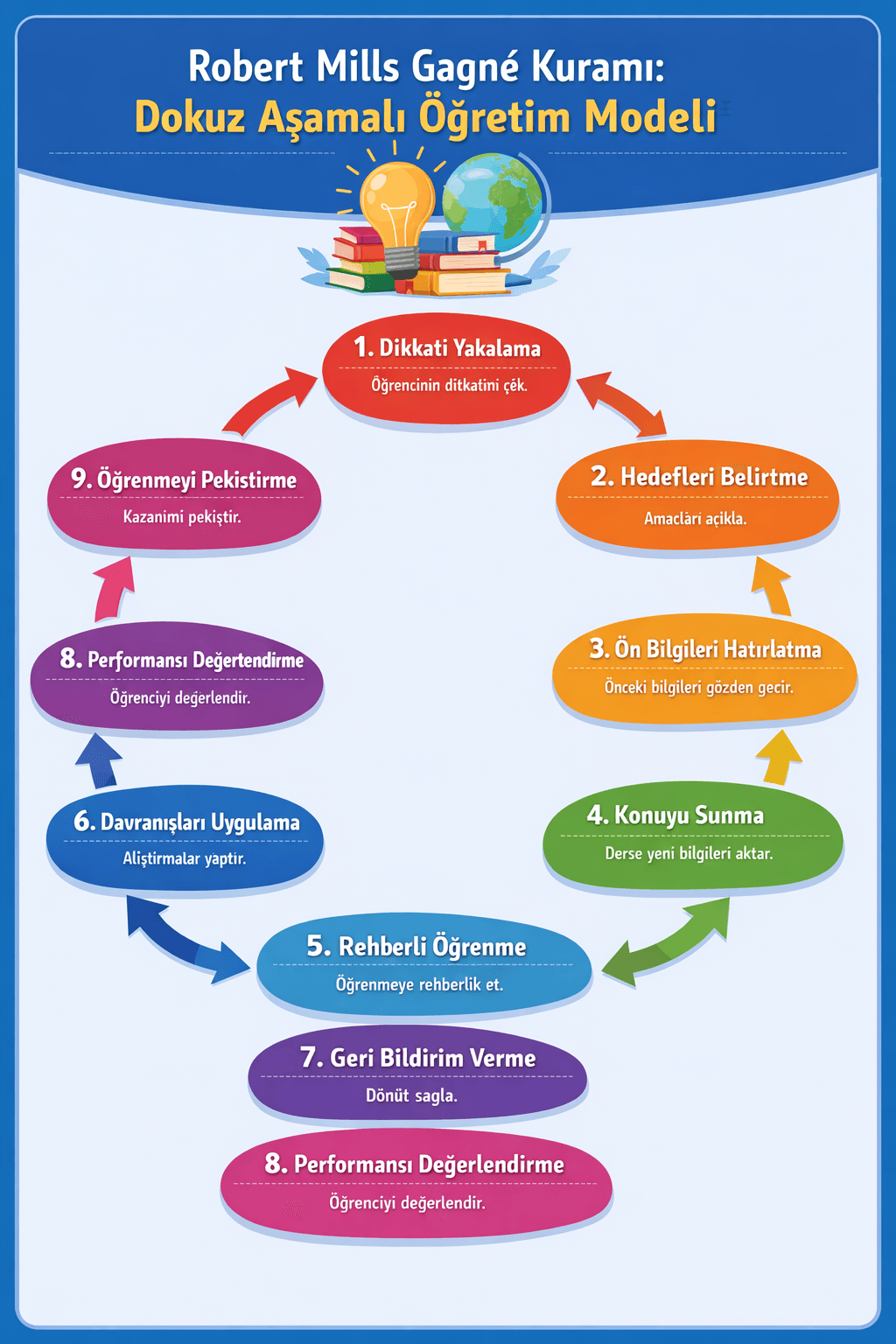
Nine-Stage Instructional Model
(Generated by Artificial Intelligence)
The outcomes of learning are classified into five primary categories:
1. Verbal information,
2. Intellectual skills,
3. Cognitive strategies,
4. Attitudes,
5. Motor skills,.
Gagné maintained that learning is a cumulative process. He proposed that intellectual skills develop through an eight-stage hierarchy. At the lowest level is signal learning, while at the highest level is problem solving, the ability to apply principles and concepts to novel situations.
Developed to design effective learning processes, this model consists of nine essential stages:
Gagné’s nine-stage model is widely used today as a foundational framework in the design of computer-assisted instruction, internet-based distance learning, and instructional software. This structured approach, which integrates behaviorist and cognitive psychology, significantly enhances student engagement and academic achievement compared to traditional methods, particularly in courses involving abstract concepts.
Genç, Hatice. “Gagne Dokuz Adım Kuramı.” SlideShare. Accessed February 20, 2026. https://www.slideshare.net/slideshow/gagne-dokuz-adm-kurampdf/256780584
Karaağaçlı, Mustafa, and Orhan Erden. “İnternet Destekli Uzaktan Eğitimde Dokuz Aşamalı Öğretim Durumunun Tasarımı.” *Bilişim Teknolojileri Dergisi.* Accessed February 20, 2026. https://dergipark.org.tr/en/download/article-file/75237
Taşkıran, Cengiz, and Zafer Çakmak. “Gagné’nin Öğretim Etkinlikleri Modeline Göre Hazırlanan Öğretim Yazılımının Sosyal Bilgiler Dersine Etkileri.” *Muğla Sıtkı Koçman Üniversitesi Eğitim Fakültesi Dergisi.* Accessed February 20, 2026. https://dergipark.org.tr/tr/pub/muefd/article/861858

Educational Process
(Generated with Artificial Intelligence)
Robert Mills Gagné Theory
Nine-Stage Teaching Process | Ensure Learning Retention and Transfer Assess Performance Provide Feedback Elicit Performance Guide Learning Present New Content Recall Prior Knowledge Inform Objectives Gain Attention | ||||||||
|---|---|---|---|---|---|---|---|---|---|
Basic Components | Planning of Learning Processes Systematic Instructional Design Instructional Events (Nine-Stage Instructional Model) Classification of Learning Types | ||||||||
Approach Type | Systematic Instructional Design Cognitive Learning Approach | ||||||||
Upper Discipline | Learning Theories Instructional Design | ||||||||
Field | Educational Sciences | ||||||||
No Discussion Added Yet
Start discussion for "Robert Mills Gagné's Theory" article
Internal and External Conditions of Learning
Learning Outcomes and Skill Hierarchy
Nine-Stage Instructional Model
Introduction
Development
Outcome
Applications in Educational Technologies