

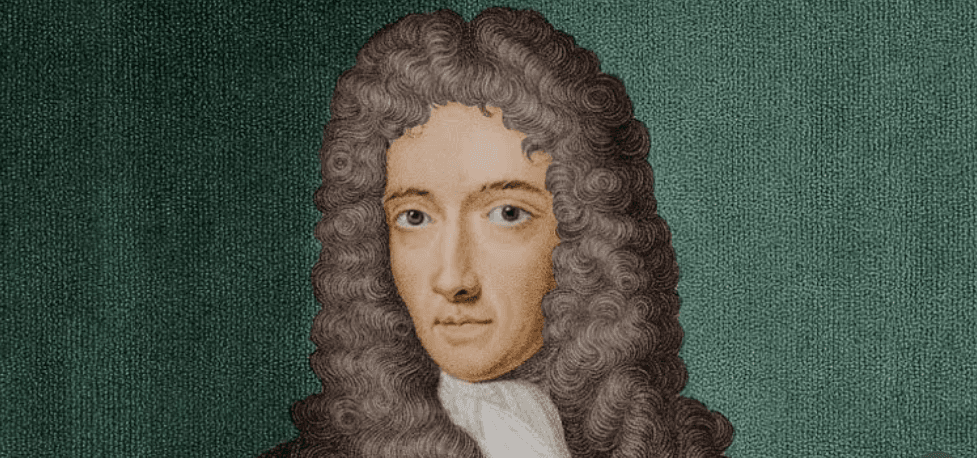

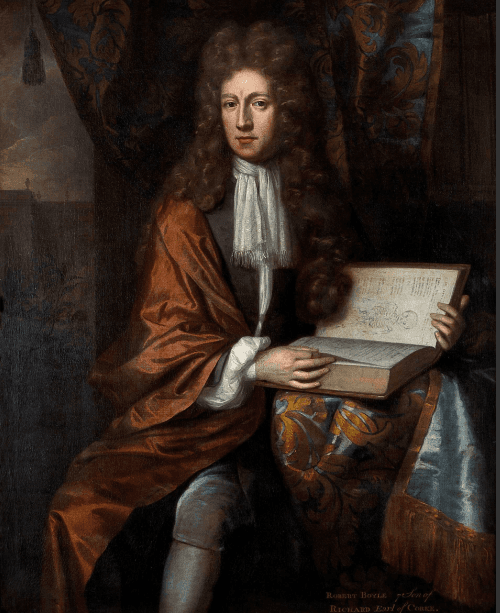
Father of Modern Chemistry
Ölüm tarihi | 1691-12-31 | ||||||||
|---|---|---|---|---|---|---|---|---|---|
Doğum tarihi | 1627-01-25 | ||||||||
Yaş | 64 | ||||||||
Babası | Richard Boyle | ||||||||
Annesi | Catherine Fenton | ||||||||
Award(s) | Member of the Royal Society | ||||||||
Robert Boyle was born on 25 January 1627 in Lismore Castle, in the county of Waterford, Ireland. His father, Richard Boyle, was one of the wealthiest landowners in England. Boyle grew up in a wealthy and cultured environment and learned Latin, Greek, and French at an early age. He began his education at Eton College and furthered it through extended travels in France, Switzerland, and Italy. The period he spent in Florence shortly after the death of Galileo Galilei in 1642 deepened his interest in the natural sciences. In 1644 he returned to England and devoted himself to scientific work.
Boyle began laboratory experiments at an estate near Oxford. He focused particularly on the physical behavior of gases and in 1662 formulated the law now known as Boyle’s Law, which states that the pressure of a gas is inversely proportional to its volume at constant temperature. His 1661 publication, The Sceptical Chymist, was one of the first scientific works to distinguish chemistry from alchemy and establish it on experimental foundations; it is regarded as one of the foundational texts of modern chemistry. Boyle also championed the corpuscular nature of matter and contributed to the development of atomic theory. His vacuum experiments and use of pressure chambers played a pioneering role in the advancement of early laboratory techniques.
Boyle’s scientific activities took place amid the political instability and religious tensions of his time. Although raised in circles sympathetic to Catholicism, he embraced Protestant faith. Boyle viewed science and religion as compatible, interpreting natural phenomena as reflections of God’s created order. This intellectual approach made him an important but sometimes controversial figure in both scientific and theological circles.
Robert Boyle died in London in 1691. His scientific legacy laid the foundations of modern science based on the experimental method. He was one of the founders of the Royal Society and played a vital role in the sharing and advancement of scientific knowledge. His contributions to the concept of chemical elements, atomic theory, and gas laws inspired later scientists such as Antoine Lavoisier. Boyle’s Law remains one of the fundamental concepts taught in physics and chemistry today, and scientific laboratory practices are built upon his experimental approaches.
Hunter, Michael. *Boyle: Between God and Science*. New Haven: Yale University Press, 2009. Accessed May 1, 2025. https://yalebooks.yale.edu/book/9780300169317/boyle/.
Science History Institute. “Robert Boyle.” *Science History Institute*. Accessed May 1, 2025. https://www.sciencehistory.org/historical-profile/robert-boyle.

Father of Modern Chemistry
Ölüm tarihi | 1691-12-31 | ||||||||
|---|---|---|---|---|---|---|---|---|---|
Doğum tarihi | 1627-01-25 | ||||||||
Yaş | 64 | ||||||||
Babası | Richard Boyle | ||||||||
Annesi | Catherine Fenton | ||||||||
Award(s) | Member of the Royal Society | ||||||||
Scientific Discoveries and Achievements
Challenges and Struggles
Legacy and Influence