

+1 More

Road sweeping machines are construction vehicles that mechanically perform surface cleaning in urban and intercity road networks, airport runways, and industrial facility sites. These machines are used for purposes such as ensuring environmental hygiene, suppressing dust, collecting waste, and improving occupational health and safety.
The development of street sweeping machines dates back to the mid-19th century, when urbanization accelerated after the Industrial Revolution. The first recorded sweeping device was a horse-drawn mechanical broom developed in 1843 by Joseph Whitworth in Manchester, England. This machine used rotating brushes to collect dust and debris from streets and marked a significant milestone in the hygiene practices of the time.
Later, in the 1860s, as the need for street cleaning grew in large U.S. cities such as Philadelphia and New York, manual brooms became insufficient. As a result, mechanization progressed and sweeping carts were developed. In 1870, the first patented motorized sweeper was invented. Although still horse-drawn, these machines featured brush systems powered by motors, enabling more systematic cleaning.
In 1911, the first fully motor-powered road sweeping machine was introduced in the United States. From that point on, vacuum systems and water-spraying technologies were integrated into the machines to suppress dust and improve cleaning efficiency. From the mid-20th century onwards, sweeping machines were equipped with diesel engines, becoming autonomous cleaning vehicles. Today, they are being designed with electric, hybrid, or low-emission engines to enhance environmental sustainability.
According to the MEB (Ministry of National Education) Construction Machinery Module, road sweeping machines are classified as special-purpose machinery equipped with mechanical cleaning functions. Their main systems include:
These components can be configured differently depending on surface types and environmental conditions. In major cities, machines are equipped with high-capacity water tanks and advanced maneuvering capabilities.
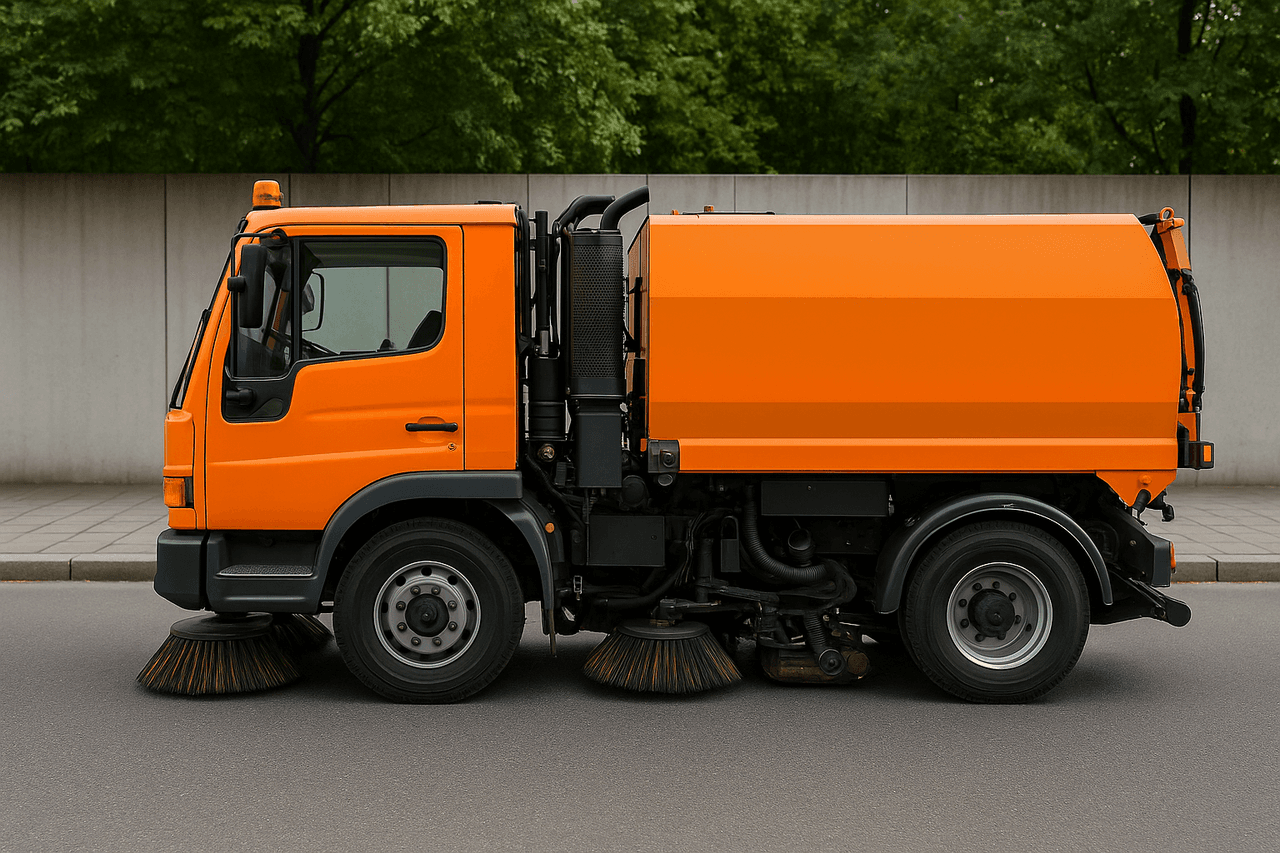
Road Sweeping Machine (AI-Generated Image)
Road sweeping machines are widely used in the following areas:
These machines are typically operated in the early morning or late at night to avoid disrupting traffic. During operation, attention must be paid to environmental emissions, noise levels, and waste management.
According to the Ministry of National Education Operator Guidelines, individuals operating road sweeping machines must possess an operator certificate issued by authorized training centers. The training process includes:
According to the guidelines, operator training must be conducted at MEB-approved institutions and follows a modular curriculum. The use of personal protective equipment (gloves, vests, goggles, etc.) is also mandatory during training.
Due to the presence of moving parts, road sweeping machines pose various physical hazards. Therefore:
According to the MEGEP module, these machines must undergo periodic inspection every six months and be properly recorded.
Republic of Türkiye Ministry of National Education. Construction Machinery. Ankara: MEGEP. Accessed May 30, 2025. https://megep.meb.gov.tr/mte_program_modul/moduller_pdf/%C4%B0%C5%9F%20Makineleri.pdf
Republic of Türkiye Ministry of National Education. Construction Machinery Operator Guidelines. Ankara: Directorate General of Secondary Education. Accessed May 30, 2025. https://ookgm.meb.gov.tr/meb_iys_dosyalar/2018_05/29114446_OPERATYRLYK_YYNERGESY.pdf
Vacuum Cleaner History. “History of the Street Sweeper.” Accessed May 30, 2025. https://www.vacuumcleanerhistory.com/vacuum-cleaner-development/history-of-street-sweeper/

No Discussion Added Yet
Start discussion for "Road Sweeping Machine" article
History and Early Areas of Use
Types of Road Sweeping Machines
Technical Structure and Functional Components
Areas of Use and Operational Principles
Operator Training and Certification Process
Occupational Health and Safety
This article was created with the support of artificial intelligence.