


This article was automatically translated from the original Turkish version.
+1 More
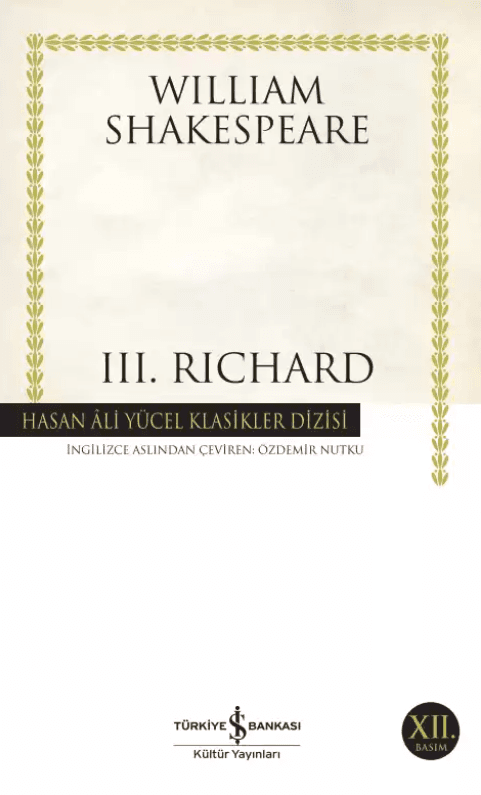
Author | William Shakespeare | ||||||||
|---|---|---|---|---|---|---|---|---|---|
Translator | Özdemir Nutku | ||||||||
Publisher | Türkiye İş Bankası Kültür Yayınları | ||||||||
Publication Date(s) | 04.05.2018 | ||||||||
Page | 175 | ||||||||
Language | Turkish | ||||||||
Genre | Tragedy | ||||||||
Richard III is a tragedy centered on Richard of the House of York, whose ambition for power led to murders during the final phase of England’s civil war, the Wars of the Roses, and ultimately to his downfall. The play begins with Richard’s schemes to seize the throne. Physically disabled and morally twisted, Richard first arranges the murder of his brother Clarence, then, after the death of King IV Edward, ensures the deaths of his young nephews, the princes.
To ascend the throne, Richard marries Lady Anne Neville, who is the widow of King VI Henry, whom Richard himself had killed. All these intrigues culminate in Richard’s proclamation as king. However, after seizing the throne, he loses the support of the people and the loyalty of those around him. Many of his allies, including Lord Buckingham, turn against him.
The play reaches its climax with a rebellion led by Richmond’s Lancaster forces. At the Battle of Bosworth, Richard meets his final downfall, uttering his famous line: “My horse, my horse, my kingdom for a horse!” He is killed in battle, and Richmond is proclaimed king, laying the foundations of the Tudor dynasty.
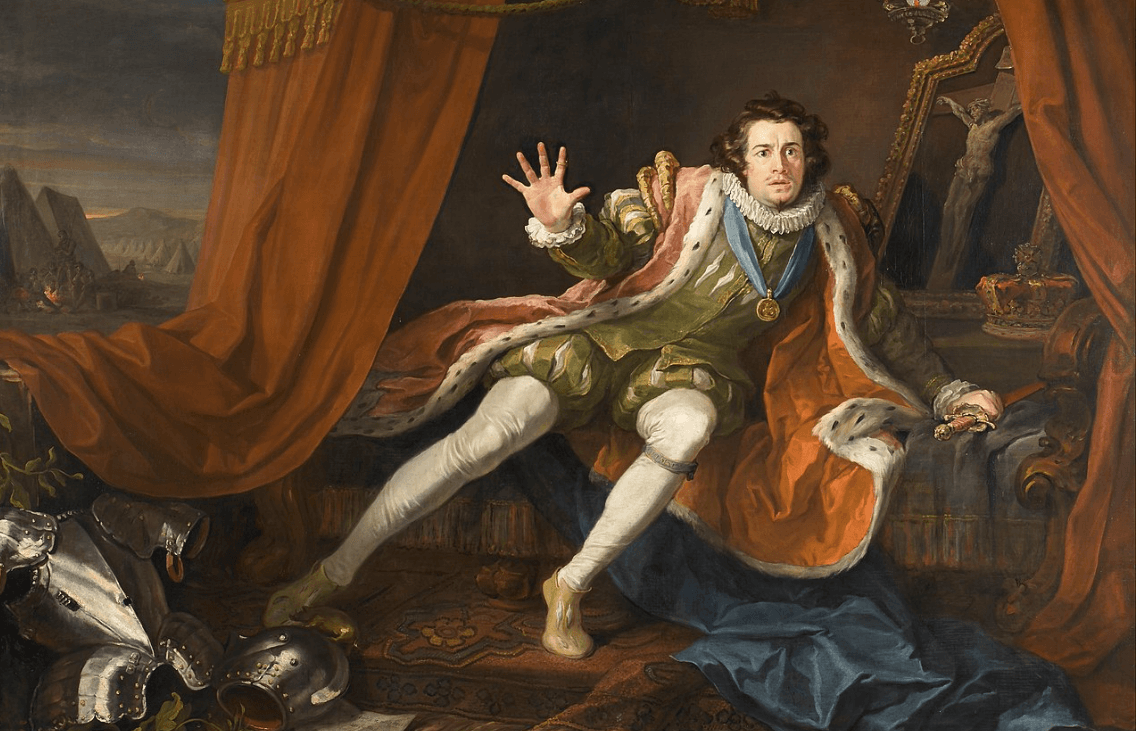
William Hogarth’s work "David Garrick as Richard III" (Art UK)
A prince of the House of York with physical disabilities. He stands out for his powerful oratory, shrewd planning, and ruthless nature. He murders many members of his own family to reach the throne. He is a tragic figure: one who rises to power through his own actions but is destroyed by their consequences.
Widow of Henry VI and wife of Richard. Despite having killed her husband and father-in-law, Richard deceives her into marriage. Presented as a passive character, Anne becomes a victim of court intrigues.
Initially one of Richard’s most important supporters. However, he develops moral unease over Richard’s cruelty and is ultimately betrayed. His character is portrayed as one caught between loyalty and morality.
Richard’s elder brother. Wrongfully accused of treason, he is imprisoned and executed on Richard’s orders. His death is Richard’s first major sacrifice on the path to the crown.
Wife of Edward IV and Richard’s sister-in-law. She loses her political influence as Richard gains power. She endures great grief after the murder of her sons and spends the play attempting to form political alliances.
Sons of Edward IV. They are imprisoned in the Tower of London before Richard’s accession and are almost certainly murdered. Their deaths symbolize Richard’s moral bankruptcy and the collapse of his bond with the people.
Initially trusts Richard. However, he becomes a victim of Richard’s strategy to eliminate every potential threat to his power.
Representative of the House of Lancaster. He defeats Richard at the end of the play and founds the Tudor dynasty. His victory signifies the restoration of legitimate order. He embodies justice and national unity.
Richard’s murders, lies, and manipulations to seize power illustrate how personal ambition can lead to destruction. The play dramatizes the internal and societal collapse of a character who seeks absolute power at the cost of moral values.
The dissonance between Richard’s physical appearance and his inner corruption is one of the play’s central contradictions. His physical deformity becomes a metaphor for his moral distortion. Meanwhile, courtiers and subjects appear loyal but are in fact self-serving.
Richard skillfully uses language to manipulate, deceive, and control those around him. His rhetorical prowess makes him dangerous not only militarily but intellectually as well.
Throughout the play, there is a growing expectation of divine retribution for Richard’s crimes. The demands for vengeance voiced by his enemies through dreams, curses, and prophecies represent the inevitable workings of fate.
Richard’s unlawful seizure of the throne raises questions about the moral and political legitimacy of rule. Richmond’s victory is presented as the restoration of rightful order.
Art UK. "David Garrick as Richard III." Accessed April 18, 2025.https://artuk.org/discover/artworks/david-garrick-as-richard-iii-98269.
Shakespeare, William. III. Richard. Trans. Özdemir Nutku. Istanbul: Türkiye İş Bankası Kültür Yayınları, 2018.

Author | William Shakespeare | ||||||||
|---|---|---|---|---|---|---|---|---|---|
Translator | Özdemir Nutku | ||||||||
Publisher | Türkiye İş Bankası Kültür Yayınları | ||||||||
Publication Date(s) | 04.05.2018 | ||||||||
Page | 175 | ||||||||
Language | Turkish | ||||||||
Genre | Tragedy | ||||||||
Characters and Traits
Themes Explored