


This article was automatically translated from the original Turkish version.
Renewable energy is the field of energy that aims to produce energy services such as heat, electricity, and fuel by harnessing flows that are continuously replenished through natural processes and can regenerate at a human scale. Resources such as solar radiation, wind, geothermal heat, the water cycle, and biomass are considered renewable due to their continuity in nature. The growth of this field is assessed alongside objectives such as reducing the environmental impacts of fossil fuel-based production on air pollution and the climate system, strengthening energy supply security, and expanding access to energy services.
Energy systems are classified according to the nature of the source and the mode of conversion. Renewable energy occupies a category opposite to non-renewable energy in terms of the source’s depletion dynamics; in terms of conversion, it is defined by technological chains that involve the transition from primary flows to secondary carriers. Within this framework, renewable energy technologies encompass not only the “source” but also the conversion, control, and operation layers that connect this source to the grid, heating systems, or fuel infrastructure.
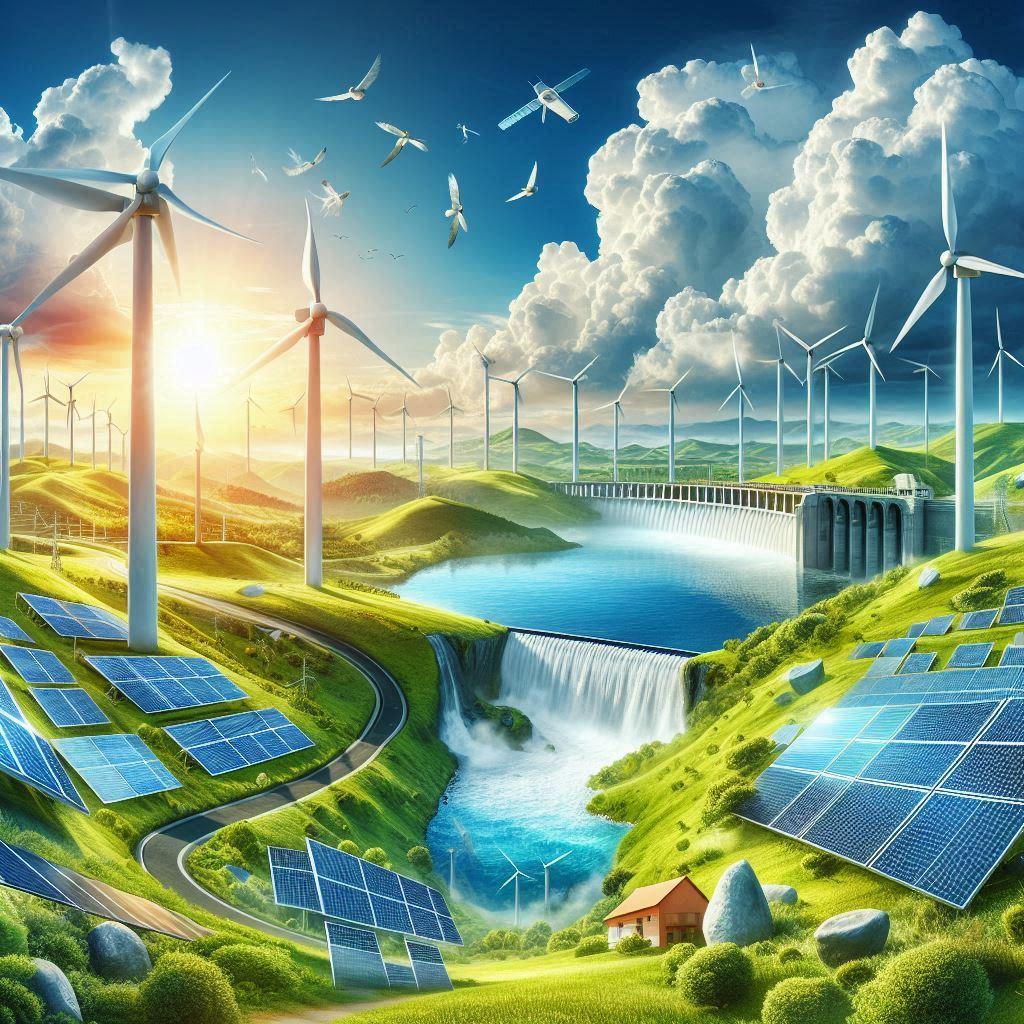
Yenilenebilir Enerji Kaynakları (Yapay Zeka ile Oluşturulmuştur.)
Solar energy is utilized either through photovoltaic conversion for direct electricity generation or via thermal systems for heat and indirect electricity production. Wind energy relies on the conversion of mechanical energy into electrical energy through turbines, and its generation characteristics vary with meteorological conditions. Hydroelectric energy is defined by the conversion of water’s potential and kinetic energy into electricity using turbine-generator systems; it includes applications such as reservoir-based, run-of-river, and various scale implementations. Biomass and biofuel applications involve the conversion of organic matter into energy carriers through methods such as combustion, gasification, fermentation, or biochemical transformation. Geothermal energy stands out through the utilization of subsurface heat for electricity generation and particularly for heating applications. Ocean energy targets the conversion of marine flows such as tides and waves into energy; technical feasibility and local conditions are among the key factors determining the prevalence of this subfield.
The transition to renewable energy is analyzed in the context of reducing greenhouse gas emissions and limiting the impacts of climate change. This approach aims to lower climate forcing agents by reducing the share of fossil fuels in energy production, while simultaneously linking to development goals such as energy security and energy access. However, sustainability is not limited solely to emissions generated during production; lifecycle aspects such as raw material procurement, equipment manufacturing, land use, water consumption, waste management, and recycling are also included in the evaluation.
Another key dimension in sustainability discussions is policy and market design. The widespread adoption of renewable technologies is closely linked to regulatory frameworks, incentive mechanisms, the reduction of information gaps, and the resilience of supply chains. Therefore, the energy transition encompasses not only increases in technical capacity but also governance and institutional design.
Although renewable energy sources stand out for their low-carbon production potential, each technology has distinct local environmental and social impacts. In solar technologies, issues such as the use of certain chemical components during production, use, and end-of-life management, as well as water consumption especially in arid regions, may arise. In wind farms, concerns such as bird collisions, habitat impacts, and noise are related to site selection and operational practices. In hydropower, changes in sediment transport, fish migration, and river ecology are significant. In biomass, air pollutants, forestry pressures, and competition between food and land use are key issues. In geothermal, discharge and waste management challenges may become important due to certain fluid components.
These impacts necessitate a multidimensional evaluation that cannot be reduced to a single metric. Joint consideration of criteria such as economics, efficiency, employment, and social acceptance requires that technology selection and project design be based not only on energy output but also on social and environmental compatibility.
The increasing penetration of variable generation sources such as solar and wind raises the need for better uncertainty management and system flexibility. Because instantaneous fluctuations in generation can complicate the maintenance of supply-demand balance, strengthening forecasting, planning, and real-time control layers becomes critical.
A significant portion of renewable power plants connects to the grid via power electronics converters, causing system dynamics to differ from classical synchronous generator-dominated systems. This shift can complicate frequency stability due to reduced system inertia, grid resilience requirements during faults, and short-circuit current and protection coordination challenges. Additionally, converter-based connections may introduce new operational demands through harmonics and power quality effects. These issues are addressed alongside approaches such as virtual inertia and virtual synchronous behavior, fault resilience enhancement methods, power quality improvement solutions, and uncertainty modeling techniques.
Energy storage systems play a dual role in this context. On one hand, they contribute to grid stability through short-term balancing and frequency support functions; on the other, they enhance market and operational flexibility by making variable generation more predictable. In the design of storage solutions, factors such as performance, cycle life, and the impact of operational strategies on equipment lifespan are also evaluated.
One important aspect of energy transition is the shift from centralized to distributed generation. Local-scale systems based on renewable resources are gaining attention due to reasons such as bringing production closer to consumption, reducing losses and costs, enhancing local resilience, and contributing to energy independence. This approach also encompasses energy community models that are realized through mechanisms such as citizen participation, collective investment, shared production, and local governance. Key determinants for implementing these models include regulatory definitions, market access, financing, data and measurement infrastructure, grid connection procedures, and social acceptance.
In Türkiye, planning renewable energy resources involves multi-criteria decision-making processes considering both resource diversity and technology selection. Evaluation frameworks that jointly apply criteria such as economic viability, efficiency, employment impact, social acceptability, and economic lifetime may identify certain resource types as more suitable under specific conditions. Such approaches encourage the integrated assessment of local resource potential, grid infrastructure, industrial supply chains, and environmental constraints.
Cost reductions, economies of scale, improvements in manufacturing processes, and policy design significantly influence the widespread adoption of renewable energy technologies. Parallel to this, in systems with high renewable shares, issues such as grid codes, converter control strategies, fault management, cybersecurity, flexibility markets, storage, and demand-side participation become more central. On the technical side, uncertainty modeling, virtual inertia provision, fault resilience, protection coordination, and power quality improvement are emerging as key research areas that underpin the reliability and quality dimensions of the transition.
Adhikari, Dilli R., Kuaanan Techato, and Rattana Jariyaboon. “A Systematic Literature Review on Renewable Energy Technologies for Energy Sustainability in Nepal: Key Challenges and Opportunities.” *International Journal of Renewable Energy Development* 13, no. 2 (2024): 206–222. Accessed December 13, 2025.https://doi.org/10.61435/ijred.2024.60032
Ahmed, Shoaib, Amjad Ali, and Antonio D’Angola. “A Review of Renewable Energy Communities: Concepts, Scope, Progress, Challenges, and Recommendations.” *Sustainability* 16, no. 5 (2024): 1749. Accessed December 13, 2025.https://doi.org/10.3390/su16051749
Alam, Md. Shafiul, Fahad Saleh Al-Ismail, Aboubakr Salem, and Mohammad A. Abido. “High-Level Penetration of Renewable Energy Sources into Grid Utility: Challenges and Solutions.” *IEEE Access* 8 (2020): 190277–190299. Accessed December 13, 2025.http://dx.doi.org/10.1109/ACCESS.2020.3031481
Ang, Tze-Zhang, Mohamed Salem, Mohamad Kamarol, Himadry Shekhar Das, Mohammad Alhuyi Nazari, and Natarajan Prabaharan. “A Comprehensive Study of Renewable Energy Sources: Classifications, Challenges and Suggestions.” *Energy Strategy Reviews* 43 (2022): 100939. Accessed December 13, 2025.https://doi.org/10.1016/j.esr.2022.100939
Bingöl Üniversitesi, Institute of Natural Sciences, Renewable Energy Sources
General Directorate of Meteorology, Turkey Wind Atlas
Ministry of Energy and Natural Resources, Resources
Neha and Rambeer Joon. “Renewable Energy Sources: A Review.” *Journal of Physics: Conference Series* 1979, no. 1 (2021): 012023. Accessed December 13, 2025.https://doi.org/10.1088/1742-6596/1979/1/012023
Owusu, P. A., and S. Asumadu-Sarkodie. “A Review of Renewable Energy Sources, Sustainability Issues and Climate Change Mitigation.” *Cogent Engineering* 3, no. 1 (2016). Accessed December 13, 2025.https://doi.org/10.1080/23311916.2016.1167990
Seminario-Córdova, Renzo, and Raúl Rojas-Ortega. “Renewable Energy Sources and Energy Production: A Bibliometric Analysis of the Last Five Years.” *Sustainability* 15, no. 13 (2023): 10499. Accessed December 13, 2025.https://doi.org/10.3390/su151310499
Özbektas, Seyda, Mahmut Can Şenel, and Bilal Sungur. “Dünyada ve Türkiye’de Yenilenebilir Enerji Durumu ve Kurulum Maliyetleri.” *Mühendis ve Makina / Engineer and Machinery*. Accessed December 13, 2025.https://dergipark.org.tr/en/download/article-file/3229736
Özgüner, Mert, and Zeynep Özgüner. “Türkiye’deki Yenilenebilir Enerji Kaynaklarının Entropi-TOPSIS Yöntemiyle Değerlendirilmesi.” *Mühendis ve Makina / Engineer and Machinery* 64, no. 711 (2023): 317–351. Accessed December 13, 2025.https://doi.org/10.15659/3.sektor-sosyal-ekonomi.21.10.1618

Conceptual Framework
Main Renewable Energy Sources and Conversion Technologies
Sustainability Dimension and Relationship with Climate Change
Environmental and Social Impacts
Integration into the Electricity Grid and System Operation
Distributed Generation, Local Energy Systems, and Energy Communities
Assessment Approaches in the Context of Türkiye